
|
Original Dixieland Jazz Band
Powered by Oxford University Press.
Five-piece jazz band
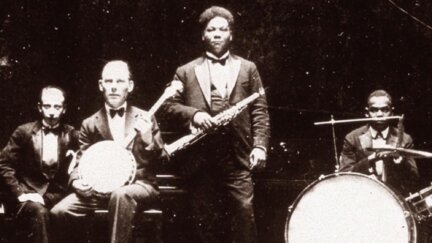
The original members of the Original Dixieland Jazz Band, all from New Orleans, were Nick LaRocca (leader and comet), Larry Shields (clarinet), Eddie Edwards (trombone), Tony Sbarbaro (drums), and Henry Ragas (who was replaced by J. Russel Robinson, piano). After playing in Chicago in 1916, the five musicians moved to New York where they enjoyed sensational receptions during their residency at Reisenweber's Restaurant from January 1917. During the same year, the group became the first jazz band to make phonograph recordings, and in doing so the musicians achieved a degree of eminence that was out of proportion to their musical skills. During the mid-1920s, when the vogue for jazz dancing temporarily subsided, the group disbanded; it reformed again in 1936, but the reunion was brief and only moderately successful.
No member of the Original Dixieland Jazz Band was particularly talented as an improviser, and the group's phrasing was rhythmically stilted; but even so, its collective vigor had an infectious spirit. When black jazz bands began to record regularly it soon became apparent that many of them were more adept at jazz improvising and phrasing than was the Original Dixieland Jazz Band. Detractors of the band maintain that it merely simplified the music of black New Orleans groups, and cite specific antecedents for its compositions Tiger Rag and Sensation Rag. Casual listeners were intrigued by its repertory, however, which was unlike anything else then on record. The group presented a new sound rather than a new music; this sound, and the rhythms in which it was couched, appealed to young dancers, who were eager to break away from the rigidly formal dance steps of the era.
The most passionate advocate of the Original Dixieland Jazz Band's importance to jazz history was LaRocca himself, who never ceased claiming that his band had played a vital role in the "invention" of jazz in New Orleans during the early years of the 20th century. The fact that there is no evidence to support LaRocca's contention has caused many jazz devotees to ignore the merits of the band's music. But it is indisputable that the group played a major part in popularizing the dixieland style of jazz throughout the USA and Europe.
The New Grove Dictionary of Jazz, Oxford University Press. All rights reserved. For personal, non-commercial use only. Copying or other reproduction is prohibited.
|