
|
Artie Shaw
Powered by Oxford University Press.
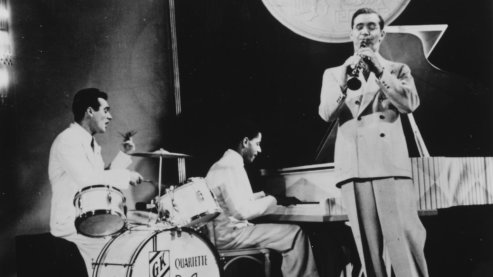
Arshawsky, Arthur Jacob (1910- ) Clarinetist, bandleader, composer, and arranger
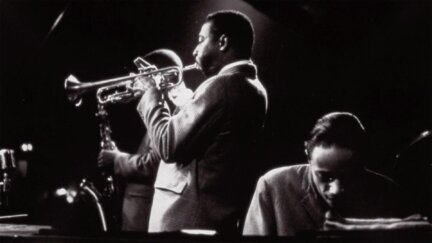
 Image courtesy Music Division, New York Public Library
|
Artie Shaw grew up in New Haven, Connecticut, where in the summer of 1925 he joined
Johnny Cavallaro's dance band as an alto saxophonist. While touring with Cavallaro the following year, he took up the clarinet, which later became his principal
instrument. From 1926 to 1929, he worked in Cleveland and established a lasting reputation as music director and arranger for an orchestra led by the violinist Austin
Wylie. He then toured as a tenor saxophonist with Irving Aaronson's band, and while in Chicago in 1929 played in jam sessions with several local musicians. At the
same time, he discovered the music of Debussy and Stravinsky; both influences were important in his musical development.
Later that year, Shaw traveled with Aaronson to New York, where he played in Harlem jam sessions and came under the influence and tutelage of Willie "the Lion" Smith. From 1931 to 1935, he worked as a freelance studio musician, and in 1936 he formed his first group for a concert at the Imperial Theater. Shaw's unorthodox
band, consisting of a string quartet, three rhythm instruments, and clarinet, created a sensation by performing his chamber composition Interlude in B Flat. Adding
two trumpets, trombone, saxophone, and a singer, he signed a recording contract with Brunswick and led a band at New York's Lexington Hotel. However, the
public remained indifferent to the group's unusual style and instrumentation, and Shaw was forced to disband in March 1937.
 |
Artie Shaw
On aiming at something which cannot be done
(Audio Excerpt from JAZZ A Film by Ken Burns) |
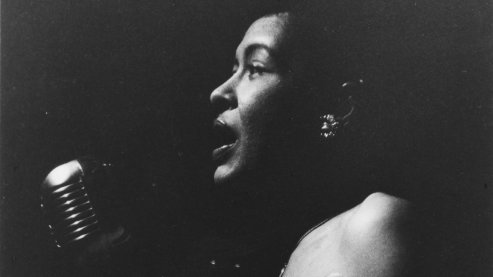
One month later, Shaw formed a conventional swing band with a new library of music by Jerry Gray, trombonist Harry Rogers, and himself, and later adding pieces by the best popular song composers of the day. With this group, which briefly included Billie Holiday, he recorded his first big hit in 1938, Cole Porter's Begin the Beguine. This marked a breakthrough to public fame and established Shaw as a rival to Benny Goodman. Constitutionally and emotionally unequal to his role as a
matinee idol, however, Shaw withdrew from public view in November 1939, a move which served only to provoke the publicity he sought to avoid.
In early 1940, Shaw worked in Hollywood on the film Second Chorus and recorded his next big hit, Frenesi, using a studio orchestra with a large string section. The success of this recording forced him on tour again with a big band augmented by nine strings. From within this group Shaw organized the Gramercy Five,
including Johnny Guarnieri (harpsichord) and Billy Butterfield (trumpet), and recorded one of his best-known compositions, Summit Ridge Drive, in 1940. Despite
high critical acclaim, Shaw again dissolved his band a few months later, settling in New York to record with studio groups and to study orchestration. His last pre-war
band, organized in September 1941, included Hot Lips Page, Max Kaminsky, Georgie Auld, and Guarnieri.
 |
Artie Shaw
Remembering an engagement on the USS Saratoga
(Audio Excerpt from JAZZ A Film by Ken Burns) |
After enlisting in the US Navy in January 1942, Shaw was asked to form a band, which he then led throughout the Pacific war zone in 1943. Following his discharge
and convalescence, he organized a new group in 1944, which was by all accounts his best jazz band. One of its recordings, Little Jazz in 1945 with Roy
Eldridge, became a classic. He also continued to perform and record with a small group drawn from the members of the big band under the name Gramercy Five.
During the next decade, Shaw organized two more big bands, appeared at Carnegie Hall, and issued recordings on several labels. He assembled his last Gramercy
Five in October 1953 and after recording with the group in February and March 1954, he retired. In 1983, however, he was persuaded to reorganize
his band, which he has continued to conduct occasionally; it mainly performs under the leadership of Dick Johnson, who also plays clarinet.
Shaw was a leading musician of the swing period and a public figure whose handsome features and eight marriages made him a darling of gossip columnists. His
clarinet playing has often been compared with that of his rival Benny Goodman. Though less hot than Goodman, he demonstrated superb technical facility in his
recordings of fast and lively numbers and a genuine sense of jazz phrasing in ballads. The full range of his gifts is especially displayed in his recording Concerto for Clarinet in 1940.
Like Goodman, Shaw was an energetic spokesman for racial equality in jazz, hiring and recording black musicians such as Holiday, Page, and Eldridge. His
autobiography from 1952 sets him apart from many of his jazz colleagues by its intelligent and lucid writing. His collection of scores and other materials is now in the
library of Boston University.
The New Grove Dictionary of Jazz, Oxford University Press. All rights reserved. For personal, non-commercial use only. Copying or other reproduction is prohibited.
|