
|
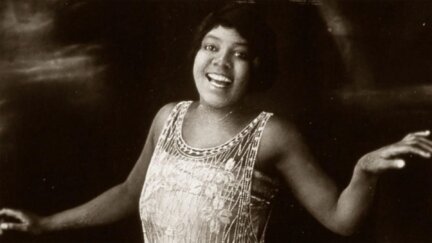
Ethel Waters
Powered by Oxford University Press.
née Howard (1896- 1977) Singer
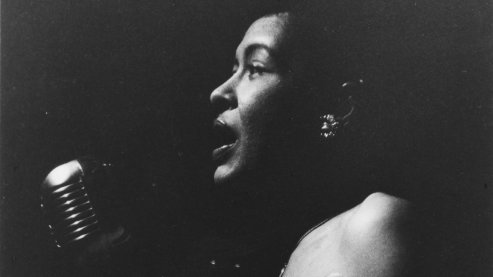
 Image courtesy of Frank Driggs Collection
|
Ethel Waters grew up in the Philadelphia area, where she came more strongly under the influence of white vaudeville singers such as
Nora Bayes and Fanny Brice than her southern contemporaries. Early in her career she sang "coon" songs and became an outstanding example of the group
of black singers known as "cake-walking babies" to distinguish them from southern classic blues singers such as Ma Rainey and Bessie Smith. Some of her
performances from the mid-1920s (she began recording in 1921) foreshadow the scat-singing devices later developed by Louis Armstrong and Ella Fitzgerald.
Later, in the 1930s, Waters found the mainstream of popular music, including jazz and congenial, and brought to it a combination of tragedy (in Harold Arlen's Stormy
Weather, 1933) and comedy (in H. I. Marshall's You Can't Stop Me From Loving You, 1931) which, in its range, was unsurpassed by any other popular singer.
Among the fine jazz instrumentalists who accompanied her in recording sessions were Fletcher Henderson (1921-6), Joe Smith (1922, 1924-7), Coleman Hawkins
(1925), James P. Johnson and Clarence Williams (both 1928), Duke Ellington (1932), and Benny Carter (1939). From the late 1930s, she began appearing on the
stage, and her acting career eventually eclipsed her accomplishments as a singer in the public eye.
Waters was the first black entertainer to move successfully from the vaudeville and nightclub circuits to what blacks called "the white time" (the West Indian Bert
Williams had done this earlier in the Ziegfield Follies but in blackface). Her vocal resources were adequate though unexceptional, but this shortcoming was
mitigated by an innate theatrical flair that enabled her to project the character and situation of every song she performed. The early recordings of Mildred Bailey, Lee
Wiley, and Connee Boswell clearly reflect a debt to Waters, and most other popular singers of the time came under her influence to some degree. From 1960 to
1975, Waters toured with the evangelist Billy Graham, singing with less vocal prowess than before but with an undiminished ability to characterize her material.
The New Grove Dictionary of Jazz, Oxford University Press. All rights reserved. For personal, non-commercial use only. Copying or other reproduction is prohibited.
|