
|
Paul Whiteman
Powered by Oxford University Press.
(1890-1967) Bandleader
 Image courtesy of Frank Driggs Collection
|
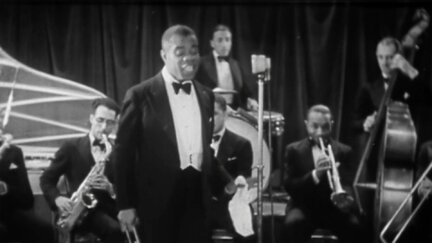
Paul Whiteman played viola in the Denver Symphony Orchestra from 1907 and in the San Francisco Symphony Orchestra from 1914. During World War I he led a 40-piece navy band, playing march tunes by day and show music by night. Sensing new dimensions for popular music in the transition from ragtime to jazz, he organized a dance band in San Francisco in 1918, later moving to New Jersey, before settling in New York in 1920. There he soon became the best-known American bandleader, particularly with his recording of Whispering and Japanese Sandman (1920), which sold more than a million copies. By the early 1920s his lush orchestral style was widely copied on countless bandstands at home and abroad. He toured the British Isles in 1923 and Europe in 1926.
For his first extended concert tour of the USA, Whiteman commissioned George Gershwin to write Rhapsody in Blue, which, as part of Whiteman's concert called An Experiment in Modern Music, was performed with the composer as soloist in Aeolian Hall in New York in 1924. Favorable publicity prompted Whiteman to stage seven performances of this kind between 1925 and 1938, thereby obtaining wide exposure for such American composers as Victor Herbert, William Grant Still, and Duke Ellington. Between 1928 and 1952, Whiteman's orchestras were featured on many network radio shows and took part in several films, beginning with King of Jazz (1930). He provided music for six Broadway shows and produced more than 600 phonograph recordings. Later he served as music director for ABC.
 Image courtesy of Frank Driggs Collection
|
Whiteman was a key figure in American popular music. While jazz purists accused him of diluting the character of early jazz for commercial purposes, less biased observers applauded the high polish and versatility of his orchestras, which had to be as comfortable in the concert hall as at a college dance. He employed a number of talented musicians: in the original arrangement of Rhapsody in Blue three of his reed players were required to play a total of 17 instruments. Although his dance music tended to be sedate, there were occasional jazz solos from musicians such as Bix Beiderbecke, Frankie Trumbauer, Eddie Lang, Bunny Berigan, and Jack Teagarden. Whiteman's musical memorabilia, including his large library of more than 3000 arrangements, were bequeathed to Williams College in Williamstown, Massachusetts, where they now form the Whiteman Collection.
The New Grove Dictionary of Jazz, Oxford University Press. All rights reserved. For personal, non-commercial use only. Copying or other reproduction is prohibited.
|