
|
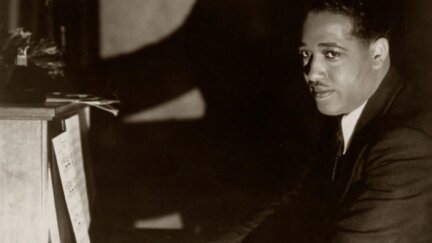
Teddy Wilson
Powered by Oxford University Press.
Theodore Shaw (1912-1986) Pianist
 |
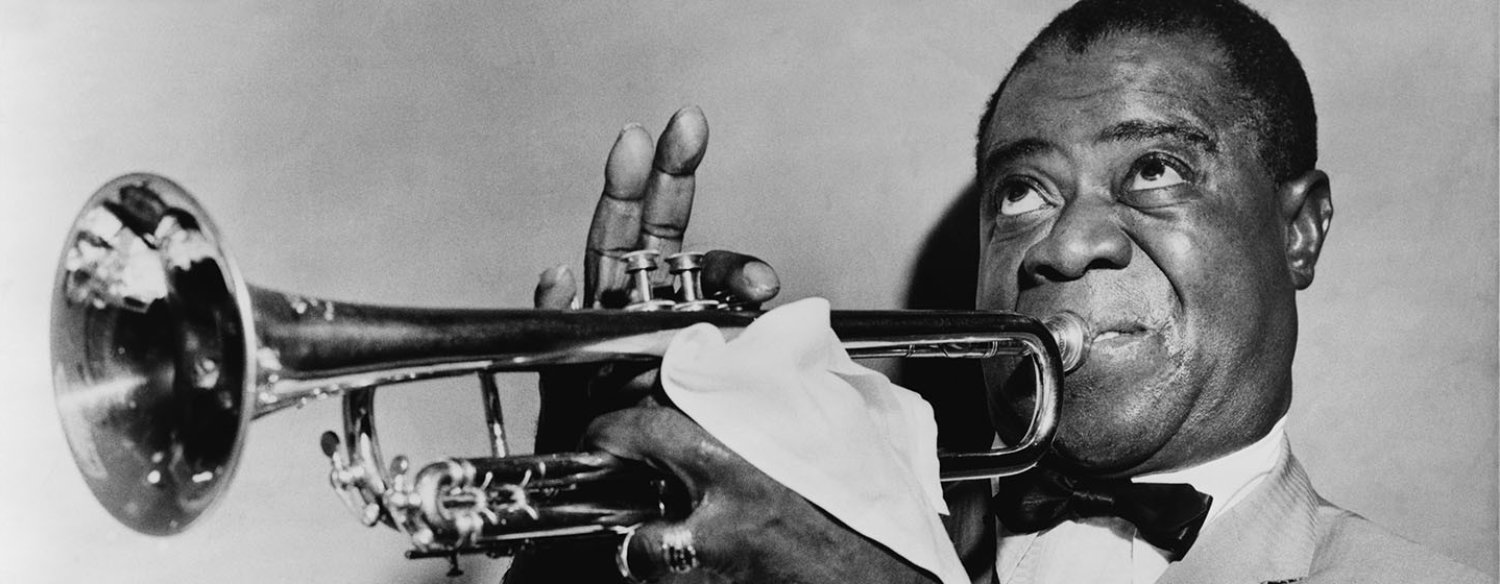
NPR's Louis Armstrong Centennial Radio Project: Teddy Wilson
Jazz critic Stanley Crouch profiles pianist Teddy Wilson, who played with Armstrong, Billie Holiday and Benny Goodman, among many others.
(Courtesy NPRJazz.org) |
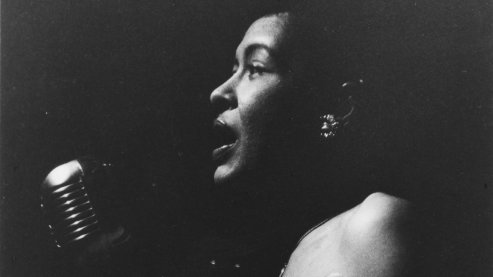
 Image courtesy of Frank Driggs Collection
|
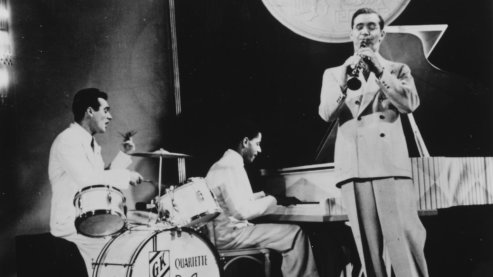
Teddy Wilson grew up in Tuskegee, Alabama, and briefly studied music at Talladega College. After working in Chicago with Jimmie Noone, Louis Armstrong, and others he moved in 1933 to New York to join Benny Carter's band. He played informally with Benny Goodman in 1935 and officially joined Goodman's trio the following year, thereby becoming one of the first black musicians to appear prominently with white artists. Wilson remained with Goodman until 1939, playing on many of the latter's small group recordings and also on recordings under his own name with other important swing musicians, above all Billie Holiday and Lester Young. After leaving Goodman he briefly led his own big band (1939-40), and thereafter worked primarily as a leader of small ensembles and as a soloist. Around 1950 he was an instructor at the Juilliard School in New York, an early instance of the recognition of jazz by an important conservatory. He frequently rejoined Goodman for reunions, most notably for a tour of the USSR (1962), an appearance at the Newport Festival (1973), and a concert at Carnegie Hall (1982).
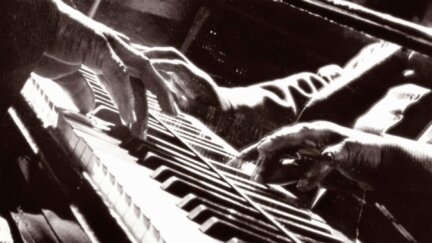
Wilson was the most important pianist of the swing period. His early recordings reveal a percussive style, with single-note lines and bold staccatos, that was indebted to Earl Hines; but by the time of his first performances with Goodman he had fashioned a distinctive legato idiom that served him for the rest of his career. Wilson's style was based on the use of conjunct 10ths in the left hand; by emphasizing the tenor voice and frequently omitting the root of the chord until the end of the phrase he created great harmonic refinement and contrapuntal interest. For the right hand he adapted Hines' "trumpet" style, playing short melodic fragments in octaves, frequently separated by rests and varied with fleet, broken-chord passage work. He used the full range of the piano, often changing register or texture to underscore formal divisions. His poised, restrained manner and transparent textures are especially evident on his solo recordings from the late 1930s, which served as models for countless pianists in the late swing period. From 1940 Wilson's playing became somewhat florid, with frequent pentatonic passage work, but he retained his basic approach and prowess into the 1980s.
The New Grove Dictionary of Jazz, Oxford University Press. All rights reserved. For personal, non-commercial use only. Copying or other reproduction is prohibited.
|