
|
|
|
|
|
  |
|
|
|
|
|
 |
|
|
Powered by Grove’s Dictionaries, Inc.
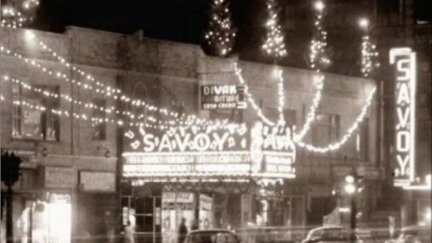
Savoy Ballroom. Located at 596 Lenox Avenue, between West 140th Street and West 141st Street, New York.
 Savoy Ballroom at night Image courtesy of Schomberg Center for Research in Black Culture, New York Public Library
|
The Savoy was opened on March 12, 1926 by Moe Gale (Moses Galewski), Charles Galewski, and a Harlem real estate businessman called Charles Buchanan, who functioned as the ballroom's manager. The Savoy was billed as the world's most beautiful ballroom; it occupied the second floor of a building that extended along the whole block between 140th and 141st streets, and featured a large dance floor (200 feet by 50 feet), two bandstands, and a retractable stage. It swiftly became the most popular dance venue in Harlem, and many of the jazz dance crazes of the 1920s and 1930s originated there; it enjoyed a long and glittering career that lasted well into the 1950s, before a decline in its fortunes set in.
 |
Frankie Manning, dancer
Joyful memories of the Savoy Ballroom
(Audio Excerpt from JAZZ A Film by Ken Burns) |
 |
Frankie Manning, dancer
The evolution of the Lindy Hop
(Audio Excerpt from JAZZ A Film by Ken Burns) |
 Dancers at the Savoy Ballroom Image courtesy of Charles Peterson
|
On its opening night the Savoy featured Fess Williams and his Royal Flush Orchestra, the Charleston Bearcats, fronted by Leon Abbey, and, as a guest band, Fletcher Henderson's Roseland Orchestra; the Charleston Bearcats formed a lasting connection with the venue and later changed its name to the Savoy Bearcats. Except on special occasions, the ballroom engaged two bands, which played alternate sets, and this policy led to its becoming a famous venue for battles of bands. Elaborate events of this kind were also organized by the management: on May 15, 1927 the Savoy presented a "Battle of Jazz," which featured King Oliver's Dixie Syncopators, a band led by Williams, Chick Webb's Harlem Stompers, and Henderson's Roseland Orchestra; other battles were fought between bands led by Lloyd Scott, Webb, Alex Johnson, Charlie Johnson, Williams, and Henderson (May 6, 1928) and between Cab Calloway's Missourians and groups led by Duke Ellington, Henderson, Cecil Scott, Lockwood Lewis, and Webb (May 14, 1930).
 |
NPR's All Things Considered: The Savoy Ballroom
Tom Vitale reports on this legendary swing music venue, the so-called "Home
of Happy Feet." He speaks with Savoy dancer Norma Miller and Count Basie
alto sax player Earl Warren about the ballroom's history.
(Courtesy NPRJazz.org) |
The New Grove Dictionary of Jazz, Macmillan Publishers Ltd. All rights reserved. For personal, non-commercial use only. Copying or other reproduction is prohibited.
|
|
|
|
|
|
|