
|
|
Lesson 13 Discovering New Species
Learning Objectives
Students will:
- Identify animals chronicled in the journals of Lewis and Clark's expedition;
- Evaluate the animal's habitat and describe the animal’s behaviors;
- Research information about the animal using various reference materials;
- Compare the animal's position in the food web during the early 1800’s with the animal's current position;
- Create a Food Web mobile.
Standards
This lesson correlates to the national McREL standards located online at http://www.mcrel.org/
Science
Standard 6: Understands relationships among organisms and their physical environment
Standard 7: Understands biological evolution and the diversity of life
Language Arts
Standard 4: Gathers and uses information for research purposes
Standard 9: Uses viewing skills and strategies to understand and interpret visual media
Standard 8: Uses listening and speaking strategies for different purposes
Materials
- A copy of Lewis and Clark: The Journey of the Corps of Discovery (To order, visit ShopPBS)
- A television and VCR or DVD player
- Reference sources, either from the Internet or a library
- String
- Scissors
- Coat hangers
- Hole punch
Time Needed
Three to four 45-minute class periods or two 90-minute class periods.
Teaching Strategy
- Create student interest by asking students to think about why people are so drawn to
zoos and wildlife parks. Spend time discussing why people are interested in seeing
and learning about species of animals that they are unfamiliar with and why learning
about and documenting new species is important.
- Provide students with background about the goals of Lewis and Clark’s expedition,
paying particular attention to President Jefferson’s interest in learning about the new
animals that were discovered by the Corps members. (Jefferson required each species
be measured, their descriptions and habitats noted, and that specimen’s be sent to him
at his home.)
- Have students view the film and encourage them to take notes and record information
about the new species that were encountered during the expedition. Stop the film and
discuss as needed to point out relevant information.
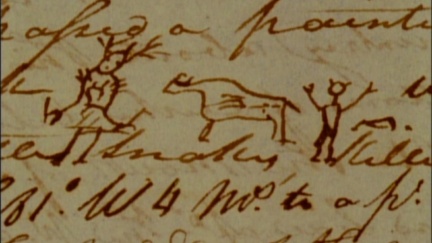
- When viewing is complete, have students learn more about the discovery of these new species by referring to the journals in the Archive section. View the journal entries from September 7, 1804 to September 18, 1804 to read the accounts of the Corps encounters with prairie dogs, antelope, jackrabbits, coyotes, and magpies.
- Introduce the concept of food chains and food webs using the following definitions.
Food chain: a series of events which food energy is transferred from one organism to another: in other words, who is eaten by whom.
Food web: a more complex diagram consisting of many overlapping food chains.
Producers: all the plants in an environment
Consumers: animals feeding on either the producers or other consumers.
Sun: the first source of all energy on earth.
Provide concrete examples for each term to facilitate student understanding.
- Next, explain to students that food chains and food webs can change over time
because of many variables. Conduct a class brainstorming session and record a list of
all of the things that could cause food chains and food webs to change.
- Using books, CD-ROM reference materials, or a search engine on the Internet, have
students conduct their research.
- Next, have students create a 5” X 8” picture of each item in the food chain. This can
be done by printing pictures from electronic or Internet sources or by drawing them
freehand. Remind students that the sun provides energy to the plants and at least one
animal eats plants only, so they will need to draw some plants and the sun.
- Students should construct their food web mobile by cutting out the organisms
they’ve drawn, punching a hole in each one, and hanging the organisms from a
clothes hanger to create a mobile.
- On a separate piece of paper students should write a description of each animal or
plant and the sun and explain its position in the food chain.
- To complete the assignment, a short paper should be written to address each of
the following questions:
A. Cities now exist where prairies once stood. Have populations of animals and
plants changed over time with increasing numbers of humans. Explain.
B. How are the conditions of the Great Plains different than they were at the time
of the expedition?
- When all students have completed their mobiles and written responses, place
them in small groups. There, each person should share his/her mobile.
- Facilitate a class discussion about the questions presented in Step 12 above.
Encourage students to site their research to support their responses.
Assessment Recommendations
- Assign participation grades for completion of class discussion and group activities.
- Create a scoring guide to use when evaluating food web mobiles.
- Assign a letter grade and/or completion grade to the written response activity.
Extensions/Adaptations
- Now that students have learned about the impact of man on various species,
introduce them to endangered animal species that are native to their area. Invite a
local conservation expert to visit the classroom to teach them more about these
species, man’s impact on them, and what can be done to protect them.
- Have students conduct research about species that are now extinct and report how
the loss of the species has impacted the food chain and the food web. Students could
report their findings to classmates in the form of a multimedia presentation,
informational brochure, public awareness poster, etc.
|