
|
|
Lesson 14 Describing the Unknown to Others
Learning Objectives
Students will:
- Utilize creative and descriptive writing skills to communicate ideas to others;
- Implement the use of graphic organizers to arrange ideas;
- Simulate the communication challenges faced by the members of the Corps of Discovery as they attempted to describe unfamiliar plants, animals, climates, terrain, and people to people in the eastern United States.
Standards
This lesson correlates to the national McREL standards located online at http://www.mcrel.org/.
Language Arts
Standard 1: Uses the general skills and strategies of the writing process.
Standard 3: Uses grammatical and mechanical conventions in written compositions
Standard 4: Gathers and uses information for research purposes.
Standard 5: Uses the general skills and strategies of the reading process
Standard 9: Uses viewing skills and strategies to understand and interpret visual media
Technology
Standard 3: Understands the relationships among science, technology, society, and the individual.
Materials
- A copy of the program Lewis and Clark: The Journey of the Corps of Discovery (To order, visit ShopPBS)
- A television, and a VCR or DVD player
- Computers with Internet access
- Selected journal entries from the Archives section of this Web site
- Lesson 14 Student Activity Sheet
- Two to three 45-minute class periods or one to two 90-minute class periods
Teaching Strategy
- Ask students to imagine they are members of the Lewis and Clark expedition team. They have discovered new animals and plants, experienced new climates and challenges with terrain, and met new groups of people. The challenge now is how to preserve this information for people back home. Discuss the following:
How are you going to record this information?
How will you describe your new discoveries and experiences to your friends and family back home?
- Once discussion has been completed, tell students they will hear actual journal entries
written by members of the Corps. Their job is to listed to each journal entry and try to
guess what plant, animal, climate, or terrain the Corps member is describing. Students
will then share their guesses and point out specific words or phrases that led them to
make their guess. The teacher should be sure to provide the correct answer for each of
the journal entries once guesses have been shared or students have answered correctly.
Selected Journal Entries
Clark: June 6, 1804 "What are greens?"
Clark: June 26, 1804 "What kind of Parakeets?"
Clark: June 30, 1804 "What kind of very large wolf?"
Clark: July 14, 1804 "What kind of storm?"
Clark: July 29, 1804 "What species of catfish?"
Ordway: July 30, 1804 (Excellent example) "What is a brarow?"
Gass: September 3, 1804 "Where could they be located?"
Ordway: September 7, 1804 "Read Ordwayís description of ground hogs."
Clark: October 7, 1804 "What species of white bear?"
Clark: November 13, 1804 "Where might the expedition team be located now?"
Lewis: May 28, 1805 "Where might the expedition team be located now? What species of bear might they have seen?"
Whitehouse: June 16, 1805 "Where would they have found sulfur/mineral water?"
Gass: June 25, 1805 "What species of brown bear? Can you eat spear- mint and currant bushes?"
Ordway August 3, 1805 (Excellent example) "What species of panther?"
- Finish the activity by explaining to students that members of the Corps of Discovery
faced real communication challenges because they encountered so many new things
that had to be documented and shared with others later on.
- To further illustrate this point, have students view the two segments of the Lewis and
Clark documentary described below. Discuss the challenges of documenting and
sharing this information after viewing.
Video Clips:
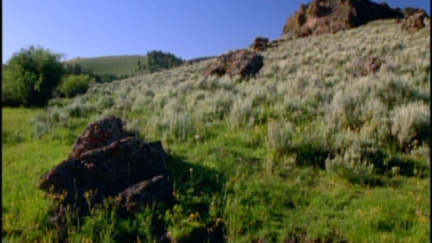
Landscape View of the Prairies: Part I, 00:33:20-00:38:50.
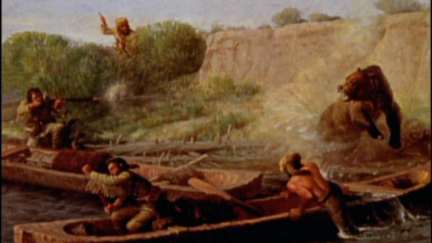
New Species: 0:53:10-0:54:20.
- Students are now ready to undertake the challenge of describing a “mystery” plant,
animal, climate, terrain, or group of people to another student. To do this, they should
read and research information available in the journal entries located in the Archives
section of the Lewis and Clark Web site. Students should read until they find the topic
of their “mystery” description. Students should use the graphic organizer from the Lesson 14 Student Activity Sheet to record information about their topic in order to
organize it and provide details in their writing.
- To complete the graphic organizer, students should write the name of the topic in the
center, main ideas describing the subject in the extending ovals, and precise details on
the “fingers” of the ovals.
- Using their graphic organizer, students should write a paragraph describing the
"mystery" plant, animal, or climate. They should use as much detail and description
as possible in order to paint a word picture for readers who are attempting to guess
what the “mystery” subject is.
- Students should exchange “mystery” writings with one another or share them with the
entire class. As in the earlier activity, students should guess what is being described
based on clues from the writing. Encourage students to discuss specific things in each
piece of writing that made them formulate their guesses.
- Close the lesson by reminding students that this process resembles how Lewis and
Clark had to record and explain their observations during the expedition. Discuss the
advantages and disadvantages to this type of recording.
Assessment Recommendations
- Create a scoring guide to evaluate the effectiveness of each writer’s paragraph. This
could be completed by the teacher, the writer, or a peer evaluator.
- Assign participation grades for class discussion and game activities.
- Assign completion grades for students who finish the graphic organizer and construct their writing according to the established guidelines.
Extensions/Adaptations
- Instead of a written paragraph, have students exchanges graphic organizers, but be sure the center section naming the “mystery” subject has been kept blank. Have students make guesses about the topic based on the details supplied in the graphic organizer.
- Students might prefer creating a limerick, poem, or even rap lyrics, to describe their chosen plant, animal, or climate.
- Pair up with another class from another school to complete the “mystery” subject writing activity by sharing writing assignments via email.
|