
|
|
Who was York?
 Stephen Ambrose
Listen to the RealAudio
|
|
|
|
York was Clarks childhood companion. He was a slave. We know he was big.
We know he was very athletic. He was a great dancer. He was devoted to William
Clark. He was a great help to the expedition because he was such a curiosity.
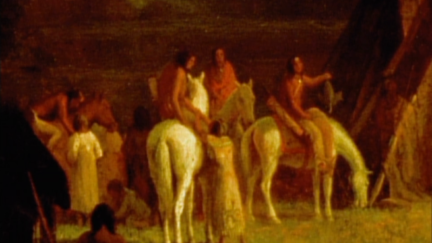
Indians who had seen white men had never seen a black man before and theres the
famous is it Catlin or Charley Russell and theres the famous Charley Russell
painting in the Mandan lodges of the Mandan chief trying to rub the black off of
Yorks skin. York had a great time on the expedition. He had, had his own
rifle. He got to vote. He was a full member of the expedition. He had a, the
Indians loved him, and the Indian women especially loved York and he took full
advantage of that so that on many occasions York would be missing that night and
he would be in the lodge with one of the Indians. Sometimes with the Indian
husband standing guard while the business was completed.
|
Listen to the RealAudio
|
What kinds of contributions did York make to the expedition? York made invaluable contributions to the expedition on many occasions.
Risking his life to save Clark in a flash flood on the Missouri River near Great
Falls in present-day Montana. Going out and hunting and bringing in the game.
Putting up the captains tents, managing the sails, plying his oar, doing all the
things that everyone else did. He made his contribution. And he was a part of
the team. And I would emphasize this, that, that, from the, the infant boy who
danced around the fire and gladdened the hearts of the men and was enormously
popular with all the men, through Sacagawea, through York, through the lowliest
privates, through the sergeants, up to the captains themselves, this was a family
that had come together and formed a team for the exploration of the continent of
North America. And they couldnt have done it if they hadnt become a family.
And forged themselves into a team.
|
What was the Indians response to York?
 Gerard Baker
Listen to the RealAudio
|
|
|
|
One of the stories obviously, comes from the journals, that they took,
different tribes would take dirt, and I remember my father telling me about this
story, taking dirt and try to go up to him and rub that black off. And when they
found out they couldnt rub it off, that he was a man, of course he was very, he
was very muscular and he was a big man, apparently, and so they had a lot of
respect for that, and he was, he was followed around all the time by the, by the
children and, and by the women, because he was powerful, you know, and people
respect that. And he was different. He was different. The Indian way teaches
us that just because youre different, doesnt mean its wrong. You be, you
could be, you could be handicapped some way, mentally or physically, or you could
have a, just like York came as, as a first black man they ever seen, and that was
different. So he was very worship, he wasnt ostracized by any means at all. In
fact, he was just the opposite.
|
How did York feel at the end of the expedition?
 Jim Ronda
Listen to the RealAudio
|
|
|
|
Think about this as an African-American man reentering the world of races and
enslavery. Having seen life on the other side of the mountains, in a real sense,
as a man whos crossed the river Jordan. Whos seen life as a free man, whos
acted in free ways. He has crossed the river Jordan. And now, back to St.
Louis. Back to a world that represents, at least for a moment in his life,
slavery and bondage and doing the will and the bidding of others. William Clark
was a slave holder. York was not his servant, he was his slave. And we should
understand that. How Clark will eventually arrange for York to be free and this
is a man who will be at least in quotes, free. But think about being an
African-American free man in a world surrounded by race and slavery. And by
racial attitudes that say freedom may only be what is written on a piece of
paper. At heart, you are always the other. You are always on the edges of
respectability. On the edges of freedom. I want to say it again, York crossed
the river, he crossed the mountains, he saw what freedom meant. And then
re-entered a world of slavery where slavery was everywhere.
|
|