
|
|
What happened to the Indians in the years after Lewis and Clark?
 Gerard Baker
Listen to the RealAudio
|
|
|
|
In a nutshell, what happened to our people in the years after Lewis and Clark
is that we went downhill. In a nutshell, we lost. Like, like all the other
tribes that Lewis and Clark, not only opened up a route, established a waterway
and established a new country and did scientific value for, after Lewis, after
the Louisiana Purchase. But, they, they changed the people. We, we, we started
going from a dependency on the environment, on the spiritualism of the land, to a
dependency on the traders and the military and everything else that came after
Lewis and Clark. So it, it, we, we, we essentially lost.
|
Listen to the RealAudio
|
Was it the beginning of the end? The Indian people see the expedition, especially today, that yes, it was the
beginning of an end. We already start seeing dependencies going from a
traditional way of life to, to more of a European style. We already see them,
Im not gonna to say lose respect, but maybe losing, lose a small identity
towards, towards the environment, by Lewis and Clark coming. It was, it was a
good time for that year, for 1804-1805, but theres been a lot of changes, theres
been a lot of negative changes after that. It wasnt, you know, they didnt know
it was going to be that way I guess for the future. They had no idea to see the
future, and its been gone ever since.
|
What draws us to the story of Lewis and Clark?
 Dayton Duncan
Listen to the RealAudio
|
|
|
|
Its Americas story, I think. Theres something in there for, for everybody.
Its accessible to so many people for so many different reasons. If youre
interested in an adventure, a road trip its got that, you know. Two guys go
West. If youre interested in science, you know, theyre out discovering new
plant, new animals, new territory. If youre interested in, What did the
Indians look like before the United States moved West, it tells you that, it
answers those questions for you. Whatever it is that you want, its there. Its
a tremendous cast of characters, its an adventure story, its science, its
history. Its everything rolled up into one. I know a guy who has a doctorate
degree in Lewis and Clark--hes studied it all his life. And one night he was
camping in the mountains of Idaho, and next to him he discovered as he was
camping, he came to a guy who was a plumber, who spends part of his summer
camping somewhere along the Lewis and Clark trail. So here was a guy who has a
doctorate degree, a man who had a sixth grade education the only thing they had
in common was this desire to camp where the first Americans who went west camped.
So it brings us together.
|
How is the expedition historically significant?
 Jim Ronda
Listen to the RealAudio
|
|
|
|
Sometimes we talk about the expedition as the great American odyssey. If the
Civil War is our Iliad, then this is our odyssey. You know, one of the ways to
to understand American history is to think about our history as a series of
journeys. Were forever going somewhere. All the coyote stories begin, Coyote
was going there. So Coyote is going there. Kiowa people are going somewhere,
were always going somewhere. Weve attached great meaning to the Lewis and
Clark story because its an emblem of us being on the road. Were a people on
the road, were a people caught in a in a tension between wanting to be at home
and yet being always on the road. Its a tension that is pervasive in our
culture. Its hard sometimes to to understand why the Lewis and Clark story is
so important. After all, Lewis and Clark didnt start the western fur trade.
They dont pioneer a route that other overland immigrants will use. Those routes
are pioneered by others. Lewis and Clark dont provide the legal framework for
an American claim to the Pacific Northwest, that came from other travelers. I
think that weve seized on them because they remind us about the journey. Life
is a journey. They were on the road. Were on the road too. We see that in our
literature, in our writing. From Pilgrims Progress and Canterbury Tales to
John Wayne in Stagecoach. We think about life as a journey. The Lewis and Clark
journey is so accessible. We can all get on board. We can be members of the
Corps of Discovery. We can slip our own lives into their lives and then we can
make the journey with them. A journey of wonder and excitement. But also, a
frightening journey, a journey of danger, we can be with them. We can also stand
on shore and watch them as they come to us. This is one of the central American
stories. It has, like few other stories, a place for all of us. All of us want
to find a place in story. And this is one of those stories that reaches out and
says, there is a place in this story for you.
|
Is there any lesson we can take from the story of Lewis and Clark?
 Stephen Ambrose
Listen to the RealAudio
|
|
|
|
Teamwork. The number one story here is there is nothing that men cant do if
they get themselves together and act as a team. Here you have 32 men who had
become so close, so bonded, that everyone of them could recognize a cough in the
night and know who it was. They could hear a footstep and know who it was. They
knew who liked salt on their meat and who didnt. They knew whos the best shot
on the expedition. Who is the fastest runner. Who is the man who could get a
fire going the quickest on a rainy day. They knew, because they sat around the
campfire, about each others parents and loved ones. Each others hopes. And
they had come to love each other. To the point that they would sell their own
lives gladly to save a comrade. They had developed a bond, they had become a
band of brothers, and together they were able to accomplish feats that we just
stand astonished at today when we look at them. The crossing of the continent
with nothing but rifles to depend on in the face of dangers, of the, the greatest
possible imaginable dangers and physical difficulties. To, to manage the portage
of the Great Falls, to get over the Lolo Trail, to go down that Columbia River,
these are feats that, had they not welded themselves together into that team,
they just could not possibly have accomplished. So, I think the number one human
lesson of the Lewis and Clark expedition is, what can be accomplished by a team
of disciplined men who are dedicated to a common purpose.
|
Listen to the RealAudio
|
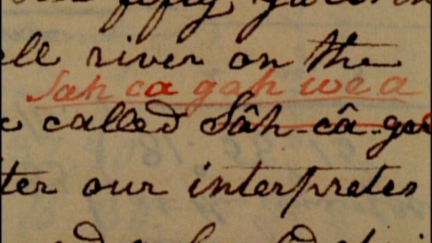
They werent just men. Very much so. Its not just a team of men. It includes a young Indian girl,
who saved the expedition on numerous occasions, sometimes even from starvation,
when she could find roots that nobody else knew about. And obviously in dealing
with Cameahwait and the Shoshonis. And she brought a womans touch to this
expedition. I like to think as she was nursing Pomp at night around the
campfire, that scene had to have had a great effect on the men, to hear a womans
laugh at night around the campfire bolstered spirits. To have Sacagawea say to
them, Thats the Beaverhead, were getting close to the Three Forks, were on
the right trail. All that lifted spirits when spirits were very low and they
thought theyd never come to an end of this journey.
|
|