
Michael Feinstein’s
American Songbook: The PBS Episodes
While chronicling Feinstein’s fabulous but exhausting life on the road—150 performances a year, all over the country—Michael Feinstein’s American Songbook delves into cultural history to reveal how popular music reflected different eras in the 20th century and shaped the style, attitude and self-image of America for more than a century.
Season 3
Show Tunes

Angela Lansbury in her Tony-award winning performance in the 1966 musical “Mame” by Jerry Herman.
source: Jerry Herman
Stephen Sondheim, Angela Lansbury and Christine Ebersole, join Feinstein in this episode about great American musicals. Sondheim talks about his 1971 musical, Follies, his homage to his favorite songwriters. Tony Award-winner Ebersole gives a tour de force performance of a showstopper from the stage musical Funny Girl, and Lansbury reflects on her Broadway career, from Mame to Sweeney Todd and Gypsy. And Feinstein discusses his personal relationship with the lyricist Ira Gershwin.
Season 3
Let’s Dance
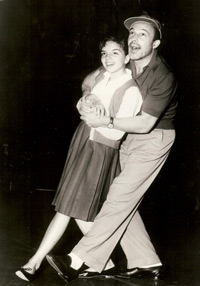
Liza Minnelli, age 13, rehearses with Gene Kelly for an appearance on Kelly’s first television special in 1959.
source: Liza Minnelli
Why was Fred Astaire—the iconic dancer—the favorite singer of all the great songwriters? Feinstein thinks it lies in the relationship between music and choreography. He unearths rare home movies of Astaire rehearsing, and some remarkable never-before-seen footage of that other screen-dance icon, Gene Kelly in his Broadway debut in the original Pal Joey. Liza Minnelli, who knew both men, struts her own stuff, and encourages Feinstein to indulge his inner Astaire with private dance lessons.
Season 3
On The Air
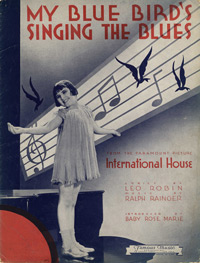
Child radio star Baby Rose Marie (later famous as the character Sally Rogers on The Dick Van Dyke Show) was one of the highest paid entertainers in show business when she appeared in the 1933 film “International House.”
source: Rose Marie
In its heyday, the medium of radio could mint superstars overnight. Feinstein explains why Bing Crosby, Cab Calloway, Kate Smith and a handful of others ruled the airwaves, including Rose Marie (“Sally” on “The Dick Van Dyke Show”) who had her own radio show as “Baby” Rose Marie. On his own NPR program, Feinstein showcases the virtuoso violinist Joshua Bell and pianist Jeremy Denk. And he discovers a lost radio program starring Rosemary Clooney, and recalls his own memorable duet with her.
Season 2
Time Machines
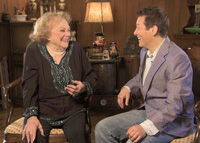
Michael Feinstein visits with entertainer Rose Marie, who literally opened in Las Vegas in 1947, at the first big casino/nightclub, The Flamingo.
source: Dave Davidson,
Hudson West Productions
Why are the great songs and singers of the past still with us today? Because of Time Machines like Soundies (the original music videos); the historic Kansas City building where “Jam Sessions” were born; and the collectors and performers who help keep the music alive, in clubs, in archives, in warehouses, even in the Playboy Mansion…
Season 2
Lost and Found
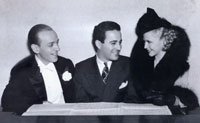
Fred Astaire and Ginger Rogers flank their rehearsal pianist and arranger Hal Borne, in whose papers Michael Feinstein discovers a mysterious manuscript attributed to a major American songwriter.
source: Michael Feinstein
What happens to good songs that don’t get sung? They are tossed into what songwriters call their “trunk”, and all too often, they are lost and forgotten. “Lost and Found” follows Michael’s efforts to unravel the mystery surrounding a musical manuscript attributed to Irving Berlin. Along the way, Michael persuades Broadway legend Jerry Herman to teach him one of his “trunk songs.”
Season 2
Saloon Singers
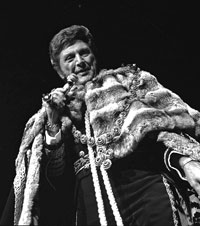
Liberace performing in Las Vegas in one of his trademark over-the-top costumes, circa 1970s.
source: Las Vegas News Bureau
Nightlife has always played an important role in popular culture, from Delta juke joints to the Vegas strip. Join Michael on a tour of nightclubs, from blues dives to the casinos where Frank Sinatra’s Rat Pack reigned; and get a private tour of the now-closed Liberace Museum in Las Vegas.
Season 1
Putting On the Tail Fins (1950s–1960s)
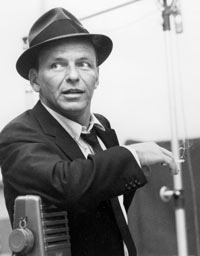
Frank Sinatra’s career was in the dumps in the early 1950s, until he left Columbia Records and signed up with Capital, where he was teamed with the arranger Nelson Riddle and they began re-recording standards from the 1930s and ’40s. Sinatra not only re-invented his own image, but re-imagined the American Songbook.
source: Photofest
Episode 1 focuses on the 1950s and 1960s, when the Great American Songbook competed with new forms like rock ‘n’ roll, and rhythm & blues. As Feinstein crisscrosses the country performing with big bands, symphony orchestras and jazz combos, viewers learn how iconic singers like Frank Sinatra, Nat King Cole and Rosemary Clooney kept the Songbook alive by reinventing pop standards of the 1930s and 1940s.
Season 1
Best Band in the Land (1940s)
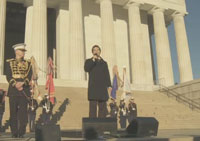
Michael Feinstein and the US Marine Corps Band perform “We Dreamed These Days”, an original song with music by Feinstein and words by Maya Angelou, composed in 2009 in honor of the Lincoln Bicentennial celebration at the Lincoln Memorial in Washington, DC.
source: Hudson West Productions
Episode 2 examines how popular songs provided emotional solace and patriotic inspiration during World War II. While preparing an original patriotic song, Michael weaves in the history of 1940s big bands, USO shows, V-disks, war bond rallies, and the powerful role popular music played in boosting morale.
Season 1
A New Step Every Day (1920s–1930s)
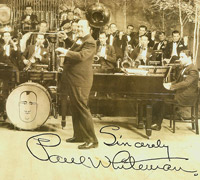
Paul Whiteman and his Orchestra in the 1920s. Notice the “branded” PW logo on the drumkit, which was used as Whiteman’s signature icon throughout his career.
source: Peter Mintun
Episode 3 explores the fast and furious 1920s and 1930s, when jazz was hot, credit was loose, and illegal booze flowed freely in underground speakeasies. Between performances, Feinstein illustrates the impact of talking pictures, the dawn of radio, and the fledgling recording industry. Additionally, it introduces viewers to other collectors and musicians who keep the spirit of the Jazz Age alive today.
Providing support for pbs.org. Learn more