
Add to Scrapbook
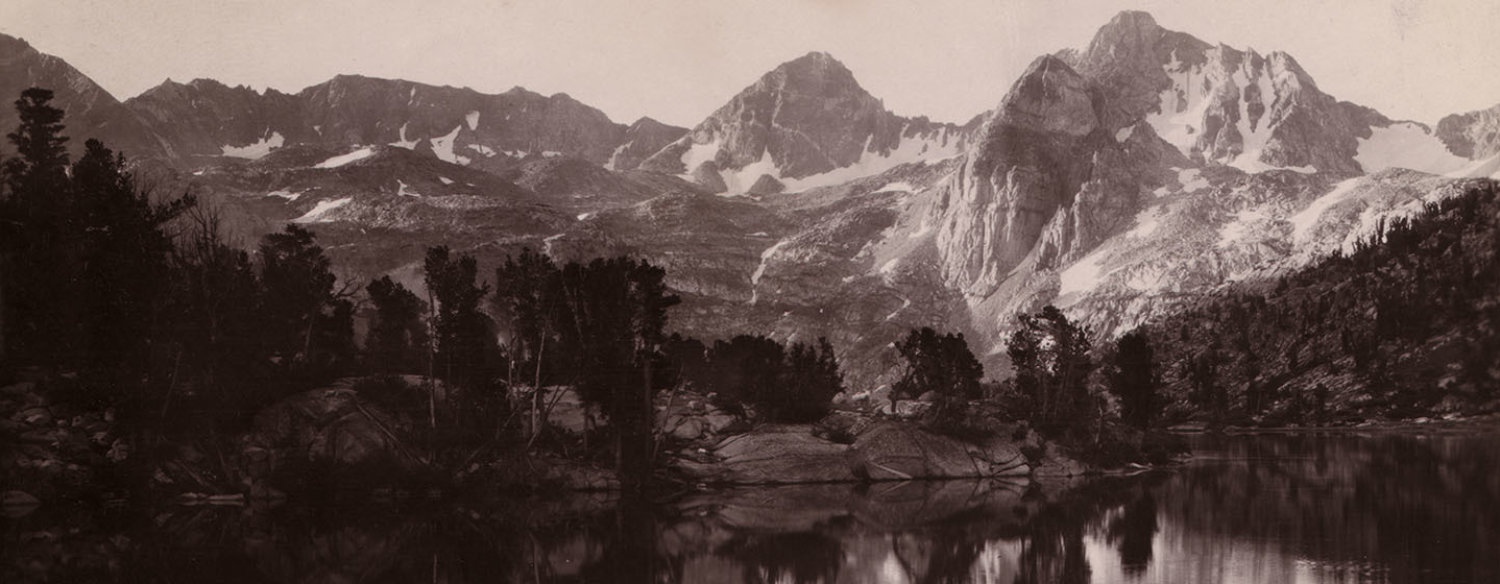
Hutchings' Hotel, Yosemite National Park |
The Law Prevails
Meanwhile, James Mason Hutchings was embroiled in legal battles over Yosemite. When a special bill exempting him from the law that had set the valley aside as public property was overturned by the Senate, Hutchings sued. This led to a ruling in the U.S. Supreme Court that the Act creating Yosemite was, in fact, constitutional.
In 1875, Hutchings was evicted from his hotel and banished from the valley he had so tirelessly promoted.
As for Muir, he moved to Oakland to begin work on a series of reports and articles about Yosemite. His writing would articulate for millions of Americans a deep and abiding love for their land, urging them to see that "wildness is a necessity" and to appreciate places like Yosemite for reasons other than their economic value.
Yellowstone: Rumors of Wonderland
Add to Scrapbook
Thomas Moran, Grand Canyon of the Yellowstone, 1874 |
Add to Scrapbook
Nathaniel Pitt Langford |
In the early 1800s, reports emerged of a fantastical place in the northwest corner of Wyoming Territory, where mud boiled, water spouted and steam came out of the ground. The area in question was at the headwaters of the Yellowstone River and the reports were not taken seriously. As late as 1869, a group of prospectors who had ventured into the area wrote an account of their journey. But editors refused to publish what they deemed to be a work of fiction.
Then, in the late summer of 1870, a much more prestigious group set out to investigate the rumors. Led by Henry D. Washburn, the group included a prominent banker; a son of a United States Senator; a part-time newspaper correspondent; and Truman C. Everts, at age 54 the oldest member of the expedition, a Vermonter who had come along on a lark.
The driving force behind the expedition was Nathaniel P. Langford, who believed that the future prosperity of the territory rested with completion of a second transcontinental railway, the Northern Pacific. Langford knew that any publicity about the region's attractions would be good for the territory, the railroad, and – since he was on the railroad's payroll – for Nathaniel P. Langford.
The Rumors Confirmed
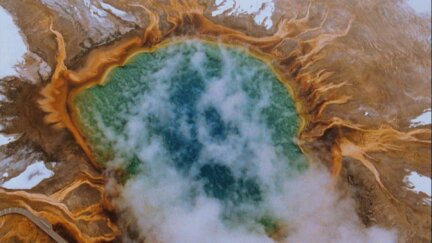
Two weeks into his expedition's journey, Langford came across the kind of scenery the rumors had described. They passed through a landscape of "boiling sulphur springs" with vents that were too hot to touch, even with gloved hands. Langford was now convinced that Yellowstone could be an even greater attraction than he and the backers of the Northern Pacific had dreamed.
Add to Scrapbook
Truman Everts' "Thirty-Seven Days of Peril," Scribner's Monthly |
During their exploration, the nearsighted Truman Everts was separated from the main group and went missing. Over the next several days, search parties were dispatched but they found no trace of Everts or his horse. (See sidebar)
A surprise storm forced the expedition to turn for home. After struggling through snow and dense timber, they came upon a large clearing where they beheld "an immense body of sparkling water" projected into the air. The sight of the geyser was so exhilarating that "the entire group threw up their hats and shouted with ecstasy." General Washburn named the geyser "Old Faithful," because of the regularity of its eruptions.
But the big news upon their return was that Truman Everts was still lost. The Vermonter would wander for 37 days, eating mostly thistle roots, before he was found. He weighed only 50 pounds and his frost-bitten feet had been worn to the bone.