
Add to Scrapbook
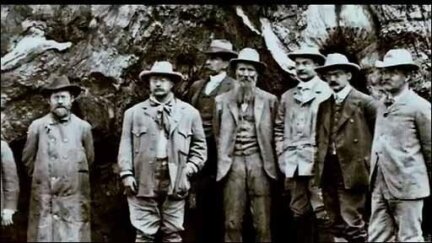
Hayden Survey expedition, Yellowstone National Park, circa 1871 |
The Creation of the World's First National Park
In the summer of 1871, Ferdinand Hayden led an expedition of scientists to Yellowstone to determine the real value of the land. Included in the group were a painter and a photographer. For the first time, Americans would see what mere words had previously described.
As Hayden prepared the report that Congress was expecting, he received an intriguing letter from a man named A. B. Nettleton, a shrewd lobbyist working for the Northern Pacific, suggesting that Hayden urge Congress to pass a bill reserving the Great Geyser Basin as a public park forever.
Add to Scrapbook
Nathaniel Pitt Langford, Mammoth Hot Springs Terrace, Yellowstone National Park, circa 1871 |
Hayden was happy to oblige and wrote a report in which he assured Congress that the Yellowstone region was unsuitable for farming and that, because of its volcanic origins, no valuable mines were likely to be found there. Hayden warned that if Congress did not protect Yellowstone from private development, it would become another Niagara Falls − another national embarrassment.
On March 1, 1872, President Ulysses S. Grant signed the bill creating Yellowstone Park. Unlike Yosemite, which was being administered by the state of California, this would be a national park - the first in the history of the world.
A National Park with No Protection
Add to Scrapbook
Nathaniel Pitt Langford, Yellowstone promoter |
The new national park at Yellowstone was huge. With more than 2 million acres of remote, mountainous terrain, it was 50 times larger than the Yosemite grant in California. But having created the world's first national park, Congress did nothing to provide for its protection.
The job of superintendent was offered to Truman Everts, Yellowstone's most renowned visitor. Since the position paid no salary, Everts politely turned it down. However, Nathaniel P. Langford, who liked to take credit for the park idea and boasted that his initials "N.P." stood for "National Park," eagerly accepted the position.
But during his five years as superintendent Langford visited Yellowstone only twice and seemed to be deliberately delaying development of the park until the Northern Pacific Railroad arrived and the choicest concessions could be awarded to his former employer. (See sidebar)
The Park Grab
Add to Scrapbook
Completion ceremony for the Northern Pacific Railroad, September 8, 1883 |
Add to Scrapbook
George Bird Grinnell, circa 1890 |
In 1883, the Northern Pacific Railroad was completed, bringing tourists from the East to Yellowstone in relative comfort and speed. Attendance increased five-fold in that first year.
But everything was under the exclusive control of the Yellowstone Park Improvement Company, which had been granted a remarkable monopoly within the park. The Company was allowed to cut as much timber as it needed; kill elk, deer, and bison for food; farm the land; and even rechannel some of the hot springs for water.
The contract also allowed the company to choose one-square-mile parcels of land at seven locations within the park. The prime attractions of Yellowstone were in grave danger of being completely surrounded and exploited.
Magazine editor George Bird Grinnell began a crusade to stop what he called "The Park Grab." Educated at Yale in ornithology and paleontology, Grinnell had made an excursion to Yellowstone in 1875, which instilled in him a deep love of the new park and a fierce desire to protect it and its wildlife.