
Add to Scrapbook
Women sporting feather-trimmed hats |
The Call for a Featherless Hat
By 1900, feathers were in fashion and no woman's hat, it seemed, was complete without an array of plumes. Some hats even included entire stuffed birds. The long, white plumes of egrets had become more valuable than gold. To satisfy the demands of this latest fashion trend, more than 5 million birds a year were being slaughtered; nearly 95 percent of Florida's shore birds had been killed by plume hunters.
The Audubon Society tried unsuccessfully to persuade women not to buy hats with feathers, while the powerful millinery industry used its influence in Congress to defeat a series of national laws aimed at stopping the slaughter of birds.
Add to Scrapbook
Audubon Society condemns the use of bird feathers as fashion, The New York Times, December 3, 1897 |
An unlikely champion stepped forward in the form of Congressman John F. Lacey. Despite being part of a group of die-hard conservatives, when it came to defending wildlife, Lacey was one of the most progressive politicians of his day. After years of ceaseless effort, he won passage of the Lacey Bird and Game Act of 1900. The bill made it a federal crime to transport birds killed in violation of any state law, and soon government agents were confiscating huge shipments of bird skins and feathers.
But in the lawless Everglades, the Lacey Act did not put an end to plume hunting. Five years after the bill's passage, a game warden was murdered by poachers. Another was gunned down three years later. The wildlife in southern Florida, it seemed, would never be safe unless the Everglades itself was set aside as a national park.
Theodore Roosevelt, Champion of the Conservation Movement
As America moved into a new century, a new word – "conservation" – had crept into the nation's vocabulary. A new president, Theodore Roosevelt, would become conservation's greatest advocate and would turn the word into a movement.
Add to Scrapbook
Theodore Roosevelt, 1885 |
Not since Thomas Jefferson had there been an American president with greater interest in the natural world. Much of Roosevelt's childhood was devoted to studying animals and learning taxidermy. At age 12, he donated some of his specimens to the American Museum of Natural History.
In 1883, after hearing reports about the rapidly disappearing herds of buffalo, 24-year-old Roosevelt headed west, afraid that the animals might become extinct before he had a chance to shoot one. He went home not only with a hunting trophy, but with an understanding of what was at stake in the debate about the future of nature in America.
Twenty years later, in 1903, he once again boarded a train headed west, arriving just outside of Yellowstone National Park. He was no longer a scrawny and inexperienced Easterner, but a national hero, and the youngest president in United States history.
For the Benefit and Enjoyment of the People
Add to Scrapbook
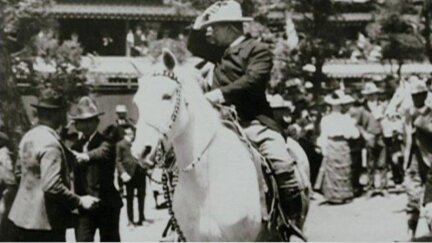
Theodore Roosevelt arrives at Yellowstone National Park, 1903 |
President Theodore Roosevelt's visit to Yellowstone in 1903 was a break from an eight-week national tour during which he delivered over 200 speeches. Yearning to be alone in nature, he immediately set off on horseback with the Army's acting park superintendent, leaving the rest of the presidential entourage behind.
Roosevelt delighted in seeing so many animals, especially since the increase in game animals could be attributed to the wildlife protection bill that he, along with George Bird Grinnell and John F. Lacey, had worked so hard to pass.
The president was a hunter and he was itching to shoot something. Since the park managers were killing predators, he hoped a mountain lion would be fair game – until his advisers convinced him that killing any animal in a national park would not be good politics.