
Add to Scrapbook
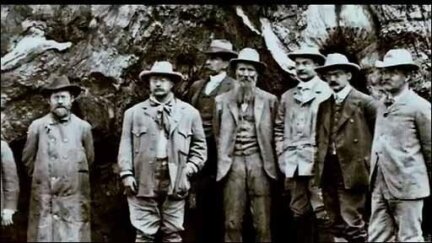
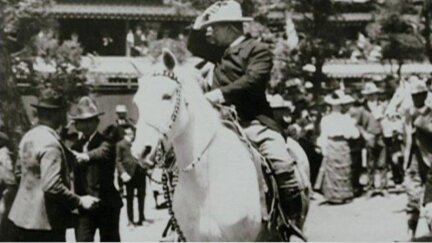
Theodore Roosevelt delivers speech at cornerstone ceremony for Roosevelt Arch, Yellowstone National Park, 1903 |
For the Benefit and Enjoyment of the People (continued)
At the end of Roosevelt's two-week visit, he spoke at the construction site of a new arch at the north entrance of Yellowstone. In his speech, Roosevelt reminded people of the essential democratic principle embodied by the parks; they were created "for the benefit and enjoyment of the people." These words were later carved into the arch's mantle as a reminder of why the park was there – and for whom. (See sidebar video.)
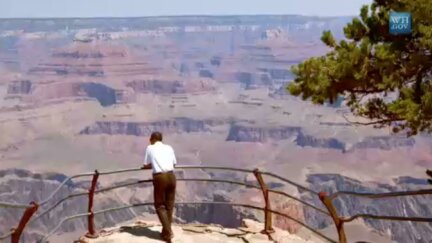
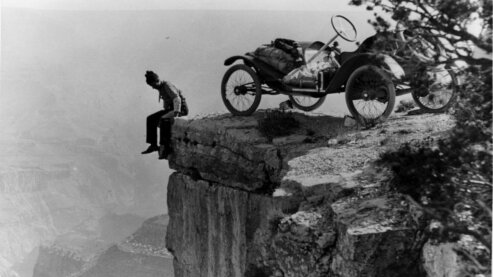
The next stop on Roosevelt's whirlwind tour was a brief visit to the Grand Canyon where he was overwhelmed by the spectacular vista from the South Rim. The president urged the people of Arizona to "keep this great wonder of nature as it now is." (See sidebar video.)
The Ancient Ruins of Mesa Verde
Add to Scrapbook
Excavator in Cliff Palace during restoration, Mesa Verde National Park |
In 1889, rancher Richard Wetherill and his four brothers stumbled across ancient ruins in the cliffs of Mesa Verde in Colorado. They excavated the site, gathering thousands of artifacts which they sold to museums. The brothers sought to protect the ruins by making Mesa Verde a national park, but the government turned down their request.
When authorities tried to stop a Swedish archaeologist from sending a huge shipment of Mesa Verde artifacts abroad, they discovered that they were powerless to do so. There was no law in existence protecting antiquities.
Richard Wetherill and the Discovery of Chaco Canyon
Add to Scrapbook
Richard Wetherill, 1904 |
Add to Scrapbook
Ruins at Pueblo Bonito, Chaco Canyon National Historic Park, 1940 |
Without any law protecting them, the ruins that the Wetherill brothers had first discovered at Mesa Verde were subjected to looting and vandalism.
Archaeologists were horrified by it all, fearing that a record of an ancient civilization would be lost forever. In their eyes, the Wetherill brothers were as much to blame as anyone else. This was a particularly sore spot for Richard Wetherill, who, despite his lack of formal education, wanted to be taken seriously as an archaeologist.
He had left Mesa Verde to search for other ruins in the southwest. Finally, in New Mexico, he came to a place called Chaco Canyon, where he began to study another set of ruins left behind by the ancient Puebloans.
Although Wetherill tried to carry on his work as scientifically as possible, he was still dismissed as a "pothunter," and professional archaeologists urged the government do something to stop him. Wetherill offered to give up any claim to the Chaco Canyon ruins, if only the federal government would do something to protect them.
The Extraordinary Power of the Antiquities Act
On June 29, 1906, President Roosevelt signed the law creating Mesa Verde National Park. It was the first park created specifically to celebrate a prehistoric culture and its people, and marked a broadening of the park idea.
Add to Scrapbook
John F. Lacey, circa 1903 |
But while Mesa Verde had been saved, there was no law protecting any of the other ancient ruins scattered throughout the Southwest. Growing anger over Richard Wetherill's excavations at Chaco Canyon would set in motion events that would change the course of park history.
With the help of John F. Lacey, the Act for the Preservation of American Antiquities was passed. Now, any unauthorized disturbance of a prehistoric ruin was a federal crime.
The Antiquities Act also gave the president an extraordinary power: the exclusive authority – without any Congressional approval – to preserve places that would be called national monuments.