
A President's Delight
Add to Scrapbook
Tourists camping at the base of Devils Tower, Devils Tower National Monument, 1887 |
Theodore Roosevelt wasted no time in putting his new powers to use. Devils Tower, in eastern Wyoming, became the first of many national monuments. And on March 11, 1907, the president did exactly what Richard Wetherill had wanted, by creating Chaco Canyon National Monument.
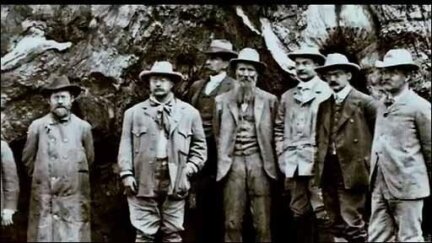
Roosevelt would also use the Antiquities Act to protect Muir Woods, an endangered grove of giant coastal redwoods named after his friend John Muir. He would use it again at Muir's request, to save an endangered fossilized forest in Arizona that dated back 200 million years. With a stroke of his pen, he created the Petrified Forest National Monument. (See sidebar)
There was one more national park that President Roosevelt wanted to add to his list: the Grand Canyon, which was under threat by developers, miners and ranchers. But local opposition was so strong that not even he could persuade Congress to act.
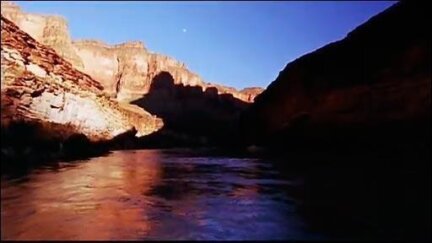
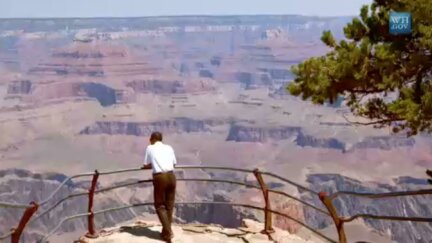
Roosevelt realized that the wording of the Antiquities Act could be used to his advantage. He created a furor when on January 11, 1908, he stretched the Act to its limit by declaring the Grand Canyon to be "an object of unusual scientific interest" – and a national monument.
Add to Scrapbook
Hetch Hetchy Valley, before a dam and reservoir entombed it |
Add to Scrapbook
Hetch Hetchy with O'Shaughnessy Dam, Yosemite National Park, 1930 |
Add to Scrapbook
John Muir's obituary, New York Times, December 25, 1914 |
The Death of a Valley and its Protector
In John Muir's eyes, the Hetch Hetchy Valley of Yosemite National Park was "one of Nature's rarest and most precious mountain temples." When the city of San Francisco, eager to create a better water supply, set its sights on building a dam in the Hetch Hetchy Valley, Muir embarked on a long and bitter fight to save his beloved temple.
Initially, Muir's view prevailed. But when, in 1906, an earthquake and ensuing fires reduced San Francisco to ash and rubble, politicians falsely claimed that a water supply from a reservoir at Hetch Hetchy could have prevented the destruction.
To John Muir, allowing a dam in a national park was sacrilege and set a dangerous precedent. To Gifford Pinchot, Muir's old adversary, who had stepped forward to campaign on the city's behalf, it would be the "greatest good for the greatest number." Despite Muir's appeal to President Roosevelt to save Hetch Hetchy, Pinchot's view eventually prevailed.
In 1913, President Woodrow Wilson signed the bill approving the dam into law. Muir, now 75, was devastated. In December of 1914, he came down with pneumonia and on Christmas Eve, the wilderness prophet died. Four years after Muir's death, work on the dam began.
Muir may have lost the fight, but it had struck a chord in many Americans, who rightly wondered if any of the national parks were truly safe. A proposal that Muir had supported began gaining greater ground: to create an agency within the federal government whose sole job would be to protect the national parks – to make sure they endured for countless generations.