
Add to Scrapbook
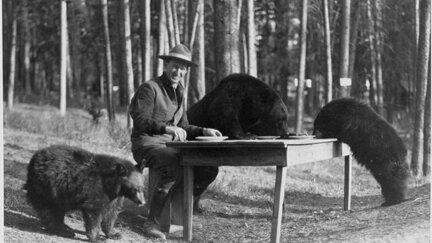
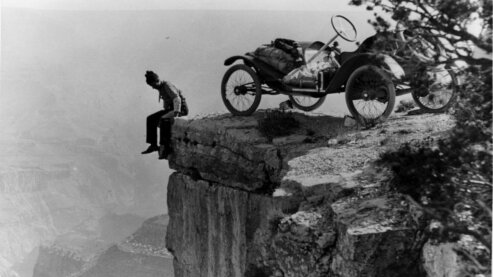
Auto-camping, Yellowstone National Park, 1925 |
Before the establishment of the National Park Service in 1916, the parks had existed as a haphazard collection of scenic places – occasionally guarded by the Army, often ignored by Congress, and in many ways controlled by the railroads that had funded much of the development in the parks. Stephen Mather, the first director of the National Park Service, was determined to change all that. He wanted more national parks within reach of more people, and he wanted them promoted as one cohesive system.
In order to increase the number of visitors, Mather and his young assistant, Horace Albright, would ally themselves with the machine that had already begun transforming American life: the automobile. Their efforts would bring Americans to the parks as never before. But for some, allowing cars into the parks was the equivalent of allowing the serpent into Eden. While it was an easy decision for Mather, many park supporters worried that he had made a pact with the devil.
Mather's Mission: Attracting Visitors to the Parks
Add to Scrapbook
Camping in Yosemite Valley, Yosemite National Park, 1920s |
For Stephen Mather, directing the National Park Service was a noble calling – one so compelling that it had drawn him away from private industry where he had made his fortune.
While he was known for his intense energy and friendliness, he was also prone to bouts of depression that required hospitalization. In the parks, he found solace and rejuvenation, and he wanted all Americans to experience that healing power. But he realized that until more people started showing up, Congress would never create more parks, or even support the existing ones. "There could never be too many tourists for Stephen Mather," Horace Albright remembered. "He wanted as many as possible to enjoy his 'treasures.'"
Add to Scrapbook
Stephen Mather and Horace Albright, Yellowstone National Park, 1923 |
Add to Scrapbook
Rangers stampeding buffalo, Buffalo Plains Week, Yellowstone National Park, 1925 |
Mather and Albright were willing to try almost anything to attract publicity and lure more visitors. They approved golf courses and zoos at different parks, and even proposed Yosemite as an ideal setting for the winter Olympics. When a new hotel was to be built in Yosemite, Mather arranged for the first charge of dynamite to be detonated via remote control by the Secretary of the Interior, sitting at his desk thousands of miles away.
Park superintendents tried to follow Mather's lead in creative public relations. In Yellowstone, Albright arranged for a "Buffalo Plains Week" in which cowboys and Crow Indians stampeded the park's bison herd for arriving tourists. In Mesa Verde, the superintendent's 12-year-old son was encouraged to write a book about growing up among the cliff dwellings. Mather wrote the book's foreword and posed for a picture with the young author. Albright even proposed stringing a cable across the Grand Canyon to allow trams to carry tourists from the South Rim to the North Rim; at the last minute, Mather rejected the idea when he realized it would ruin the view of the great chasm.
Mather Embraces the Automobile
It was Mather's decision to embrace the automobile that would have the greatest impact on the number of people visiting national parks. Even John Muir, Mather's hero, had admitted that the automobile might help create new allies for the parks, but the great naturalist worried that automobiles would "mingle their gas-breath" with the pristine air of the parks. (See sidebar video.)