
Add to Scrapbook
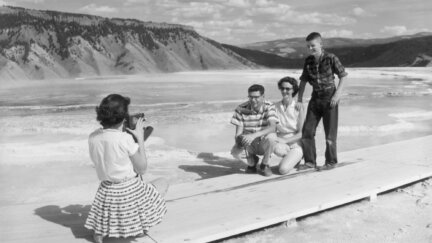
Crowds at Yellowstone National Park in the 1960s |
Wearing Out the Scenery
By the mid-1950s, the number of Americans crowding into their national parks each year reached close to 62 million. Most of the visitors arrived by car, and the parks weren't ready for them.
In Yosemite, meadows had been paved for parking lots and campgrounds were overcrowded. "The people are wearing out the scenery," said one park official. The situation was the same across the park system. To make matters worse, staff levels and budgets had not increased since the Great Depression of the 1930s.
As President Dwight D. Eisenhower pushed plans through Congress to spend $25 billion over 10 years to build an interstate highway system, the new Park Service director, Colin Wirth, proposed a similar 10-year plan for the parks. He named the ambitious project "Mission 66," timing its completion to coincide with the agency's 50th anniversary in 1966.
Mission 66
Add to Scrapbook
Mission 66 road construction, Yellowstone National Park, 1958 |
Add to Scrapbook
Mission 66 visitor center, Mount Rushmore National Monument, 1963 |
Wirth called for spending $787 million, more than half for new construction and the rest for repairs, better maintenance and more staff. Once the president agreed, work began almost immediately. Roads were fixed, sewer systems upgraded, campgrounds improved, and visitor centers added. (See sidebar video.)
The visitor centers were modern structures which brought museums, restrooms, and information offices together under one roof. Before Mission 66 was through, 110 of them would be built.
But many of the parks' oldest allies became Mission 66's harshest critics. They hated the increased development, and the new buildings reminded them of suburban shopping centers. Environmentalist David Brower and the Sierra Club opposed highway construction, particularly a plan to pave the old Tioga Road in the high country of Yosemite.
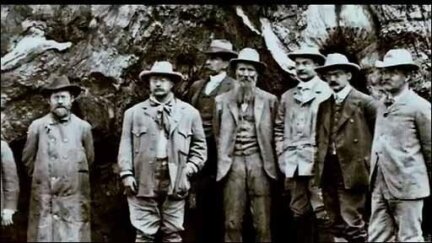
In the end, though, the road was built, and some Sierra Club members began to question the entire premise of helping more people visit the parks. John Muir had argued that in order for people to value their national parks, they had to experience them firsthand. But could too many visitors actually ruin the parks?
The controversy would forever tarnish some of the real accomplishments of Mission 66. From then on, the emerging environmental movement would be as likely to confront the National Park Service as to support it.
But the American people continued to flock to their national parks. Going to the parks was becoming an American rite of passage – journeys creating memories that would last a lifetime.
Stewart Udall and the Expansion of the Parks
Add to Scrapbook
Stewart Udall and Senator Frank Church |
Add to Scrapbook
Guadalupe Mountains National Park, Texas |
Throughout the 1960s, Stewart Udall would serve as Secretary of the Interior to Presidents John F. Kennedy and Lyndon Johnson. He would oversee the most ambitious program of creating new parks since the time of Franklin Roosevelt.
The pace of population growth and development in the West gave Udall a sense of urgency. "What we save now," he said, "may be all we save."
He joined forces with the Sierra Club to push for creation of Redwood National Park, along the northern coast of California, home to the tallest trees in the world. By the 1960s, logging had already cleared 85 percent of the original redwood forest. The new national park saved half of what remained.
In West Texas, Udall oversaw the creation of Guadalupe Mountains National Park in an area that had once been the home of grizzly bears, wolves, and buffalo – as well as the Mescalero Apaches before they, too, were driven out.