
Add to Scrapbook
North Cascades National Park |
Stewart Udall and the Creation of New Parks
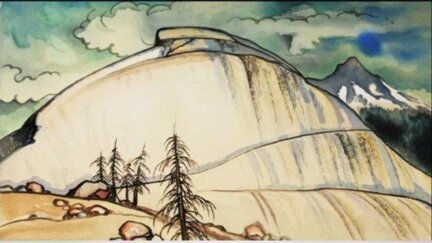
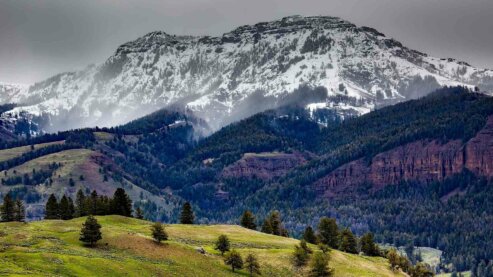
Udall also supported North Cascades National Park, a roadless wilderness on the border of Washington and Canada containing nearly a third of all the remaining glaciers in the Lower 48 states.
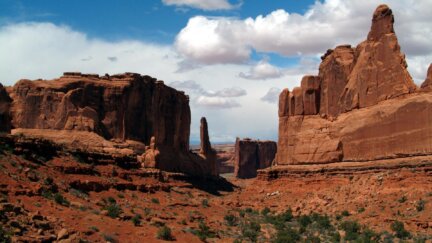
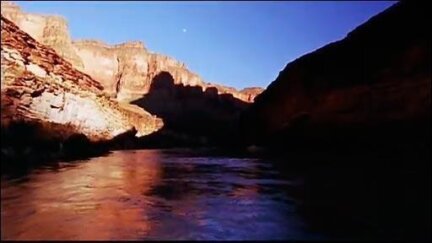
And in the stark desert of eastern Utah, where the Green River meets the Colorado amidst a seemingly endless maze of canyons, he helped create Canyonlands National Park.
But it wasn't just places with canyons and glaciers and tall trees Udall wanted to save. He persuaded Congress to set aside other parts of the American landscape and place them under Park Service protection:
Add to Scrapbook
Hiker on Appalachian Trail, Bigelow Mountain, Maine |
- National seashores, from Cape Cod in Massachusetts to Point Reyes in California.
- National lakeshores, such as Indiana Dunes and Pictured Rocks in the Great Lakes.
- The Ozark National Scenic Riverway in southwestern Missouri, the first in a string of rivers that would have portions kept in their free-flowing, natural conditions.
- National trails, such as the Appalachian Trail.
Udall also championed the creation of Biscayne National Monument near fast-growing Miami, Florida. The monument later became a national park.
Preserving History
Add to Scrapbook
George Hartzog and Stewart Udall |
Add to Scrapbook
Martin Luther King, Jr. delivering his "I Have a Dream" speech, Lincoln Memorial National Memorial, 1963 |
Interior Secretary Udall appointed George Hartzog to be the new Park Service director. The energetic Hartzog would push the Park Service to have a greater presence in urban areas, to increase its number of historic and cultural sites, and to serve minority populations that did not yet have a relationship with the parks.
For Hartzog, the park system's role in preserving and interpreting American history was just as crucial as its mission to protect the large natural parks. Together, he said, they represent the "delicate strands of nature and culture that bond generation to generation."
Hartzog had been at the Lincoln Memorial on August 28, 1963, when a quarter of a million people gathered on the National Mall as part of the March on Washington to protest Jim Crow laws. He listened to Martin Luther King Jr. give an electrifying speech that would be considered a turning point in American history.
Hartzog was proud that the massive protest took place at a National Park Service location and that on the steps next to Dr. King stood two park rangers. "What higher purpose can a national park serve," he said, "than to be responsive to the crisis in our society, to the voice of the underprivileged, to the voice of the protester who's objecting to the institutional status quo?"
Five years later, Dr. King would be assassinated. Twelve years after that, his birthplace in Atlanta, Georgia, would be dedicated as a historic site, part of the national park system.
Add to Scrapbook
Newly completed section of road, Mt. McKinley (later Denali) National Park, 1962 |
Add to Scrapbook
Olaus and Adolph Murie, Mt. McKinley (later Denali) National Park, 1961 |
Preserving the Wilderness
When the Mission 66 plans for Mount McKinley National Park were unveiled in 1956, they called for widening and paving the park's 90-mile gravel road.
"I am afraid," Adolph Murie wrote to a friend, that "they will try to make McKinley into another Yellowstone or Yosemite." He submitted a detailed analysis calling for preservation of the wilderness spirit in the Alaska park.
But no one was interested in his views and he was quickly reassigned to Grand Teton National Park, where he was told to catch up on writing about his studies of McKinley's flora and fauna. Returning to McKinley two years later, Murie was dismayed to see 13 miles of newly paved park road and a partly completed visitors center.
Murie was determined to stop further road construction. He turned to his older brother Olaus, who was now the director of the Wilderness Society. With the help of other groups, including the National Parks Association, the brothers persuaded George Hartzog to shelve most of the Mission 66 plans for McKinley.