
Add to Scrapbook
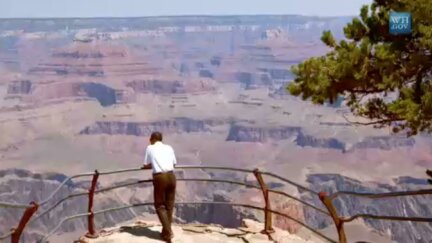
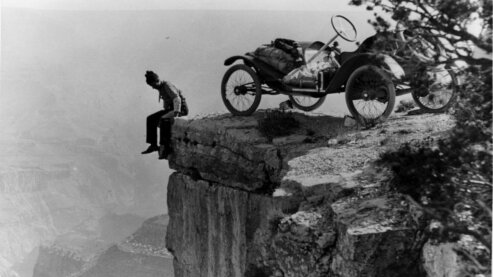
Tourist at Bright Angel Point, Grand Canyon National Park, circa 1919 |
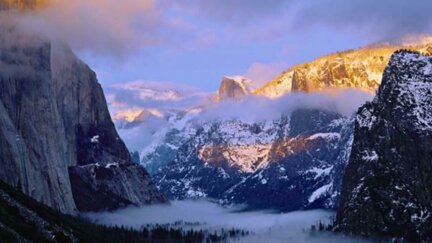
The Grand Canyon is the biggest canyon on earth: 277 miles long, 10 miles wide, and a mile deep. It contains some of the oldest exposed rock on earth, Precambrian Vishnu schist, formed 1.7 billion years ago.
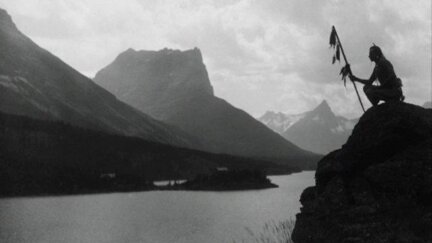
Over thousands of years, the canyon has been the home of the ancient Puebloans and the Hopi, the Hualapai and Havasupai, the Paiute and the Navajo. It entered recorded history in 1540, when Spanish conquistadors under the command of Francisco Vázquez de Coronado peered into its depths.
Add to Scrapbook
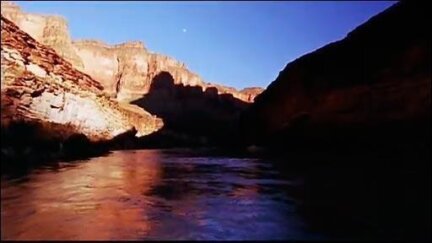
Colorado River, Grand Canyon National Park |
Three hundred years later, in 1857, an American explorer named Joseph Christmas Ives wrecked his boat trying to ascend the river, but brought back the first sketches of what he called the "Big Canyon of the Colorado." Ives predicted that the "valueless" region would be "forever unvisited and undisturbed."
In 1869, a one-armed Civil War veteran and geology professor named John Wesley Powell led an expedition to chart the wild Colorado and make the first detailed study of the massive architecture of stone that encloses it. Despite losing four men and two boats, the expedition was a success and brought the Grand Canyon to national attention.
The canyon, (Theodore) Roosevelt said, is "the one great sight which every American should see." Although he advised the people of Arizona to "leave it as it is," no one listened to him.
Early proposals to make it a national park date back to the 1880s, but they all failed in Congress because of fierce opposition from local ranchers, miners, and settlers who did not want the federal government imposing restrictions on what they could and could not do.
Add to Scrapbook
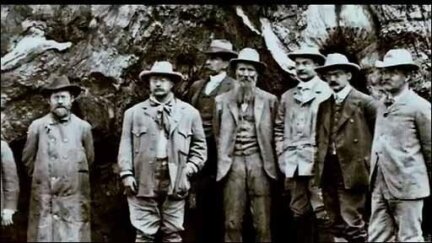
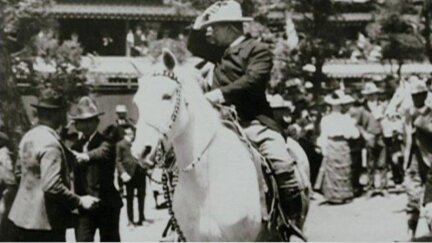
Theodore Roosevelt with tourists at Grand Canyon rim |
In 1893, President Benjamin Harrison offered a modicum of preservation by using his executive powers to create the Grand Canyon Forest Reserve. Fifteen years later, when Congress again refused to create a national park, President Theodore Roosevelt stretched the limits of the Antiquities Act and established the Grand Canyon National Monument.
The canyon, Roosevelt said, is "the one great sight which every American should see." Although he advised the people of Arizona to "leave it as it is," no one listened to him.
A few rustic hotels had already been built, and when the Atchison, Topeka, and Santa Fe Railway extended its tracks to the South Rim in 1901, construction of even more buildings began. Yearly visitation rose into the tens of thousands.
By 1919, the Grand Canyon was attracting nearly as many tourists as Yellowstone or Yosemite. But it was still a national monument, and still administered by the Forest Service. Grazing was permitted and mining claims were allowed wherever a prospector thought a valuable mineral might be found. Stephen Mather, the director of the National Park Service, desperately wanted to change all that by making the canyon a national park.
Add to Scrapbook
Ralph Henry Cameron, Grand Canyon National Park |
Add to Scrapbook
Tourists and guide, Bright Angel Trail, Grand Canyon National Park, Kolb Bros. photo |
At every turn, however, Mather and his assistant, Horace Albright, found themselves blocked by Ralph Henry Cameron, a prospector and hotel owner who considered the canyon his own private domain and was unafraid to take on anyone who got in his way.
Cameron had claims on the most scenic and strategically located spots, and he viewed Mather's efforts at creating a national park a direct economic and political threat.
At one claim, near the head of the Bright Angel Trail (which he preferred to call the "Cameron Trail"), he built a log cabin, named it Cameron's Hotel and sent employees to hound tourists arriving by train to patronize it.
On the trail itself, he erected a gate at the rim and collected a toll of a dollar a person. When Coconino County was declared the trail's proper owner, Cameron used his influence as a county commissioner to be awarded the franchise to continue collecting the tolls. Halfway down the trail, at a small oasis, he operated a tent camp where he charged travelers outrageous prices for water, then charged again for the only outhouses between the rim and the river.