
Marjory Stoneman Douglas (1890–1998)
"Her voice...seemed to tame the rowdiest of the local stone crabbers, plus the developers, and the lawyers on both sides."
Add to Scrapbook
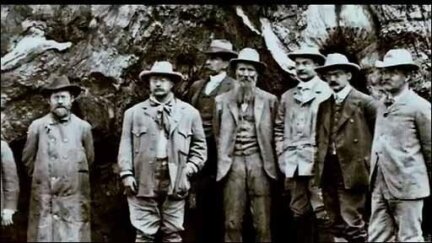
Marjory Stoneman Douglas (2nd from right), 1918 |
Born in Minneapolis and a graduate of Wellesley College, Douglas moved to Miami in 1915, following a brief and unhappy marriage, to work for her father at the Miami Herald. She started as a society reporter, but soon distinguished herself as a feisty and articulate crusader for women's rights, racial justice, and conservation.
Conservationist Ernest Coe recruited her in the fight to save the Everglades as a national park. Although she herself found the Everglades "too buggy, too wet, too generally inhospitable" for frequent visits, she soon became the public voice of the effort. Her 1947 book, The Everglades: River of Grass, generated support for protection of the fragile ecosystem and is still considered a classic work.
Add to Scrapbook
Marjory Stoneman Douglas in the Everglades |
Add to Scrapbook
Marjory Stoneman Douglas (3rd from left) at tree-planting outing |
"There are no other Everglades in the world," she wrote. "They are unique...in the simplicity, the diversity, the related harmony of the forms of life they enclose. The miracle of the light pours over the green and brown expanse of saw grass and of water, shining and slow-moving below, the grass and water that is the meaning and the central fact of the Everglades of Florida."
Her work did not end with the creation of Everglades National Park. She continued to fight against efforts by the Army Corps of Engineers to divert the natural flow of the waters and in 1970, she founded Friends of the Everglades to broaden the constituency for its protection.
Writer John Rothchild describes the unstoppable octogenarian's appearance at a public meeting in Everglades City in 1973: "Mrs. Douglas was half the size of her fellow speakers and she wore huge dark glasses, which along with the huge floppy hat made her look like Scarlett O'Hara as played by Igor Stravinsky.... Her voice...seemed to tame the rowdiest of the local stone crabbers, plus the developers, and the lawyers on both sides." Douglas was there to oppose a bridge permit that was eventually turned down, Rothchild adds. "This was no surprise to those of us who'd heard her speak."
In 1986, the National Parks Conservation Association established the Marjory Stoneman Douglas Award "to honor individuals who often must go to great lengths to advocate and fight for the protection of the National Park System." In 1993, she was awarded a Presidential Medal of Freedom.
Douglas died in May 1998, at the age of 108. Her ashes were scattered in Everglades National Park – her river of grass.