
|
| People Overview | Historical Figures | National Park Service | People Behind the Parks |
Park Visitors | Artists and Writers | Contemporary Commentators |
|
The Kolb Brothers and the Grand Canyon (04:39) |
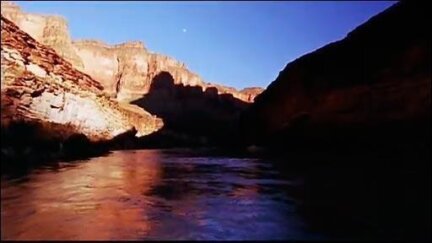
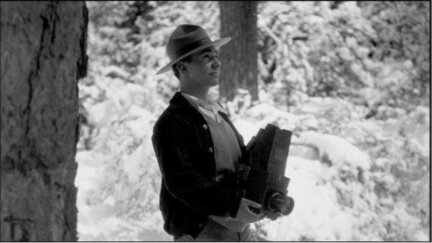
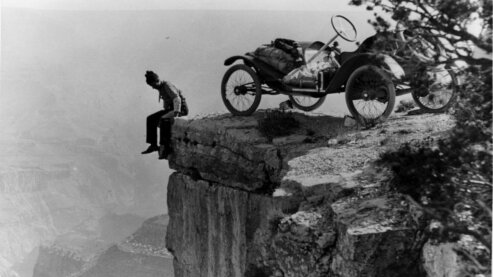
In 1902, the Kolb brothers bought a photographic studio in Williams, Arizona, and had its contents moved to the South Rim of the Grand Canyon, 50 miles away. They opened for business in a canvas tent near one of the tourist hotels, and later built a wooden structure at the head of the Bright Angel Trail. They supported themselves by taking photographs of tourists about to descend the trail on mules, then offering the developed photos for sale when the visitors returned from the river a mile below. They were also known for daring treks into the canyon to capture images from seemingly impossible vantage points.
In 1911, the Kolbs retraced John Wesley Powell's historic descent of the Colorado River, bringing along a moving-picture camera to record footage they later showed in a specially-built theater in their South Rim studio. The brothers were active in virtually anything that went on in the canyon – from government surveys to the search for Glen and Bessie Hyde in 1928.
Ellsworth went his own way in 1924, but Emery stayed on at the South Rim, photographing tourists and giving his lecture at the studio until his death at age 95.
Add To Scrapbook
John F. Lacey, circa 1905 |
An arch-conservative Republican congressman from Oskaloosa, Iowa, Lacey became the unlikely champion of a number of progressive laws important to conservation and national parks. One, in 1894, was the law that finally put legal muscle behind regulations against poaching and vandalism in Yellowstone National Park. (Lacey had seen how lawless the young park could be; in 1887, the stagecoach he was taking through Yellowstone was stopped and robbed by bandits.) His second major legislation was the Lacey Bird and Game Act of 1900, which helped bring an end to the heedless slaughter of plumed birds in Florida and elsewhere.
But perhaps his most important legacy was the Act for the Preservation of American Antiquities of 1906. Originally meant to stop vandals from looting southwestern ruins, the act gave the president unilateral authority – without consulting Congress – to set aside parcels of the public domain. Theodore Roosevelt, who signed Lacey's bill into law, then stretched it to save the Grand Canyon in 1908. Future presidents – from Franklin Roosevelt at the Tetons, to Jimmy Carter in Alaska, to Bill Clinton in Utah – would also employ it, often against local opposition, to preserve vast portions of the American landscape.
Lacey was also the author of the bill creating Wind Cave National Park and an early advocate of a National Park Service.
Add To Scrapbook
Gifford Pinchot, circa 1905 |
Yale-educated, Pinchot studied forestry in Europe and was the first American to declare himself a professional forester. At first a friend and ally of John Muir's in his opposition to the wasteful destruction of American forests, Pinchot eventually became an adversary of Muir's within the growing conservation movement. Pinchot's favorite saying, "the greatest good for the greatest number," attested to his view of conservation-through-use that would come to be known as "utilitarian." Muir, on the other hand, was what came to be called a "preservationist." To him, the great value of forests and wilderness was more spiritual than practical.
With the creation of the National Forest Service within the Department of Agriculture, and with Pinchot as its first director, his view prevailed in Washington: forests would be treated like a crop, not a temple. Pinchot prevailed again when he persuaded President Theodore Roosevelt to allow the construction of the Hetch Hetchy dam in Yosemite, despite Muir's vociferous objections.
After Muir's death, supporters of the creation of a National Park Service believed that Pinchot – and his Forest Service – tried their best to prevent a separate parks agency from being established and then to keep the number of new parks at a minimum. To a certain degree, the rivalry exists to this day. Pinchot remained a powerful political force and leader in conservation; he went on to become governor of Pennsylvania from 1923 to 1927, and 1931 to 1935.
Add To Scrapbook
John D. Rockefeller Jr. |
John D. Rockefeller Jr. was the son of the richest man in America: John D. Rockefeller Sr., the founder of the vast Standard Oil trust. The younger Rockefeller became a prominent philanthropist and conservationist who donated millions of dollars towards the creation and expansion of national parks across the nation. No single American donated more to the parks.
Rockefeller purchased land and donated money ($45 million by some estimates) to create or expand Acadia, Great Smoky Mountains, Grand Teton, Yosemite and Shenandoah National Parks, and contributed to many other park activities such as the creation of museums. He passed his love of the parks on to his children, particularly his son Laurance, who was responsible for the creation of Virgin Islands National Park and helped launch the National Park Foundation to encourage more Americans to contribute to their parks.
Create personalized postcards using images from The National Parks series and email them to friends or family.
Download some of the glorious images from the documentary to enjoy on your desktop.
Discover the "hidden" stories of the national parks that explore the role of minorities in the creation and protection of the parks.
You own 391 national parks. Come for a visit and take away the experience of a lifetime. Help the National Park Service make America's Best Idea even better!