
|
| |
|
| 1870 |
Buffalo hunters begin moving onto the plains, brought there by
the expanding railroads and the growing market for hides and meat
back east. In little more than a decade, they reduce the once numberless
herd to an endangered species.
Railroad
companies begin massive advertising campaigns to attract settlers
to their land grants in the West, sending agents to rural areas
in the eastern states and throughout Europe to distribute handbills,
posters and pamphlets that tout the rich soil and favorable climate
of the region. But the higher costs of railroad land compared to
public lands, and the fact that railroads pay no taxes on their
lands, soon stirs charges of extortion, leading to state laws controlling
railroad rates and land sale practices by the decade's end.
|
 |
| 1870 |
With Brigham Young's support, the
Utah territorial legislature grants women the right to vote, providing
the Mormons with an added margin of political power. |
 |
| 1870 |
A California court rules in White
vs. Flood that a black child may not attend a white school, setting
the legal precedent for school segregation. |
 |
| 1870 |
The Union Pacific in Wyoming hires
Chinese laborers for $32.50 a month rather than pay $52.00 a month
to whites. From incidents like this one, white laborers across the
West develop the opinion that Chinese immigrants are competing unfairly
for jobs, a feeling that will lead to violent racial conflict and
labor unrest in years to come. |
 |
| 1870 |
Bret Harte publishes The Luck
of Roaring Camp and Other Sketches, a collection of stories based
on his years as a San Francisco journalist, which offers a sentimental
and humorous view of "uncouth" frontier characters, establishing
a set of stereotypes that will remain an important part of the myth
of the American West. |
 |
| 1871 |
More than 100 Apaches -- most of
them women and children -- are murdered outside Camp Grant, Arizona,
where they had been given asylum, when members of the Tucson Committee
of Public Safety arrive with a force of Papago Indians, the Apaches'
long-time enemies. The committee members claim they acted in retaliation
for raids by various Apache bands at distant points across the region,
but public opinion, particularly in the East, links the event to the
recently investigated Sand Creek Massacre of 1864 as further evidence
of Westerners' deep-seated hatred for Indians. |
 |
| 1871 |
Congress approves the Indian Appropriations
Act, which ends the practice of treating Indian tribes as sovereign
nations by directing that all Indians be treated as individuals and
legally designated "wards" of the federal government. The
act is justified as a way to avoid further misunderstandings in treaty
negotiations, where whites have too often wrongly assumed that a tribal
chief is also that tribe's chief of state. In effect, however, the
act is another step toward dismantling the tribal structure of Native
American life. |
 |
| 1871 |
Federal judge James B. McKean,
seeking to break the alliance between church and state in Utah, orders
the arrest of Brigham Young and other Mormon leaders on charges of
polygamy. Federal prosecutors also charge John D. Lee and others with
murder for the Mountain Meadows Massacre of 1857. |
 |
| 1871 |
A quarrel over a woman between
two Chinese men in Los Angeles escalates into a city-wide anti-Chinese
riot, ending in the murder of at least 23 of the city's 200 Chinese
residents. |
 |
| 1871 |
Cochise, the Apache chief who led
a decade-long guerilla war against whites in Arizona, surrenders to
General George Crook but escapes back to his mountain stronghold rather
than let his people be sent to a New Mexico reservation. General Otis
Howard finally makes peace with Cochise the next year, agreeing to
establish an Apache reservation in Arizona. |
 |
| 1872 |
Arbor Day (April 10) is celebrated
for the first time in near-treeless Nebraska. |
 |
| 1872 |
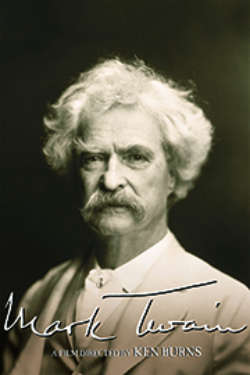
Mark Twain publishes Roughing
It, a humorous account of his adventures as a budding journalist
in the West, which adds a self-conscious depth to the entertaining
Western myth pioneered by Twain's one-time mentor, Bret Harte. |
 |
| 1872 |
The
Yellowstone Act sets aside more than 2 million acres in northwest
Wyoming as a public "pleasuring-ground" for the "preservation...
of all timber, mineral deposits, natural curiosities or wonders...
and their retention in their natural condition." It marks the
first time any national government has set aside public lands to preserve
their natural beauties and sets a precedent later followed in countries
around the world. Much of the impetus for establishing the park can
be traced to William H. Jackson's photographs of its natural wonders,
taken when he traveled there with the Hayden expedition of 1871. |
 |
| 1872 |
"Buffalo Bill" Cody is
awarded the Congressional Medal of Honor for his service as a scout
in General Philip Sheridan's four-year campaign against the Cheyenne.
The same year Cody begins his theatrical career, appearing as "Buffalo
Bill" in Ned Buntline's The Scouts of the Plains. |
 |
| 1873 |
Cable cars are introduced in San
Francisco. |
 |
| 1873 |
Although federal authorities estimate
that hunters are killing buffalo at a rate of three million per year,
President Grant vetoes a law protecting the herd from extermination. |
 |
| 1874 |
Mennonite immigrants from Russia
arrive in Kansas with drought-resistant "Turkey Red" wheat,
which will help turn the one-time "Great American Desert"
into the nation's breadbasket. |
 |
| 1874 |
Joseph Glidden receives a patent for barbed wire, an inexpensive,
durable and effective fencing material which, with the destruction
of the buffalo, will open the plains to more efficient agriculture
and ranching.
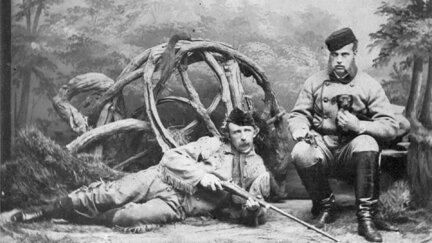
George
Armstrong Custer announces the discovery of gold in the Black Hills
of Dakota, setting off a stampede of fortune-hunters into this most
sacred part of Lakota territory. Although the 1868 Fort Laramie
Treaty requires the government to protect Lakota lands from white
intruders, federal authorities work instead to protect the miners
already crowding along the path Custer blazed for them, which they
call "Freedom's Trail" and the Lakota call "Thieve's
Road."
|
 |
| 1874 |
William H. Jackson discovers and
photographs the centuries-old Anasazi cliff dwellings at Mesa Verde
in Colorado. |
 |
| 1875 |
Pinkerton agents fire-bomb the
James family farm in Missouri in an unsuccessful attempt to kill the
notorious outlaws. The incident stirs widespread sympathy for the
James Gang, who are seen as populist enemies of the banks and railroads
who "rob" the common man. |
 |
| 1875 |
Deadwood, soon to be one of the
wildest towns in the West, springs into existence when Black Hills
miners find gold on Deadwood Creek. Within a year, the legendary gunfighter
"Wild Bill" Hickock will be murdered here while holding
aces and eights -- the dead man's hand -- in a game of poker. |
 |
| 1875 |
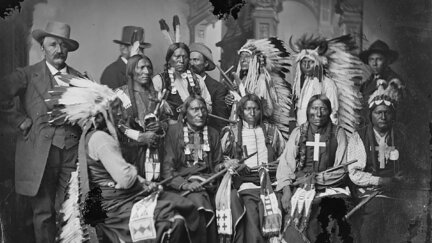
THE LAKOTA WAR
A Senate commission meeting with Red Cloud and other Lakota
chiefs to negotiate legal access for the miners rushing to the Black
Hills offers to buy the region for $6 million. But the Lakota refuse
to alter the terms of the 1868 Fort Laramie Treaty, and declare
they will protect their lands from intruders if the government won't.
|
 |
| 1876 |
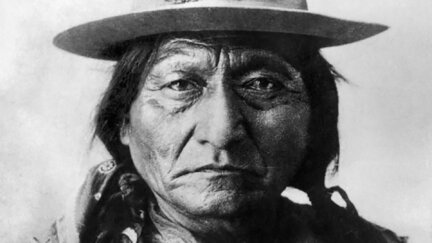
Federal authorities order the Lakota chiefs to report to their
reservations by January 31. Sitting Bull, Crazy Horse and others
defiant of the American government refuse.
General
Philip Sheridan orders General George Crook, General Alfred Terry
and Colonel John Gibbon to drive Sitting Bull and the other chiefs
onto the reservation through a combined assault. On June 17, Crazy
Horse and 500 warriors surprise General Crook's troops on the Rosebud
River, forcing them to retreat. On June 25, George Armstrong Custer,
part of General Terry's force, discovers Sitting Bull's encampment
on the Little Bighorn River. Terry had ordered Custer to drive the
enemy down the Little Bighorn toward Gibbon's forces, who were waiting
at its mouth, but when he charges the village Custer discovers that
he is outnumbered four-to-one. Hundreds of Lakota warriors overwhelm
his troops, killing them to the last man, in a battle later called
Custer's Last Stand. News of the massacre shocks the nation, and
Sheridan floods the region with troops who methodically hunt down
the Lakota and force them to surrender. Sitting Bull, however, eludes
capture by leading his band to safety in Canada.
|
 |
| 1876 |
Colorado enters the Union. |
 |
| 1877 |
Crazy Horse finally surrenders
to General George Crook at Fort Robinson, Nebraska, having received
assurances that he and his followers will be permitted to settle in
the Powder River country of Montana. Defiant even in defeat, Crazy
Horse arrives with a band of 800 warriors, all brandishing weapons
and chanting songs of war. By late summer, there are rumors that Crazy
Horse is planning a return to battle, and on September 5 he is arrested
and brought back to Fort Robinson, where, when he resists being jailed,
he is held by an Indian guard and killed by a bayonet thrust from
a soldier. |
 |
| 1877 |
Congress votes to repeal the 1868
Fort Laramie Treaty and take back the Black Hills, along with 40 million
more acres of Lakota land. |
 |
| 1877 |
With the threat of Indian attack
removed, mining camps and boom towns -- French Creek, Whitewood Gulch,
Black Tail Gulch -- crowd the Black Hills. |
 |
| 1877 |
John D. Lee is brought to trial
for the Mountain Meadows Massacre of 1857, but Mormon loyalty to one
of their own leads to a hung jury. The national outcry at this result
persuades Mormon leaders to withdraw their support for Lee, and in
a second trial he is convicted by an all-Mormon jury. On March 23
he is executed by firing squad at the site of the massacre, after
denouncing Brigham Young for abandoning him. His last words are for
his executioners: "Center my heart, boys. Don't mangle my body." |
 |
| 1877 |
On August 29, Brigham Young, the Mormon leader who built a prosperous
community and a vigorous church in a seeming wasteland, dies at
age 76.
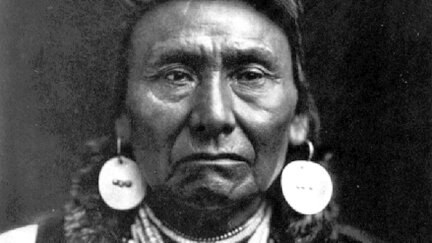
Chief
Joseph, leader of the Nez Percé, surrenders to General Oliver Howard,
bringing to an end his four-month-long circuitous retreat from the
Wallowa Valley in eastern Oregon toward Sitting Bull’s encampment
in Canada -- one of the most remarkable military feats of the Indian
Wars. Eluding or defeating army troops at every turn, Joseph and
a band of fewer than 200 warriors bring nearly 500 women and children
over 1,500 miles of mountainous terrain to within forty miles of
the border before they are finally stopped by a force of 500 troopers
led by Colonel Nelson A. Miles. Reduced by this time to just 87
men, Joseph still holds out for five days in a pitiless snowstorm,
and then surrenders only because his people have no food or blankets
and will soon die of cold and starvation. "I am tired of fighting,"
he declares as he holds out his rifle to General Howard. "I
want to have time to look for my children, and see how many of them
I can find. Maybe I shall find them among the dead. Hear me, my
chiefs! I am tired. My heart is sick and sad. From where the sun
now stands I will fight no more forever."
|
 |
| 1877 |
John Wesley Hardin, a Texas gunfighter
who claims to have killed more than 40 men, is sentenced to 25 years
in the Texas State Prison for the murder of a deputy sheriff. "I
take no sass but sasparilla," he once said, explaining his deadly
disposition. |
 |
| 1877 |
Congress passes the Desert Land
Act, which permits settlers to purchase up to 640 acres of public
land at 25˘ per acre in areas where the arid climate requires large-scale
farming, provided they irrigate the land. |
 |
| 1877 |
The last Federal troops withdraw
from the South, bringing the Reconstruction era to an end. |
 |
| 1878 |
With
racial discrimination on the rise in the post-Reconstruction South,
an estimated 40,000 African Americans begin to migrate from the former
slave states into Kansas. Many of these so-called Exodusters answer
the call of Benjamin “Pap” Singleton, a land speculator with a vision
of establishing independent black communities across the state. |
 |
| 1879 |
The Supreme Court upholds the constitutionality
of anti-polygamy laws, denying Mormon arguments that plural marriage
is protected under the First Amendent guarantee of religious freedom
and giving federal authorities the weapon they have hoped for in their
efforts to break the alliance between church and state in Utah. |
 |
| 1879 |
At the urging of John Wesley Powell
and others, Congress creates the United States Geological Survey to
coordinate the many independent survey projects it has funded since
army surveyors first charted potential routes for a transcontinental
railroad in the 1850s. Under Powell's direction beginning in 1881,
the USGS expands its focus beyond mineral resources and geological
formations to include study of the potential for irrigating the West's
arid lands and the selection of suitable sites for dams and reservoirs.
This pioneering work eventually bears fruit with passage of the Newlands
Reclamation Act in 1902. |
 |
| 1879 |
To complete its consolidation of federally-funded scientific exploration
in the West, Congress creates the United States Bureau of Ethnology
to coordinate study of the region's native peoples and complete
a record of their cultures before they vanish under the pressure
of expanding white settlement. Directed by John Wesley Powell, the
Bureau of Ethnology launches an ambitious program to document the
culture and society of Native Americans, sending one of its first
field teams to Zuni Pueblo, where ethnologist Frank Hamilton Cushing
anticipates the methods of 20th century anthropology by becoming
a member of the Zuni community.
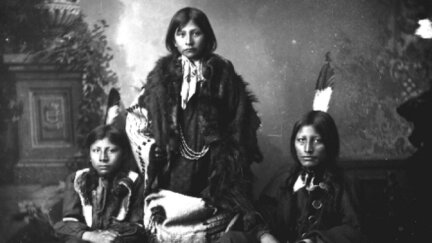
The
first students, a group of 84 Lakota children, arrive at the newly
established United States Indian Training and Industrial School
at Carlisle, Pennsylvania, a boarding school founded by former Indian-fighter
Captain Richard Henry Pratt to remove young Indians from their native
culture and refashion them as members of mainstream American society.
Over the next two decades, twenty-four more schools on the Carlisle
model will be established outside the reservations, along with 81
boarding schools and nearly 150 day schools on the Indians’ own
land.
|