
|
|

The Life and Adventures
of Buffalo Bill
CHAPTER I.
INCIDENTS OF MY CHILDHOOD.
I have written about other scouts and pioneers; such renowned men
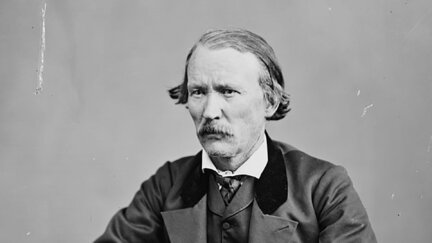
as Daniel Boone, Davy Crockett and Kit Carson, but they were dead
before I wrote of them. Otherwise, perhaps, I would not have had the
hardihood to do it, because I had great respeet for them in a general
way and their capacity for "getting even."
I wrote of these men because the atmosphere and environment in
which they had lived were peculiarly pleasant to me. There was a
kinship, so to speak, in their love of the lives they led, with my
own early ambitions and the experiences that followed.
But when it comes to writing of myself I am staggered, yet to
stagger is not easy with me. Strange as it may seem, all things
considered, I am a modest man, and I can prove it. Reminiscent
writing demands one kind of egotism, but that does not signify
self-conceit. One cannot indulge in personal reminiscence without
frequent use of the personal pronoun, hence to tell the story here
demanded of me the "ego" must occur often, otherwise the story could
not be told autobiographically.
One strong and almost mandatory reason to me, and self-excuse, for
doing this piece of work, that is anything but enticing, otherwise,
is to tell the real truth concerning my experiences rather than to
have go into history, as veracious, much of the romantic and dramatic
stuff that has been attributed to me by persons who have written of
"Buffalo Bill" and who depended upon hearsay, and more or less vivid
imagination, for their extravagant consumption of good ink and paper
used in the manner mentioned.
With all this in view, commanding as it does the leniency that it
seeks, the story is herewith given so far as I am able to give it
from memory.
I made my debut upon the stage of life February 26th, 1845. The
scene of this extremely important event, to me, was a little log
cabin situated in the backwoods of Scott County, Iowa, where
opportunities were few and society was in a state of embryo, as the
settling up of that State was just then beginning. My father, Isaac,
and mother, Mary Ann, were honest folks, but their possessions
comprehended scarcely anything more than good characters and eight
ehildren, of which latter I was fourth in rank. I was christened
William Frederick, which name I have never discarded, though more
than once in my life I would have found it convenient, and decidedly
to my comfort, to be known, for the time being at least, as some
other fellow.
If in early youth I was different from other boys it was because I
was without example and not from any inherent distinguishing
characteristics. Playmates I had none, save among my brothers, and of
these there were only two, one of whom was too young to appreciate my
ambitions and the other too old to indulge my fancies. Accordingly,
we were forced to the rather unsatisfactory compromise of each
brother playing by himself, a condition very harmful in the raising
of a large family.
My father did not make a successful farmer, and when I was five
years of age he abandoned the log cabin of my nativity and moved the
family to a little village fifteen miles north of Davenport, on the
Mississippi, named LeClair. A year before this removal he became so
seriously affected by the California fever that he resolved to
emigrate to that exciting climate of gold, flowers, oranges, sweet
odors and fighting whisky. A party was organized, an outfit provided
and a start made, but after proceeding some fifty miles on the way
they all thought it best to change their former determination before
increasing the distance from home, and carried this idea so far and
successfully that every one in the party returned to their respective
habitations.
At LeClair I was sent to a school where, by diligence and fairly
good conduct I managed to familiarize myself with the alphabet, but
further progress was arrested by a suddenly developed love for
skiff-riding on the Mississippi, which occupied so much of my time
thereafter that really I found no convenient opportunity for further
attendance at school, though neither my father nor mother had the
slightest idea of my new found, self-imposed, employment, much to my
satisfaction, let me add. When I was thrown in the society of other
boys I was not slow to follow their example, and I take to myself no
special credit for my conduct as a town-boy, for, like the majority,
I foraged among neighboring orchards and melon patches, rode horses
when I was able to catch them grazing on the commons, trapped
innocent birds, and sometimes tied the exposed clothes of my comrades
while they were in swimming and least suspicious of my designs or
acts. I would not like to admit any greater crimes, though anything
may be implied in the confession that I was quite as bad, though no
worse, than the ordinary every-day boy who goes barefoot, wears a
brimless hat, one suspender and a mischievous smile.
REMOVAL TO KANSAS
Shortly after my father's removal to LeClair he became a stage driver
on the line between Davenport and Chicago, but he had not followed
this occupation long when he was chosen a justice of the peace, and
soon after was elected to the Legislature, positions which reflected
honor rather than material profit. He was a very popular man and I
may with justice also add that he possessed considerable ability for
the meager opportunities he had received. But he was a natural
pioneer and his longing for new fields of adventure led him away from
the place where his popularity was rapidly extending, and to the
wilds of what was then the far West. Following the bent of his
inclination, in the spring of 1852 he disposed of a small farm he
owned at Walnut Grove, and packing his possessions in one carriage
and three wagons he started with his family for the territory of
Kansas. Father had a brother, Elijah, living at that time at Weston,
Platte County, Missouri, near the Kansas line, and as he was a
well-todo merchant of the place, father concluded to stop with him
awhile until he could decide upon a desirable location in the
territory. The overland trip was an uneventful one, save as it gave
me an opportunity for seeing a large stretch of uninhabited
wilderness, and the meeting of several rough characters on the route
of which we stood in no small dread, and afforded me my first sight
of a negro. When within twenty miles of Weston we asked permission to
stop at a farm-house owned by a widow lady, but owing to the feeling
of insecurity excited by frequent acts of pillage and outrage
committed by a bad class of emigrants, our request was refused until,
by chance, my father mentioned his brother&146;s name, when a
conversation was begun that resulted in a hospitable welcome from the
widow, whose name was Burnes, and who was well acquainted with my
uncle Elijah. We stopped at the farm-house a day and were regaled
with many good things, among which was wheat-bread, something
that I had not before eaten nor ever heard of, as corn-dodger had
always been the chief staff of our frugal lives.
On the following day father and mother drove over to Weston in the
carriage and in the evening returned with Elijah, who was very glad
to see us and who took us to his home in Weston where we remained for
some time. Father did not tarry long, but crossed over into Kansas,
on a prospecting tour, hoping to find a place in which to settle his
family. He visited the Kickapoo agency in Leavenworth County and soon
after established a trading post at Salt Creek Valley, within four
miles of the agency. Having thus entered into business, he settled
his family on a farm belonging to Elijah, three miles from Weston,
intending that we should remain here until the territory was opened
up for settlement.
BOYHOOD DAYS IN KANSAS.
At this time Kansas was occupied by numerous tribes of Indians who
were settled on reservations, and through the territory ran the great
highway to California and Salt Lake City. In addition to the
thousands of gold-seekers who were passing through Kansas by way of
Ft. Leavenworth, there were as many more Mormons on their hegira from
Illinois to found a new temple in which to propagate their doctrines.
This extensive travel made the business of trade on the route a most
profitable one. But with the caravans were those fractious elements
of adventurous pioneering, and here I first saw the typical
Westerner, with white sombrero, buckskin clothes, long hair,
moccasined feet and a belt full of murderous bowies and long pistols.
But instead of these outre peculiarities impressing me with feelings
of trepidation, they inspired me with an ambition to become a daring
plainsman. The rare and skillful feats of horsemanship which I daily
witnessed bred in me a desire to excel the most expert; and when, at
seven years of age my father gave me a pony, the full measure of my
happiness had ripened, like Jonah's gourd, in a night. Thenceforth my
occupation was horseback riding, in which pleasurable employment I
made myself useful in performing necessary journeys in father's
interest.
In anticipation of the early passage of what was known as the
"Enabling Act of Kansas Territory," which was then pending before
Congress, my father, in the fall of 1853, took his family from the
farm of his brother and settled them at the post in Kansas, where he
at once set about erecting suitable log buildings. In the succeeding
winter the act was passed which opened up the territory for
settlement, and father immediately pre-empted the claim on which he
was living.
During the summer of this year we lived in our little log house,
and father continued to trade with the Indians, who became very
friendly; hardly a day passed without a social visit from them. I
spent a great deal of time with the Indian boys, who taught me how to
shoot with the bow and arrow, at which I became quite expert. I also
took part in all their sports, and learned to talk the Kickapoo
language to some extent.
Father desired to express his friendship for these Indians, and
accordingly arranged a grand barbecue for them. He invited them all
to be present on a certain day, which they were; he then presented
them with two fat beeves, to be killed and cooked in the various
Indian styles. Mother made several large boilers full of coffee,
which she gave to them, together with sugar and bread. There were
about two hundred Indians in attendance at the feast, and they all
enjoyed and appreciated it. In the evening they had one of their
grand fantastic war dances, which greatly amused me, it being the
first sight of the kind I had ever witnessed.
My Uncle Elijah and quite a large number of gentlemen and ladies
came over from Weston to attend the entertainment. The Indians
returned to their homes well satisfied.
My uncle at that time owned a trading post at Silver Lake, in the
Pottawattamie country, on the Kansas river, and he arranged an
excursion to that place. Among the party were several ladies from
Weston, and father, mother and myself. Mr. McMeekan, my uncle's
superintendent, who had come to Weston for supplies, conducted the
party to the post.
The trip across the prairies was a delightful one and we remained
at the post several days. Father and one or two of the men went on to
Fort Riley to view the country, and upon their return my uncle
entertained the Pottawattamie Indians with a barbecue similar to the
one given by father to the Kickapoos.
During the latter part of the summer father filled a hay contract
at Fort Leavenworth. I passed much of my time among the campers, and
spent days and days in riding over the country with Mr. William
Russell, who was engaged in the freighting business and who seemed to
take a considerable interest in me. In this way I became acquainted
with many wagon-masters, hunters and teamsters, and learned a great
deal about the business of handling cattle and mules.
It was an excellent School for me, and I acquired a great deal of
practical knowledge, which afterwards I found to be of invaluable
service, for it was not long before I became employed by Majors &
Russell, remaining with them in different capacities for several
years.
The winter of 1853-54 was spent by father at our little prairie
home in cutting house logs and fence rails, which he intended to use
on his farm, as soon as the bill for the opening of the territory
should pass. This bill, which was called the "Enablingact of Kansas
territory," was passed in April, 1854, and as before stated father
immediately pre-empted the claim on which we were living.
The summer of that year was an exciting period in the history of
the new territory. Thousands and thousands of people, seeking new
homes, flocked thither, a large number of the emigrants coming over
from adjoining States. The Missourians, some of them, would come
laden with bottles of whisky, and after drinking the liquor would
drive the bottles into the ground to mark their land claims, not
waiting to put up any buildings.
WARFARE ON THE BORDER.
Every reader of American history is familiar with the disorders which
followed close upon the heels of the "Enabling Act." Pending its
passage the western boundary of Missouri was ablaze with the camp
fires of intending settlers. Thousands of families were sheltered
under the canvas of their ox wagons, impatiently awaiting the signal
from the Nation announcing the opening of the territorial doors to
the brawny immigrants, and when the news was heralded the waiting
host poured over the boundary line and fairly deluged the new public
domain.
In this rapid settlement of the territory a most perplexing
question arose, which was contested with such virulence that a
warfare was inaugurated which became a stain upon the nation's
escutcheons and was not abated until the Missouri and Kansas borders
became drunk with blood. Nearly all those who came from Missouri were
intent upon extending slavery into the territory, whilst those who
emigrated from Illinois, Iowa and Indiana and sought homes in the new
domain were equally determined that the cursed hydra-head of slavery
should never be reared in their midst. Over this question the border
warfare began, and its fierceness can only find comparison in the
inquisitorial persecutions of the fifteenth century. Men were shot
down in their homes, around their firesides, in the furrows behind
the plow,- everywhere. Widows and orphans multiplied, the arm of
industry was palsied, while the incendiary torch lit up the prairie
heavens, feeding on blighted homes and trailing along in the path of
granaries and store-houses. Mobs of murder-loving men, drunk with
fury, and with hearts set on desolation, day and night descended upon
unguarded households, and tearing away husbands and brothers from the
loving arms of wives and sisters, left their bodies dangling from the
shade trees of their unhappy homes, or shot them down where their
blood might sear the eyes of helpless, agonized relatives. Anguish
sat on every threshold, pity had no abiding-place, and for four years
the besom of destruction, with all its pestilential influences,
blighted the prairies and rendered every heart on the border sad and
despondent.
THE STABBING OF MY FATHER
In this war of vengeance the Cody family did not escape a full
measure of affliction. Near the Salt Creek trading post was another
store, kept by a Missourian named Rively, around which a considerable
settlement had been made, which became the rendezvous of many
different elements, and particularly of pro-slavery men, who enjoyed
Rively's sympathies. In the summer of 1854, and within a few months
after the "Enabling Act" was passed, a very large meeting was held at
the popular rendezvous, and father being present was pressed to
address the crowd on the slavery question, he being regarded as
favorably disposed to making Kansas a slave territory, owing to the
fact that his brother, Elijah, was a Missourian.
After much urging he at length spoke substantially as follows:
"GENTLEMEN: You have called upon me for a speech, and I have
accepted your invitation rather against my will, as my views may not
accord with the sentiments of a majority of this assembly. My remarks
will therefore be brief and to the point. The question before us
to-day is, shall the territory of Kansas admit slavery, and
hereafter, upon her admission, shall she be a slave State? The
question of slavery is itself a broad one, which will not permit of
discussion at length in this place. I apprehend that your motive in
calling upon me is to have me express my sentiments in regard to the
introduction of slavery into Kansas. I shall gratify your wishes in
that respect. I was one of the pioneers of the State of Iowa, and
aided in its settlement when it was a territory, and helped to
organize it as a State.
"Gentlemen, I voted that it should be a white State-that negroes
whether free or slave, should never be allowed to locate within its
limits; and, gentlemen, I say to you now. and I say it boldly, that I
propose to exert all my power in making Kansas the same kind of a
State as Iowa. I believe in letting slavery remain as it now exists,
and I shall always oppose its further extension. These are my
sentiments, gentlemen, and let me tell you--"
He never finished this sentence, or his speech. His expressions
were anything but acceptable to the rough-looking crowd, whose ire
had been gradually rising to fever heat, and at this point they
hooted and hissed him, and shouted, " You black Abolitionist, shut
up!" "Get down from that box!" "Kill himl" "Shoot him!" and so on.
Father, however, maintained his position on the dry goods box,
notwithstanding the excitement and numerous invitations to step down,
until a hot-headedpro-slavery man, who was in the employ of my Uncle
Elijah, crowded up and said: "Get off that box, you black
Abolitionist, or I'll pull you off."
Father paid but little attention to him, and attempted to resume
his speech, intending doubtless to explain his position and endeavor
to somewhat pacify the angry crowd. But the fellow jumped up on the
box, and pulling out a huge bowie knife, stabbed father twice, who
reeled and fell to the ground. The man sprang after him, and would
have ended his life then and there, had not some of the better men in
the crowd interfered in time to prevent him from carrying out his
murderous intention.
The excitement was intense, and another assault would probably
have been made on my father, had not Rively hurriedly carried him to
his home. There was no doctor within any reasonable distance, and
father at once requested that he be conveyed in the carriage to his
brother Elijah's house in Weston. My mother and a driver accordingly
went there with him, where his wounds were dressed. He remained in
Preston several weeks before he was able to stir about again, but he
never fully recovered from the wounds, which eventually proved the
cause of his death.
My uncle of course at once discharged the ruffian from his employ.
The man afterwards became a noted desperado, and was quite
conspicuous in the Kansas war.
FATHER'S ESCAPE FROM AN ARMED MOB.
My father's indiscreet speech at Rively's brought upon our family all
of the misfortunes and difficulties which from that time on befell
us. As soon as he was able to attend to his business again, the
Missourians began to harass him in every possible way, and kept it up
with hardly a moments cessation. Kickapoo City, as it was called, a
small town that had sprung into existence seven miles up the river
from Fort Leavenworth, became the hot-bed of the pro-slavery doctrine
and the headquarters of its advocates. Here was really the beginning
of the Kansas troubles. My father, who had shed the first blood in
the cause of the freedom of Kansas, was notified, upon his return to
his trading post, to leave the territory, and he was threatened with
death by hanging or shooting, if he dared to remain.
One night a body of armed men, mounted on horses, rode up to our
house and surrounded it. Knowing what they had come for, and seeing
that there would be but little chance for him in an encounter with
them, father determined to make his escape by a little stratagem.
Hastily disguising himself in mother's bonnet and shawl, he boldly
walked out of the house and proceeded towards the corn-field. The
darkness proved a great protection, as the horsemen, between whom he
passed, were unable to detect him in his disguise; supposing him to
be a woman, they neither halted him nor followed him, and he passed
safely on into the corn-field, where he concealed himself.
The horsemen soon dismounted and inquired for father; mother very
truthfully told them that he was away. They were not satisfied with
her statement, however, and they at once made a thorough search of
the house. They raved and swore when they could not find him, and
threatened him with death whenever they should catch him. I am sure
if they had captured him that night they would have killed him. They
carried off nearly everything of value in the house and about the
premises; then going to the pasture, they drove off all the horses;
my pony, Prince, afterward succeeded in breaking away from them and
came back home. Father lay secreted in the corn-field for three days,
as there were men in the vicinity who were watching for him all the
time; he finally made his escape, and reached Fort Leavenworth in
safety, whither the pro-slavery men did not dare to follow him.
While he was staying at Fort Leavenworth he heard that Jim Lane,
Captain Cleveland and Captain Chandler were on their way from Indiana
to Kansas with a body of Free State men, between two and three
hundred strong. They were to cross the Missouri River near Doniphan,
between Leavenworth and Nebraska City, their destination being
Lawrence. Father determined to join them, and took passage on a
steamboat which was going up the river. Having reached the place of
crossing, he made himself known to the leaders of the party, by whom
he was most cordially received.
The pro-slavery men, hearing of the approach of the Free State
party, resolved to drive them out of the territory. The two parties
met at Hickory Point, were a severe battle was fought, several being
killed; the victory resulted in favor of the Free State men, who
passed on to Lawrence without much further opposition. My father
finally left them, and seeing that he could no longer live at home,
went to Grasshopper Falls, thirty-five miles west of Leavenworth;
there he began the erection of a saw-mill.
While he was thus engaged we learned from one of our hired workmen
at home, that the pro-slavery men had laid another plan to kill him,
and were on their way to Grasshopper Falls to carry out their
intention. Mother at once started me off on Prince (my pony) to warn
father of the coming danger. When I had gone about seven miles I
suddenly came upon a party of men who were camped at the crossing of
Stranger Creek. As I passed along I heard one of them, who recognised
me, saying, "That's the son of the old Abolitionist we are after; "
and the next moment I was commanded to halt.
Instead of stopping I instantly started my pony on a run, and on
looking back I saw that I was being pursued by three or four of the
party, who had mounted their horses, no doubt supposing that they
could easily capture me. It was very fortunate that I had heard the
remark about my being "the son of the Abolitionist." for then I knew
in an instant that they were en route to Grasshopper Falls to murder
my father. I at once saw the importance of my escaping and warning
father in time. It was a matter of life or death to him. So I urged
Prince to his utmost speed, feeling that upon him and myself depended
a human life-a life that was dearer to me than that of any other man
in the world. I led my pursuers a lively chase for four or five
miles; finally, when they saw they could not catch me, they returned
to their camp. I kept straight on to Grasshopper Falls, arriving
there in ample time to inform father of the approach of his old
enemies. That same night he and I rode to Lawrence, which had become
the headquarters of the Free State men. There he met Jim Lane and
several other leading characters, who were then organising what was
known as the Lecompton Legislature. Father was elected a member of
that body, and took an active part in organising the first
Legislature of Kansas, under Governor Reeder, who, by the way, was a
Free State man and a great friend of father's.
About this time agents were being sent to the East to induce
emigrants to locate in Kansas, and father was sent as one of these
agents to Ohio. After the Legislature had been organised at Lawrence,
he departed for Ohio and was absent several months A few days after
he had gone, I started for home by the way of Fort Leavenworth,
accompanied by two men, who were going to the fort on business. As we
were crossing a stream called Little Stranger, we were fired upon by
some unknown party; one of my companions, whose name has escaped my
memory, was killed. The other man and myself put spurs to our horses
and made a dash for our lives. We succeeded in making our escape,
though a farewell shot or two was sent after us. At Fort Leavenworth
I parted company with my companion, and reached home without any
further adventure.
My mother and sisters, who had not heard of my father or myself
since I had been sent to warn him of his danger, had become very
anxious and uneasy about us, and were uncertain as to whether we were
dead or alive. I received a warm welcome home, and as I entered the
house, mother seemed to read from the expression of my countenance
that father was safe; of course the very first question she asked was
as to his whereabouts, and in reply I handed her a long letter from
him which explained everything. Mother blessed me again and again for
having saved his life.
While father was absent in Ohio, we were almost daily visited by
some of the pro-slavery men, who helped themselves to anything they
saw fit, and frequently compelled my mother and sisters to cook for
them, and to otherwise submit to a great deal of bad treatment.
Hardly a day passed without some of them inquiring "where the old man
was," saying they would kill him on sight. Thus we passed the summer
of 1855, remaining at our home notwithstanding the unpleasant
surroundings, as mother had made up her mind not to be driven out of
the country. My uncle and other friends advised her to leave Kansas
and move to Missouri, because they did not consider our lives safe,
as we lived so near the headquarters of the pro-slavery men, who had
sworn vengeance upon father.
Nothing, however, could persuade mother to change her
determination. She said that the pro-slavery men had taken everything
except the little home, and she proposed to remain there as long as
she lived, happen what might. Our only friends in Salt Creek Valley
were two families; one named Lawrence, the other Hathaway, and the
peaceable Indians, who occasionally visited us. My uncle, living in
Missouri and being somewhat in fear of the pro-slavery men, could not
assist us much, beyond expressing his sympathy and sending us
provisions.
In the winter of 1854-55 father returned from Ohio, but as soon as
his old enemies learned that he was with us, they again compelled him
to leave. He proceeded to Lawrence, and there spent the winter in
attending the Lecompton Legislature. The remainder of the year he
passed mostly at Grasshopper Falls, where he completed his saw-mill.
He occasionally visited home under cover of the night, and in the
most secret manner; virtually carrying his life in his hand.
In the spring of this year (1855) a pro-slavery party came to our
house to search for father; not finding him, they departed, taking
with them my pony, Prince. I shall never forget the man who stole
that pony. He afterwards rose from the low level of a horse thief to
the high dignity of a justice of the peace, and I think still lives
at Kickapoo. The loss of my faithful pony nearly broke my heart and
bankrupted me in business, as I had nothing to ride.
ENGAGEMENT WITH THE GREAT OVERLAND FREIGHTERS.
One day, soon afterwards, I met my old friend, Mr. Russell, to whom I
related all my troubles, and his generous heart was touched by my
story. "Billy, my boy," said he, "cheer up, and come to Leavenworth,
and I'll employ you. I'll give you twentyfive dollars a month to herd
cattle."
I accepted the offer, and heartily thanking him, hurried home to
obtain mother's consent. She refused to let me go, and all my
pleading was in vain. Young as I was-being then only in my tenth
year, my ideas and knowledge of the world, however, being far in
advance of my age-I determined to run away from home. Mr. Russell's
offer of twenty-five dollars a month was a temptation which I could
not resist. The remuneration for my services seemed very large to me,
and I accordingly stole away and walked to Leavenworth.
Mr. Badger, one of Mr. Russell's superintendents, immediately sent
me out, mounted on a little gray mule, to herd cattle. I worked at
this for two months, and then came into Leavenworth. I had not been
home during all this time, but mother had learned from Mr. Russell
where I was, and she no longer felt uneasy, as he had advised her to
let me remain in his employ. He assured her that I was all right, and
said that when the herd came in he would allow me to make a visit
home.
Upon my arrival in Leavenworth with the herd of cattle, Mr.
Russell instructed his book-keeper, Mr. Byers, to pay me my wages,
amounting to fifty dollars Byers gave me the sum all in half-dollar
pieces. I put the bright sliver coins into a sack, which I tied to my
mule, and started home, thinking myself a millionaire. This money I
gave to mother, who had already forgiven me for running away.
Thus began my service for the firm of Russell & Majors, after
wards Russell, Majors & Waddell, with whom I spent seven years of
my life in different capacities-such as cavallard-driver,
wagon-master, pony express rider and driver. I continued to work for
Mr. Russell during the rest of the summer of 1855, and in the winter
of 1855-56 I attended school.
Father, who still continued to secretly visit home, was anxious to
have his children receive as much education as possible, under the
adverse circumstances surrounding us, and he employed a teacher, Miss
Jennie Lyons, to come to our house and teach. My mother was well
educated-more so than my father-and it used to worry her a great deal
because her children could not receive better educational advantages.
However, the little school at home got along exceedingly well, and we
all made rapid advances in our studies, as Miss Lyons was an
excellent teacher. She afterwards married a gentleman named Hook, who
became the first mayor of Cheyenne, where she now lives.
A MOB OUTWITTED
The Kansas troubles reached their highest pitch in the spring of
1856, and our family continued to be harassed as much as ever by our
old enemies. I cannot now recollect one-half of the serious
difficulties that we had to encounter; but I very distinctly remember
one incident well worth relating. I came home one aight on a visit
from Leavenworth, being accompanied by a fellow-herder-a young man.
During the night we heard a noise outside of the house, and soon the
dogs began barking loudly. We looked out to ascertain the cause of
the disturbance, and saw that the house was surrounded by a party of
men. Mother had become accustomed to such occurrences, and on this
occasion she seemed to be master of the situation from the start.
Opening a window, she coolly sang out, in a firm tone of voice "Who
are you ? What do you want here?"
"We are after that old Abolition husband of yours," was the answer
from one of the crowd.
"He is not in the house and has not been here for a long time,"
said my mother.
"That's a lie! We know he is in the house and we are bound to have
him," said the spokesman of the party.
I afterwards learned they had mistaken the herder, who had ridden
home with me, for my father, for whom they had been watching.
"My husband is not at home," emphatically repeated my heroic
mother-for if there ever was a heroine she certainly was one-"but the
house is full of armed men," continued she, "and I'll give you just
two minutes to get out of the yard; if you are not out by the end of
that time I shall order them to fire on you."
She withdrew from the window for a few moments and hurriedly
instructed the herder to call aloud certain names-any that he might
think of-just as if the house were full of men to whom he was giving
orders. He followed her directions to the very letter. He could not
have done it any better had he rehearsed the act a dozen times.
The party outside heard him, as it was intended they should, and
they supposed that my mother really had quite a force at her command.
While this little by-play was being enacted, she stepped to the open
window again and said:-
"John Green, you and your friends had better go away or the men
will surely fire on you."
At this point the herder, myself and my sisters commenced stamping
on the fioor in imitation of a squad of soldiers, and the herder
issued his orders in a loud voice to his imaginary troops, who were
apparently approaching the window preparatory to firing a volley at
the enemy. This little stratagem proved eminently successful. The
cowardly villains began retreating, and then my mother fired an old
gun into the air which greatly accelerated their speed, causing them
to break and run. They soon disappeared from view in the darkness.
The next morning we accidentally discovered that they had intended
to blow up the house. Upon going into the cellar which had been left
open on one side, we found two kegs of powder together with a fuse
secreted there. It only required a lighted match to have sent us into
eternity. My mother's presence of mind, which had never yet deserted
her in any trying situation, had saved our lives.
ANOTHER ATTEMPT TO ASSASSINATE MY FATHER.
Shortly after this affair I came home again on a visit and found
father there sick with fever and confined to his bed. One day my old
enemy rode up to the house on my pony Prince, which he had stolen
from me.
" What is your business here to-day? " asked mother.
"I am looking for the old man," he replied. "I am going to search
the house, and if I find him I am going to kill him. Here, you
girls," said he, addressing my sisters, " get me some dinner, and get
it quick, too, for I am as hungry as a wolf."
"Very well; pray be seated, and we'll get you somethingto eat, "
said one of my sisters, without exhibiting the least sign of fear.
He sat down, and while they were preparing a dinner for him, he
took out a big knife and sharpened it on a whetstone, repeating his
threat of searching the house and killing my father.
I had witnessed the whole proceeding and heard the threats, and I
determined that the man should never go upstairs where father was
lying in bed unable to rise. Taking a double-barreled pistol, which I
had recently bought, I went to the head of the stairs, cocked the
weapon, and waited for the ruffian to come up, determined, that the
moment he set foot on the steps I would kill him. I was relieved,
however, from the stern necessity, as he did not make his appearance.
The brute was considerably intoxicated when he came to the house,
and the longer he sat still the more his brain became muddled with
liquor, and he actually forgot what he had come there for. After he
had eaten his dinner, he mounted his horse and rode off, and it was a
fortunate thing for him that he did.
Father soon recovered and returned to Grasshopper Falls while I
resumed my cattle herding.
The
Autobiography of Buffalo Bill Continued
Show
Autobiography Contents |