
|
|

THE LIFE AND ADVENTURES
OF BUFFALO BILL
CHAPTER III
ACCIDENTS AND ESCAPES
My restless, roaming spirit would not allow me to remain at home very
long, and in November, after the recovery of my mother, I went up the
Republican river and its tributaries on a trapping expedition in
company with Dave Harrington. Our outfit consisted of one wagon and a
yoke of oxen for the transportation of provisions, traps and other
necessaries. We began trapping near Junction City, Kansas, and then
proceeded up the Republican River to the mouth of Prairie Dog Creek,
where we found plenty of beavers.
Having seen no signs of Indians thus far, we felt comparatively
safe. We were catching a large number of beavers and were prospering
finely, when one of our oxen, having become rather poor, slipped and
fell upon the ice, dislocating his hip, so that we had to shoot him
to end his misery. This left us without a team; but we cared little
for that, however, as we had made up our minds to remain there till
spring, but it was decided that one of us should go to the nearest
settlement and get a yoke of oxen with which to haul our wagon into
some place of safety where we could leave it.
We would probably have pulled through the winter all right had it
not been for a very serious accident which befell me just at that
time. Spying a herd of elk, we started in pursuit of them, and
creeping up towards them as slyly as possible, while going around the
bend of a sharp bluff or bank of the creek I slipped and broke my leg
just above the ankle. Notwithstanding the great pain I was suffering,
Harrington could not help laughing when I urged him to shoot me, as
he had the ox, and thus end my misery. He told me to "brace up," and
that he would bring me out "all right." "I am not much of a surgeon,"
said he, "but I can fix that leg of yours, even if I haven't got a
diploma."
He succeeded in getting me back to camp, which was only a few
yards from the creek, and then he set the fracture as well as he knew
how and made me as comfortable as was possible under the
circumstances. We then discussed the situation, which, to say the
least, looked pretty blue. Knowing that, owing to our mishaps, we
could not do anything more that winter, and as l dreaded the idea of
lying there on my back with a broken leg for weeks, and perhaps
months, I prevailed upon Harrington to go to the nearest settlement
&emdash;about one hundred and twenty-five miles distant &emdash;to
obtain a yoke of cattle and then come back for me.
This he consented to do; but before leaving he gathered plenty of
wood, and as the ground was covered with snow, I would have no
difficulty in getting water if I had a fire. There was plenty of
fresh meat and other provisions in the "dug-out," so that I had no
fears of starvation. The "dug-out," which we had built immediately
after we had determined to remain there all winter, was a cosy hole
in the ground, covered with poles, grass and sod, with a fire-place
in one end.
Harrington thought it would take him twenty days or more to make
the round trip; but being well provided for &emdash;for this length
of time &emdash;I urged him to go at once. Bidding me goodbye, he
started on foot. After his departure, each day, as it came and went,
seemed to grow longer to me as I lay there helpless and alone. I made
a note of each day, so as to know the time when I might expect him
back.
A DESPERATE SITUATION.
On the twelfth day after Harrington had left me I was awakened from a
sound sleep by some one touching me upon the shoulder. I looked up
and was astonished to see an Indian warrior standing at my side. His
face was hideously daubed with paint which told me more forcibly than
words could have done that he was on the war-path. He spoke to me in
broken English and Sioux mixed, and I understood him to ask what I
was doing there, and how many there were with me.
By this time the little dug-out was nearly filled with other
Indians, who had been peeping in at the door, and I could hear voices
of still more outside as well as the stamping of horses. I began to
think that my time had come, as the saying is, when into the cabin
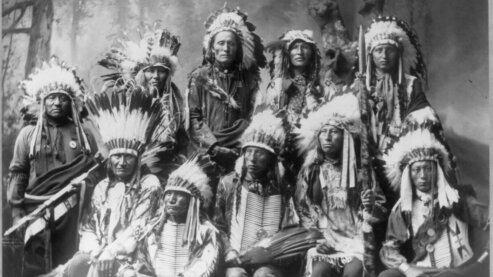
stepped an elderly Indian, whom I readily recognised as old
Rain-in-the-Face, a Sioux chief from the vicinity of Fort Laramie. I
rose up as well as I could and showed him my broken leg. I told him
where I had seen him, and asked him if he remembered me. He replied
that he knew me well, and that I used to come to his lodge at Fort
Laramie to visit him. I then managed to make him understand that I
was there alone and having broken my leg, I had sent my partner off
for a team to take me away. I asked him if his young men intended to
kill me, and he answered that was what they had proposed to do, but
he would see what they had to say.
The Indians then talked among themselves for a few minutes, and
upon the conclusion of the consultation, old Rain-in-the-Face turned
to me and gave me to understand that as I was yet a "papoose," or a
very young man, they would not take my life. But one of his men who
had no fire-arms wanted my gun and pistol. I implored old
Rain-in-the-Face to be allowed to keep the weapons, or at least one
of them, as I needed something with which to keep the wolves away. He
replied that as his young men were out on the war path, he had
induced them to spare my life; but he could not prevent them from
taking whatever else they wanted.
They unsaddled their horses as if to remain there for some time,
and sure enough they stayed the remainder of the day and all night.
They built a fire in the dug-out and cooked a lot of my provisions,
helping themselves to everything as if they owned it. However, they
were polite enough to give me some of the food after they had cooked
it. It was a sumptuous feast that they had, and they seemed to relish
it as if it were the best layout they had had for many a long day.
They took all my sugar and coffee, and left me only some meat and a
small quantity of flour, a little salt and some baking-powder. They
also robbed me of such cooking utensils as they wished; then bidding
me good-bye, early in the morning, they mounted their ponies and rode
off to the south, evidently bent on some murdering and thieving
expedition.
I was glad enough to see them leave, as my life had undoubtedly
hung by a thread during their presence. I am confident that had it
not been for my youth and the timely recognition and interference of
old Rain-in-the-Face they would have killed me without any hesitation
or ceremony.
The second day after the Indians left it began snowing, and for
three long and weary days the snow continued to fall thick and fast.
It blocked the door-way and covered the dug-out to the depth of
several feet, so that I became a snow-bound prisoner. My wood was
mostly under the snow, and it was with great difficulty that I could
get enough to start a fire with. My prospects were gloomy indeed. I
had just faced death at the hands of the Indians, and now I was in
danger of losing my life from starvation and cold. I knew that the
heavy snow would surely delay Harrington on his return; and I feared
that he might have perished in the storm, or that some other accident
might have befallen him. Perhaps some wandering band of Indians had
surprised and killed him.
I was continually thinking of all these possibilities, and I must
say that my outlook seemed desperate. At last the twentieth day
arrived &emdash;the day on which Harrington was to return &emdash;and
I counted the hours from morning till night but the day passed away
with no signs of Harrington. The wolves made the night hideous with
their howls; they gathered around the dug-out; ran over the roof; and
pawed and scratched as if trying to get in.
Several days and nights thus wore away, the monotony all the time
becoming greater, until at last it became almost unendurable. Some
days I would go without any fire at all, and eat raw frozen meat and
melt snow in my mouth for water. I became almost convinced that
Harrington had been caught in the storm and had been buried under the
snow, or was lost. Many a time during that dreary period of
uncertainty I made up my mind that if I ever got out of that place
alive I would abandon the plains and the life of a trapper forever. I
had nearly given up all hopes of leaving the dug-out alive.
A JOYOUS MEETING.
It was on the twenty-ninth day, while I was lying thus despondently
thinking and wondering, that I heard the cheerful sound of
Harrington's voice as he came slowly up the creek, yelling, "whoa!
haw!"to his cattle. A criminal on the scaffold, with the noose around
his neck, the trap about to be sprung, and receiving a pardon just at
the last moment, thus giving him a new lease of life, could not have
been more grateful than I was at that time. It was useless for me to
try to force the door open, as the snow had completely blockaded it,
and I therefore anxiously awaited Harrington's arrival.
"Hello! Billy!" he sang out in a loud voice as he came up, he
evidently being uncertain as to my being alive.
"All right, Dave," was my reply.
"Well, old boy, you're alive, are you?" said he.
"Yes; and that's about all. I've had a tough siege of it since
you've been away, and I came pretty nearly passing in my chips. I
began to think you never would get here, as I was afraid you had been
snowed under," said I.
He soon cleared away the snow from the entrance and opening the
door he came in. I don't think there ever was a more welcome visitor
than he was. I remember that I was so glad to see him that I put my
arms around his neck and hugged him for five minutes; never shall I
forget faithful Dave Harrington.
"Well, Billy, my boy, I hardly expected to see you alive again,"
said Harrington, as soon as I had given him an opportunity to draw
his breath; "I had a terrible trip of it,and I didn't think I ever
would get through. I was caught in the snowstorm, and was laid up for
three days. The cattle wandered away, and I came within an ace of
losing them altogether. When I got started again the snow was so deep
that it prevented me from making much headway. But as I had left you
here I was bound to come through, or die in the attempt."
Again I flung my arms around Dave's neck and gave him a hug that
would have done honor to a grizzly bear. My gratitude was thus much
more forcibly expressed than it could have been by words. Harrington
understood this, and seemed to appreciate it. The tears of joy rolled
down my cheeks, and it was impossible for me to restrain them. When
my life had been threatened by the Indians I had not felt half so
miserable as when I lay in the dug-out thinking I was destined to die
a slow death by starvation and cold. The Indians would have made
short work of it, and would have given me little or no time to think
of my fate.
I questioned Harrington as to his trip, and learned all the
details. He had passed through hardships which but few men could have
endured. Noble fellow, that he was. He had risked his own life to
save mine.
After he had finished his story, every word of which I had
listened to with eager interest, I related to him my own experiences,
in which he became no less interested. He expressed great
astonishment that the Indians had not killed me, and he considered it
one of the luckiest and most remarkable escapes he had ever heard of.
It amused me, however, to see him get very angry when I told him that
they had taken my gun and pistol and had used up our provisions. "But
never mind, Billy," said he, "we can stand it till the snow goes off,
which will not be long, and then we will pull our wagon back to the
settlements."
THE RETURN AND DEATH OF HARRtNGTON
A few days afterwards Harrington gathered up our traps, and cleaned
the snow out of the wagon. Covering it with the sheet which we had
used in the dug-out, he made a comfortable bed inside, and helped me
into it. We had been quite successful in trapping, having caught
three hundred beavers and one hundred otters, the skins of which
Harrington loaded on the wagon. We then pulled out for the
settlements, making good headway, as the snow had nearly disappeared,
having been blown or melted away, so that we had no difficulty in
finding a road. On the eighth day out we came to a farmer's house, or
ranch, on the Republican river, where we stopped and rested for two
days, and then went on to the ranch where Harrington had obtained the
yoke of cattle. We gave the owner of the team twenty-five beaver
skins, equal to $60, for the use of the cattle, and he let us have
them until we reached Junction City, sending his boy with us to bring
them back
At Junction City we sold our wagon and furs and went with a
government mule train to Leavenworth &emdash;arriving there in March,
1860. I was just able to get around on crutches when I got into
Leavenworth, and it was several months after that before I entirely
recovered the use of my leg.
During the winter I had often talked to Harrington about my mother
and sisters, and had invited him to go home with me in the spring. I
now renewed the invitation, which he accepted, and accompanied me
home. When I related to mother my adventures and told her how
Harrington had saved my life, she thanked him again and again. I
never saw a more grateful woman than she was. She asked him to always
make his home with us, as she never could reward him sufficiently for
what he had done for her darling boy, as she called me. Harrington
concluded to remain with us through the summer and farm mother's
land. But alas! the uncertainty of life. The coming of death when
least expected was strikingly illustrated in his case. During the
latter part of April he went to a nursery for some trees, and while
coming home late at night he caught a severe cold and was taken
seriously sick, with lung fever. Mother did everything in her power
for him. She could not have done more had he been her own son, but
notwithstanding her motherly care and attention, and the skill of a
physician from Leavenworth, he rapidly grew worse. It seemed hard,
indeed, to think that a great strong man like Harrington, who had
braved the storms and endured the other hardships of the plains all
winter long, should, during the warm and beautiful days of spring,
when surrounded by friends and the comforts of a good home, be
fatally stricken down. But such was his fate. He died one week from
the day on which he was taken sick. We all mourned his loss as we
would that of a loved son or brother, as he was one of the truest,
bravest, and best of friends. Amid sorrow and tears we laid him away
to rest in a picturesque spot on Pilot Knob. His death cast a gloom
over our household, and it was a long time before it was entirely
dispelled. I felt very lonely without Harrington, and I soon wished
for a change of scene again.
The
Autobiography of Buffalo Bill Continued
Show
Autobiography Contents
|