
|
|

THE LIFE AND ADVENTURES
OF BUFFALO BILL
CHAPTER X
ACTING AS SPECIAL SCOUT
Nearly all the scouts operating in Western Kansas, at the time of
which I write, made their principal headquarters at Fort Larned, and
were commanded by Dick Curtis, an old guide, frontiersman and Indian
interpreter. When I first visited the place in the line of duty there
were some three hundred lodges of Kiowas and Comanche Indians camped
near the fort. These Indians had not as yet gone upon the war-path,
but were restless and discontented, and their leading chiefs,
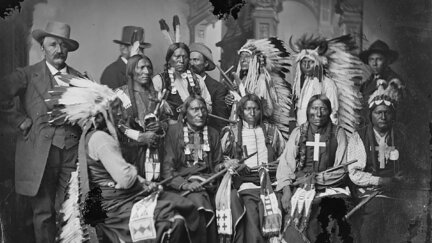
Satanta, Lone Wolf, Kicking Bird, Satank, Sittamore, and other noted
warriors, were rather saucy. The post at the time was garrisoned by
only two companies of infantry and one of cavalry.
General Hazen, who was at the post, was endeavoring to pacify the
Indians and keep them from going on the war-path. I was appointed as
his special scout, and one morning he notified me that he was going
to Fort Harker and wished me to accompany him as far Fort Zarah,
thirty miles distant. The General usually traveled in an ambulance,
but this trip he was to make in a six-mule wagon, under the escort of
a squad of twenty infantry-men.
So, early one morning in August, we started, arriving safely at
Fort Zarah at twelve o'clock. General Hazen thought it unnecessary
that we should go father, and he proceeded on his way to Fort Harker
without an escort, leaving instructions that we should return to Fort
Larned the next day.
After the General had gone I went to the sergeant in command of
the squad and told him that I was going back that very afternoon
instead of waiting until the next morning and I accordingly saddled
up my mule and set out for Fort Larned. I proceeded uninterruptedly
until I got about half-way between the two posts, when at Pawnee Rock
I was suddenly "jumped" by about forty Indians, who came dashing up
to me, extending their hands and saying, "How! How!" They were some
of the Indians who had been hanging around Fort Larned in the
morning. I saw they had on their war paint, and were evidently now
out on the war-path.
CAPTURED BY INDIANS
My first impulse was to shake hands with them, as they seemed so
desirous of it. I accordingly reached out my hand to one of them, who
grasped it with a tight grip, and jerked me violently forward;
another pulled my mule by the bridle, and in a moment I was
completely surrounded. Before I could do anything at all, they had
seized my revolvers from the holsters, and I received a blow on the
head from a tomahawk which nearly rendered me senseless. My gun,
which was lying across the saddle, was snatched from its place, and
finally the Indian who had hold of the bridle started off towards the
Arkansas river, leading the mule, which was being lashed by the other
Indians who were following. The savages were all singing, yelling and
whooping, as only Indians can do, when they are having their little
game all their own way. While looking towards the river I saw, on the
opposite side, an immense village moving down along the bank, and
then I became convinced that the Indians had left the post and were
now starting out on the war-path. My captors crossed the stream with
me, and as we waded through the shallow water they continued to lash
the mule and myself. Finally they brought me before an important
looking body of Indians, who proved to be chiefs and principal
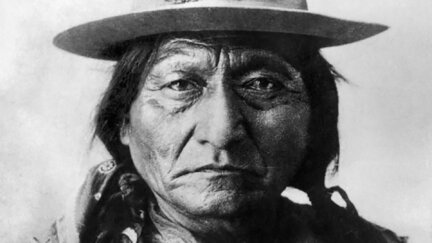
warriors. I soon recognized old Satanta among them, as well as others
whom I knew and I supposed it was all over with me.
The Indians were jabbering away so rapidly among themselves that I
could not understand what they were saying. Satanta at last asked me
where I had been; and as good luck would have it, a happy thought
struck me: I told him I had been after a herd of cattle or
"whoa-haws," as they called them. It so happened that the Indians had
been out of meat for several weeks, as the large herd of cattle which
had been promised them had not yet arrived, although expected by
them.
A CLEVER RUSE SECURES MY ESCAPE
The moment I mentioned that I had been searching for the "whoa-haws,"
old Santa began questioning me in a very eager manner. He asked me
where the cattle were, and I replied that they were back only a few
miles, and that I had been sent by General Hazen to inform him that
the cattle were coming, and that they were intended for his people.
This seemed to please the old rascal, who also wanted to know if
there were any soldiers with the herd, and my reply was that there
were. Thereupon the chiefs held a consultation, and presently Satanta
asked me if General Hazen had really said that they should have the
cattle. I replied an the affirmative, and added that I had been
directed to bring the cattle to them. I followed this up with a very
dignified inquiry, asking why his young men had treated me so. The
old wretch intimated that it was only "a freak of the boys;" that the
young men wanted to see if I was brave; in fact, they had only meant
to test my bravery, and that the whole thing was a joke.
The veteran liar was now beating me at my own game of lying; but I
was very glad of it, as it was in my favor. I did not let him suspect
that I doubted his veracity, but I remarked that it was a rough way
to treat friends. He immediately ordered his young men to give me
back my arms and scolded them for what they had done. Of course, the
sly old dog was now playing it very fine, as he was anxious to get
possession of the cattle, with which he believed "there was a heap of
soldiers coming." He had concluded it was not best to fight the
soldiers if he could get the cattle peaceably.
Another council was held by the chiefs and in a few minutes old
Satanta came and asked me if I would go over and bring the cattle
down to the opposite side of the river, so that they could get them.
I replied: "Of course; that's my instruction from General Hazen."
Satanta said I must not feel angry at his young men, for they had
only been acting in fun. He then inquired if I wished any of his men
to accompany me to the cattle herd. I replied that it would be better
for me to go alone, and then the soldiers could keep right on to Fort
Larned, while I could drive the herd down on the bottom. So, wheeling
my mule around, I was soon recrossing the river, leaving old Satanta
in the firm belief that I had told him a straight story and was going
for the cattle which only existed in my imagination.
I hardly knew what to do, but thought that if I could get the
river between the Indians and myself I would have a good
three-quarters of a mile the start of them, and could then make a run
for Fort Larned, as my mule was a good one.
STRETCHING MY MULE
Thus far my cattle story had panned out all right; but just as I
reached the opposite bank of the river I looked behind and saw that
ten or fifteen Indians who had begun to suspect something crooked
were following me. The moment that my mule secured a good foothold on
the bank I urged him into a gentle lope towards the place where,
according to my statement, the cattle were to be brought. Upon
reaching a little ridge and riding down the other side out of view, I
turned my mule and headed him westward for Fort Larned. I let him out
for all that he was worth, and when I came out on a little rise of
ground I looked back and saw the Indian village in plain sight. My
pursuers were now on the ridge which I had passed over and were
looking for me in every direction.
Presently they spied me, and seeing that I was running away they
struck out in swift pursuit, and in a few minutes it became painfully
evident that they were gaining on me. They kept up the chase as far
as Ash creek, six miles from Fort Larned. I still led them half a
mile, as their horses had not gained much during the last half of the
race. My mule seemed to have gotten his second wind, and as I was on
the old road I played the whip and spurs on him without much
cessation. The Indians likewise urged their steeds to the utmost.
Finally, upon reaching the dividing ridge between Ash creek and
Pawnee fork, I saw Fort Larned only four miles away. It was now
sundown and I heard the evening gun at the fort. The troops of the
little garrison little dreamed that there was a man flying for his
life from the Indians and trying to reach the post. The Indians were
once more gaining on me, and when I crossed the Pawnee folk, two
miles from the post, two or three of them were only a quarter of a
mile behind me. Just as I had gained the opposite bank of the stream
I was overjoyed to see some soldiers in a government wagon only a
short distance off. I yelled at the top of my voice and, riding up to
them, told them that the Indians were after me.
AMBUSHING THE PURSUERS
Denver Jim, a well known scout, asked how many there were, and upon
my informing him that there were about a dozen, he said "Let's drive
the wagon into the trees, and we'll lay for 'em." The team was
hurriedly driven in among the trees and low box elder bushes, and
there secreted.
We did not have to wait long for the Indians, who came dashing up,
lashing their horses, which were panting and blowing. We let two of
them pass by,but we opened a lively fire on the next three or four,
killing two at the first crack. The others following, discovered that
they had run into an ambush, and whirling off into the brush they
turned and ran back in the direction whence they had come. The two
who had passed heard the firing and made their escape. We scalped the
two that we had killed, and appropriated their arms and equipments;
and then catching their horses, we made our way into the post. The
soldiers had heard us firing, and as we were approaching the fort the
drums were being beaten, and the buglers were sounding the call to
fall in. The officers thought that Satanta and his Indians were
coming in to capture the fort.
It seems that on the morning of that day, two hours after General
Hazen had taken his departure, old Satanta drove into the post in an
ambulance, which he had received some months before as a present from
the government. He appeared to be angry and bent on mischief. In an
interview with Captain Parker, the commanding officer, he asked why
General Hazen had left the post without supplying the beef cattle
which he had promised him. The Captain told him that the cattle were
surely on the road, but he could not explain why they were detained.
The interview proved to be a stormy one, and Satanta made numerous
threats, saying that if he wished, he could capture the whole post
with his warriors. Captain Parker, who was a brave man, gave Satanta
to understand that he was reckoning beyond his powers, and would find
it a more difficult undertaking than he had any idea of, as they were
prepared for him at any moment. The interview finally terminated, and
Satanta angrily left the officer's presence. Going over to the
sutler's store, he sold his ambulance to Mr. Tappan the post-trader,
and with a portion of the proceeds he secretly managed to secure some
whisky from some bad men around the fort. There are always to be
found about every frontier post some men who will sell whisky to the
Indians at any time and under any circumstances, notwithstanding it
is a flagrant violation of both civil and military regulations.
Satanta mounted his horse, and taking the whisky with him he rode
rapidly away and proceeded straight to his village. He had not been
gone over an hour, when he returned to the vicinity of the post
accompanied by his warriors who came in from every direction, to the
number of seven or eight hundred. It was evident that the irate old
rascal was "on his ear," so to speak, and it looked as if he intended
to carry out his threat of capturing the fort. The garrison at once
turned out and prepared to recelve the red-skins, who, when within
half a mile, circled around the fort and fired numerous shots into
it, instead of trying to take it by assault.
GOING ON THE WARPATH.
While this circular movement was going on, it was observed that the
Indian village in the distance was packing up, preparatory to
leaving, and it was soon under way. The mounted warriors remained
behind some little time, to give their families an opportunity to get
away, as they feared that the troops might possibly in some manner
intercept them. Finally, they encircled the post several times, fired
some farewell rounds, and then galloped away over the prairie to
overtake their fast departing village. On their way thither, they
surprised and killed a party of wood choppers down on the Pawnee
fork, as well as some herders who were guarding beef cattle; some
seven or eight men in all were killed, and it was evident that the
Indians meant business.
The soldiers with the wagon &emdash;whom I had met at the crossing
of the Pawnee fork &emdash;had been out for the bodies of the men.
Under the circumstances it was no wonder that the garrison, upon
hearing the reports of our guns when we fired upon the party whom we
ambushed, should have thought the Indians were coming back to give
them another "turn."
We found that all was excitement at the post; double guards had
been put on duty, and Captain Parker had all the scouts at his
headquarters. He was endeavoring to get some one to take some
important dispatches to General Sheridan at Fort Hays. I reported to
him at once, and stated where I met the Indians and how I had escaped
from them.
"You were very fortunate, Cody, in thinking of that cattle story;
but for that little game your hair would now be an ornament to a
Kiowa's lodge," said he.
Just then Dick Curtis spoke up and said: "Cody, the Captain is
anxious to send some dispatches to General Sheridan, at Fort Hays,
and none of the scouts here seem to be very willing to undertake the
trip. They say they are not well enough acquainted with the country
to find the way at night."
A TERRIBLE DUTY.
As a storm was coming up it was quite dark, and the scouts, feared
that they would lose the way; besides, it was a dangerous ride, as a
large party of Indians were known to be camped on Walnut creek, on
the direct road to Fort Hays. It was evident that Curtis was trying
to induce me to volunteer, so I made some evasive answer to him for I
did not care to volunteer after my long day's ride. But Curtis did
not let the matter drop. Said he:&emdash;
"I wish, Bill, that you were not so tired by your chase of today,
for you know the country better than the rest of the boys, and I am
certain that you could go through."
"As far as the ride to Fort Hays is concerned, that alone would
matter but little to me," I said, "but it is a risky piece of work
just now, as the country is full of hostile Indians; still, if no
other scout is willing to volunteer, I will chance it. I'll go,
provided I am furnished with a good horse. l am tired of being chased
on a government mule by Indians." At this Captain Nolan, who had been
listening to our conversation, said:&emdash;
"Bill, you may have the best horse in my company. You can take
your choice if you will carry these dispatches. Although it is
against regulations to dismount an enlisted man, I have no hesitancy
in such a case of urgent necessity as this is, in telling you that
you may have any horse you may wish."
"Captain, your first sergeant has a splendid horse, and that's the
one I want. If he'll let me ride that horse, I'll be ready to start
in one hour, storm or no storm," said I.
"Good enough, Bill; you shall have the horse; but are you sure you
can find your way on such a dark night as this?"
"I have hunted on nearly every acre of ground between here and
Fort Hays, and I can almost keep my route by the bones of the dead
buffaloes," I confidently replied.
"Never fear, Captain, about Cody not finding the way; he is as
good in the dark as he is in the daylight," said Curtis.
OFF IN THE DARK
An orderly was sent for the horse, and the animal was soon brought
up, although the sergeant "kicked" a little against letting him go.
After eating a lunch and filling a canteen with brandy, I went to
headquarters and put my own saddle and bridle on the horse I was to
ride. I then got the dispatches, and by ten o'clock was on the road
to Fort Hays, which was sixty-five miles distant across the country.
It was dark as pitch, but this I rather liked, as there was little
probability of any of the red-skins seeing me unless I stumbled upon
them accidentally. My greatest danger was that my horse might run
into a hole and fall down, and in this way get away from me. To avoid
any such accident, I tied one end of my raw-hide lariat to the bridle
and the other end to my belt. I didn't propose to be left on foot
alone out on the prairie.
It was, indeed, a wise precaution that I had taken, for within the
next three miles the horse, sure enough, stepped into a prairie dog's
hole, and down he went, throwing me clear over his head. Springing to
his feet, before I could catch hold of the bridle, he galloped away
into the darkness; but when he reached the full length of the lariat,
he found that he was not so loose as he believed. I brought him up
standing, and after finding my gun, which had dropped to the ground,
I went up to him and in a moment was in the saddle again, and went on
my way rejoicing, keeping straight on my course until I came to the
ravines leading into Walnut creek, twenty-five miles from Fort
Larned, where the country became rougher, requiring me to travel
slower and more carefully, as I feared the horse might fall over the
bank, it being difficult to see anything five feet ahead. As a good
horse is not very apt to jump over a bank, if left to guide himself,
I let mine pick his own way. I was now proceeding as quietly as
possible, for I was in the vicinity of a band of Indians who had
recently camped in that locality. I thought that I had passed
somewhat above the spot, having made a little circuit to the west
with that intention, but as bad luck would have it this time, when I
came up near the creek I suddenly rode in among a herd of horses. The
animals became frightened and ran off in every direction.
STUMBLlNG ONTO A HORNETS' NEST
I knew at once that I was among Indian horses, and had walked
into the wrong pew; so without waiting to apologize, I backed out as
quickly as possible. At this moment a dog, not fifty yards away, set
up a howl, and then I heard some Indians engaged in conversation;
&emdash;they were guarding the horses, and had been sleeping. Hearing
my horse's retreating footsteps towards the hills, and thus becoming
aware that there had been an enemy in their camp, they mounted their
steeds and started for me.
I urged my horse to his full speed, taking the chances of his
falling into holes, and guided him up the creek bottom. The Indians
followed me as fast as they could by the noise I made, but I soon
distanced them, and then crossed the creek.
When I had traveled several miles in a straight course, as I
supposed, I took out my compass and by the light of a match saw that
I was bearing two points to the east of north. At once changing my
course to the direct route, I pushed rapidly on through the darkness
towards Smoky Hill river. At about three o'clock in the morning I
began traveling more cautiously, as I was afraid of running into
another band of Indians. Occasionally I scared up a herd of
buffaloes, or antelopes, or coyotes, or deer, which would frighten my
horse for a moment, but with the exception of these slight alarms I
got along all right.
After crossing Smoky Hill river, I felt comparatively safe as this
was the last stream I had to pass. Riding on to the northward I
struck the old Santa Fe trail, ten miles from Fort Hays, just at
break of day.
My horse did not seem much fatigued, and being anxious to make
good time and get as near the post as possible before it was fairly
daylight, as there might be bands of Indians camped along Big creek,
I urged him forward as fast as he could go. As I had not "lost" any
Indians, I was not now anxious to make their acquaintance, and
shortly after reveille rode into the post. I proceeded directly to
General Sheridan's headquarters, and was met at the door by Colonel
Moore, aid-de-camp on General Sheridan's staff, who asked me on what
business I had come.
"I have dispatches for General Sheridan, and my instructions from
Captain Parker, commanding Fort Larned, are that they shall be
delivered to the General as soon as possible," said I.
Colonel Moore invited me into one of the offices, and said he
would hand the dispatches to the General as soon as he got up.
"I prefer to give these dispatches to General Sheridan myself, and
at once," was my reply.
The General, who was sleeping in the same building, hearing our
voices, called out, "Send the man in with the dispatches." I was
ushered into the General's presence, and as we had met before he
recognised me and said: "Hello, Cody, is that you?"
"Yes, sir; I have some dispatches here for you, from Captain
Parker," said I, as I handed the package over to him.
He hurriedly read them, and said they were important; and then he
asked me all about General Hazen and where he had gone, and about the
breaking out of the Kiowas and Comanches. I gave him all the
information that I possessed, and related the events and adventures
of the previous day and night.
AN INTERVIEW WITH SHERIDAN
"Bill," said he, "you must have had a pretty lively ride. You
certainly had a close call when you ran into the Indians on Walnut
creek. That was a good joke that you played on old Satanta. I suppose
you're pretty tired after your long journey ?"
"I am rather weary, General, that's a fact, as I have been in the
saddle since yesterday morning;" was my reply, "but my horse is more
tired than I am, and needs attention fully as much if not more," I
added. Thereupon the General called an orderly and gave õnstructions
to have my animal well taken care of, and then he said, "Cody, come
in and have some breakfast with me."
"No, thank you, General," said I, "Hays City is only a mile from
here, and I prefer riding over there, as I know about every one in
the town, and want to see some of my friends."
"Very well; do as you please, and come to the post afterwards as I
want to see you," said he.
Bidding him good-morning, and telling him that I would return in a
few hours. I rode over to Hays City, and at the Perry House I met
many of my old friends who were of course all glad to see me. I took
some refreshments and a two hours' nap, and afterward returned to
Fort Hays, as I was requested.
As I rodeup to the headquarters I noticed several scouts in a
little group, evidently engaged in conversation on some important
matter. Upon inquiry I learned that General Sheridan had informed
them that he was desirous of sending a dispatch to Fort Dodge, a
distance of ninety-five miles.
The Indians had recently killed two or three men while they were
carrying dispatches between Fort Hays and Fort Dodge, and on this
account none of the scouts seemed at all anxious to volunteer,
although a reward of several hundred dollars was offered to any one
who would carry the dispatches. They had learned of my experiences of
the previous day, and asked me if I did not think it would be a
dangerous trip. I gave it as my opinion that a man might possibly go
through without seeing an Indian, but that the chances were ten to
one that he would have an exceedingly lively run and a hard time
before he reached his destination, if he ever got there at all.
A LONG RIDE.
Leaving the scouts to decide among themselves as to who was to go, I
reported to General Sheridan, who also informed me that he wished
some one to carry dispatches to Fort Dodge. While we were talking,
his chief of scouts, Dick Parr, entered and stated that none of the
scouts had yet volunteered. Upon hearing this I got my "brave" up a
little, and said: "General, if there is no one ready to volunteer,
I'll carry your dispatches myself."
"I had not thought of asking you to do this duty, Cody, as you are
already pretty hard worked. But it is really important that these
dispatches should go through," said the General.
"Well, if you don't get a courier by four o'clock this afternoon,
I'll be ready for business at that time. All I want is a fresh
horse," said I; "meantime I'll take a little more rest."
It was not much of a rest, however, that I got, for I went over to
Hays City again and had "a time with the boys." I came back to the
post at the appointed hour, and finding that no one had volunteered,
I reported to General Sheridan. He had selected an excellent horse
for me, and on handing me the dispatches, he said: "You can start as
soon as you wish&emdash;the sooner the better; and good luck go with
you, my boy."
In about an hour afterwards I was on the road, and just before
dark I crossed Smoky Hill river. I had not yet urged my horse much,
as I was saving his strength for the latter end of the route, and for
any run that I might have to make in case the "wild-boys" should
"jump" me. So far I had not seen a sign of Indians, and as evening
came on I felt comparatively safe.
I had no adventures worth relating during the night, and just
before daylight I found myself approaching Saw-log crossing, on the
Pawnee fork, having then ridden about seventy miles. A company of
colored cavalry, commanded by Major Cox, was stationed at this point,
and I approached their camp cautiously, for fear that the pickets
might fire upon me &emdash;as the darkey soldiers were liable to
shoot first and cry "halt" afterwards. When within hearing distance I
yelled out at the top of my voice, and was answered by one of the
pickets. I told him not to shoot, as I was a scout from Fort Hays;
and then, calling the sergeant of the guard, I went up to the vidette
of the post, who readily recognized me. I entered the camp and
proceeded to the tent of Major Cox, to whom I handed a letter from
General Sheridan requesting him to give me a fresh horse. He at once
complied with the request. After I had slept an hour and had eaten a
lunch, I again jumped into the saddle, and before sunrise I was once
more on the road. It was twenty-five miles to Fort Dodge, and I
arrived there between nine and ten o'clock, without having seen a
single Indian.
After delivering the dispatches to the commanding officer, I met
Johnny Austin, chief of scouts at this post, who was an old friend of
mine. Upon his invitation I took a nap at his house, and when I
awoke, fresh for business once more, he informed me that the Indians
had been all around the post for the past two or three days, running
off cattle and horses, and occasionally killing a stray man. It was a
wonder to him that I had met with none of the red-skins on the way
there. The Indians, he said, were also very thick on the Arkansas
river, between Fort Dodge and Fort Larned, and making considerable
trouble. Fort Dodge was located sixty-five miles west of Fort Larned,
the latter post being on the Pawnee fork, about five miles from its
junction with the Arkansas river.
A DANGEROUS UNDERTAKING.
The commanding officer at Fort Dodge was anxious to send some
dispatches to Fort Larned, but the scouts, like those at Fort Hays,
were rather backward about volunteering, as it was considered a very
dangerous undertaking to make the trip. As Fort Larned was my post,
and as I wanted to go there anyhow, I said to Austin that I would
carry the dispatches, and if any of the boys wished to go along, I
would like to have them for company's sake. Austin reported my offer
to the commanding officer, who sent for me and said he would be happy
to have me take his dispatches, if I could stand the trip on top of
all that I had already done. "All I want is a good fresh horse, sir,"
said I.
"I am sorry to say that we haven't a decent horse here, but we
have a reliable and honest government mule, if that will do you,"
said the officer. "Trot out your mule," said I, "that's good enough
for me. I am ready at any time, sir."
The mule was forthcoming, and at dark I pulled out for Fort
Larned, and proceeded uninterruptedly to Coon creek, thirty miles out
from Dodge. I had left the main wagon road some distance to the
south, and had traveled parallel with it, thinking this to be a safer
course, as the Indians might be lying in wait on the main road for
dispatch bearers and scouts.
At Coon creek I dismounted and led the mule by the bridle down to
the water, where I took a drink, using my hat for a dipper. While I
was engaged in getting the water, the mule jerked loose and struck
out down the creek. I followed him in hopes that he would catch his
foot in the bridle-rein and stop, but this he seemed to have no idea
of doing. He was making straight for the wagon road, and I did not
know what minute he might run into a band of Indians. He finally got
on the road, but instead of going back toward Fort Dodge, as I
naturally expected he would do, he turned eastward toward Fort
Larned, and kept up a little jog trot just ahead of me, but would not
let me come up to him, although I tried it again and again. I had my
gun in my hand, and several times I was strongly tempted to shoot
him, and would probably have done so had it not been for fear of
bringing Indians down upon me, and besides he was carrying the saddle
for me. So I trudged on after the obstinate "critter," and if there
ever was a government mule that deserved and received a good round
cursing it was that one. I had neglected the precaution of tying one
end of my lariat to his bit and the other to my belt, as I had done a
few nights before, and I blamed myself for this gross piece of
negligence.
A PROVOKING MULE.
Mile after mile I kept on after that mule, and every once in a while
I indulged in strong language respecting the whole mule fraternity.
From Coon creek to Fort Larned it was thirty-five miles, and I
finally concluded that my prospects were good for "hoofing" the whole
distance. We &emdash;that is to say, the confounded mule and myself
&emdash;were making pretty good time. There was nothing to hold the
mule, and I was all the time trying to catch him &emdash;which urged
him on. I made every step count, for I wanted to reach Fort Larned
before daylight, in order to avoid if possible the Indians, to whom
it would have been "pie" to have caught me there on foot.
The mule stuck to the road and kept on for Larned, and I did the
same thing. Just as day was beginning to break, we &emdash;that is
the mule and myself &emdash;found ourselves on a hill looking down
into the valley of the Pawnee fork, in which Fort Larned was located,
only four miles away; and when the morning gun belched forth we were
within half a mile of the post.
"Now," said I, "Mr. Mule, it is my turn," and raising my gun to my
shoulder, in "dead earnest" this time, I blazed away, hitting the
animal in the hip. Throwing a second cartridge into the gun, I let
him have another shot, and I continued to pour the lead into him
until I had him completely laid out. Like the great majority of
government mules, he was a tough one to kill, and he clung to life
with all the tenaciousness of his obstinate nature. He was, without
doubt, the toughest and meanest mule I ever saw, and he died hard.
The troops, hearing the reports of the gun, came rushing out to
see what was the matter. They found that the mule had passed in his
chips, and when they learned the cause they all agreed that I had
served him just right. Taking the saddle and bridle from the dead
body, I proceeded into the post and delivered the dispatches to
Captain Parker. I then went over to Dick Curtis' house, which was
headquarters for the scouts and there put in several hours of solid
sleep.
During the day General Hazen returned from Fort Harker, and he
also had some important dispatches to send to General Sheridan. I was
feeling quite elated over my big ride; and seeing that I was getting
the best of the other scouts in regard to making a record, I
volunteered to carry General Hazen's dispatches to Fort Hays. The
General accepted my services, although he thought it was unnecessary
for me to kill myself. I told him that I had business at
Fort Hays, and wished to go there anyway, and it would make no
difference to the other scouts for none of them appeared willing to
undertake the trip.
Accordingly that night I left Fort Larned on an excellent horse,
and next morning at daylight found myself once more in General
Sheridan's headquarters at Fort Hays. The General was surprised to
see me, and
still more so when I told him of the time I had made in riding to
Fort Dodge, and that I had taken dispatches from Fort Dodge to Fort
Larned; and when, in addition to this, I mentioned my journey of the
night previous, General Sheridan thought my ride from post to post,
taken as a whole, was a remarkable one, and he said that he did not
know of its equal. I can safely say that I have never heard of its
being beaten in a country infested with hostile Indians.
To recapitulate: I had ridden from Fort Larned to Fort Zarah (a
distance of sixty-five miles) and back in twelve hours, including the
time when I was taken across the Arkansas by the Indians. In the
succeeding twelve hours I had gone from Fort Larned to Fort Hays, a
distance of sixty-five miles. In the next twenty-four hours I had
gone from Fort Hays to Fort Dodge, a distance of ninety-five miles.
The following night I had traveled from Fort Dodge thirty miles on
muleback and thirty-five miles on foot to Fort Larned; and the next
night sixty-five miles more to Fort Hays. Altogether I had ridden
(and walked) 355 miles in fifty-eight riding hours, or an average of
over six miles an hour. Of course, this may not be regarded as very
fast riding, but taking into consideration the fact that it was
mostly done in the night and over a wild country, with no roads to
follow, and that I had to be continually on the look-out for Indians
it was thought at the time to be a big ride, as well as a most
dangerous one.
The
Autobiography of Buffalo Bill Continued
Show
Autobiography Contents
|