
|
|

THE LIFE AND ADVENTURES
OF BUFFALO BILL
CHAPTER XII
A HARD WINTER'S CAMPAIGN
Very soon after our fight on Beaver creek Gen. Carr received orders
from Gen. Sheridan for a winter's campaign in the Canadian river
country, instructing him to proceed at once to Fort Lyon, Colorado,
and there to fit out for the expedition: Leaving Fort Wallace in
November, 1868, we arrived at Fort Lyon in the latter part of the
month without special incident, and at once began our preparations
for invading the enemy's country.
General Penrose had left this post three weeks previously with a
command of some three hundred men. He had taken no wagons with him
and his supply train was composed only of pack mules. General Carr
was ordered to follow with supplies on his trail and overtake him as
soon as possible. I was particularly anxious to catch up with
Penrose's command, as my old friend, Wild Bill, was among his scouts.
We followed the trail very easily for the first three days, and then
we were caught in Freeze-Out canyon by a fearful snow storm, which
compelled us to go into camp for a day. The ground now being covered
with snow, we found that it would be impossible to follow Penrose's
trail any further, especially as he had left no sign to indicate the
direction he was going. General Carr sent for me and said that as it
was very important that we should not lose the trail, he wished that
I would take some scouts with me, and while the command remained in
camp, push on as far as possible and see if I could not discover come
traces of Penrose or where he had camped at any time.
Accompanied by four men I started out in the blinding snow storm,
taking a southerly direction. We rode twenty-four miles, and upon
reaching a tributary of the Cimarron, we scouted up and down the
stream for a few miles and finally found one of Penrose's old camps.
It was now late in the afternoon, and as the command would come up
the next day, it was not necessary for all of us to return with the
information to General Carr. So riding down into a sheltered place in
a bend of the creek, we built a fire and broiled some venison from a
deer which we had shot during the day, and after eating a substantial
meal I left the four men there, while I returned to bring up the
troops.
It was eleven o'clock at night when I got back to the camp. A
light was still burning in the General's tent, he having remained
awake, anxiously awaiting my return. He was glad to see me, and was
overjoyed at the information I brought, for he he had great fears
concerning the safety of General Penrose. He roused up his cook and
ordered him to get me a good hot supper, all of which I greatly
appreciated. I passed the night in the General's tent, and next
morning rose refreshed and prepared for a big day's work.
A ROUGH MARCH
The command took up its march next day for the Cimarron, and had a
hard tramp of it on account of the snow having drifted to a great
depth in many of the ravines, and in some places the teamsters had to
shovel their way through. We arrived at the Cimarron at sundown, and
went into a nice warm camp. Upon looking around next morning, we
found that Penrose, having been unencumbered by wagons, had kept on
the west side of the Cimarron, and the country was so rough that it
was impossible for us to stay on his trail with our wagons; but
knowing that he would certainly follow down the river, General Carr
concluded to take the best wagon route along the stream, which I
discovered to be on the east side. Before we could make any headway
with our wagon train we had to leave the river and get out on the
divide. We were very fortunate that day in finding a splendid road
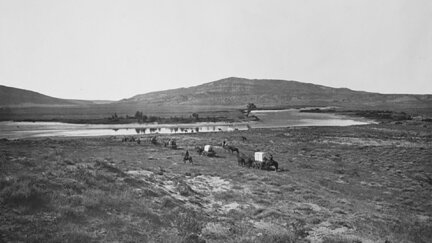
for some distance, until we were all at once brought up standing on a
high table-land, overlooking a beautiful winding creek that lay far
below us in the valley. The question that troubled us was how we were
to get the wagons down. We were now in the foot-hills of the Rattoon
mountains, and the bluff we were on was very steep.
"Cody, we're in a nice fix now," said General Carr.
"Oh, that's nothing," was my reply.
"But you can never take the train down," said he.
"Never you mind the train, General. You say you are looking for a
good camp. How does that beautiful spot down in the valley suit you?"
I asked him.
"That will do. I can easily descend with the cavalry, but how to
get the wagons down there is a puzzler to me," said he.
"By the time you've located your camp, your wagons shall be
there," said I.
"All right, Cody, I'll leave it to you, as you seem to want to be
boss," he replied pleasantly. He at once ordered the command to
dismount and lead the horses down the mountain-side. The wagon train
was a mile in the rear, and when it came up, one of the drivers
asked: "How are we going down there?"
"Run down, slide down or fall down &emdash;any way to get down,"
said I.
"We never can do it; it's too steep; the wagons will run over the
mules," said another wagon-master.
"I guess not; the mules have got to keep out of the way," was my
reply.
"I told Wilson, the chief wagon-master, to bring on his
mess-wagon, which was at the head of the train, and I would try the
experiment at least. Wilson drove the team and wagon to the brink of
the hill, and following my directions he brought out some extra
chains with which we locked both wheels on each side, and then
rough-locked them. We now started the wagon down the hill. The
wheel-horses &emdash;or rather the wheel-mules &emdash;were good on
the hold-back, and we got along finely until we nearly reached the
bottom, when the wagon crowded the mules so hard that they started on
a run and galloped down into the valley and to the place where
General Carr had located his camp. Three other wagons immediately
followed in the same way, and in half an hour every wagon was in
camp, without the least accident having occurred It was indeed an
exciting sight to see the six-mule teams come straight down the
mountain and finally break into a full run. At times it looked as if
the wagons would turn a somersault and land on the mules.
This proved to be a lucky march for us, as far as gaining on
Penrose was concerned, for the route he had taken on the west side of
the stream turned out to be a bad one, and we went with our immense
wagon-train as far in one day as Penrose had in seven. His command
had
marched on to a plateau or high table-land so steep that not even
a pack-mule could descend it, and he was obliged to retrace his steps
a long ways, thus losing three days' time, as we afterwards learned.
A TURKEY HUNT WITH CLUBS
While in this camp we had a lively turkey hunt. The trees along the
banks of the stream were literally alive with wild turkeys, and after
unsaddling the horses between two and three hundred soldiers
surrounded a grove of timber and had a grand turkey round-up, killing
four or five hundred of the birds, with guns, clubs and stones. Of
course, we had turkey in every style after this hunt &emdash;roast
turkey, boiled turkey, fried turkey, "turkey on toast," and so on;
and we appropriately called this place Camp Turkey.
From this point on, for several days, we had no trouble in
following Penrose's trail, which led us in a southeasterly direction
towards the Canadian river. No Indians were seen nor any signs of
them found. One day, while riding in advance of the command, down San
Francisco creek, I heard some one calling my name from a little bunch
of willow brush on the opposite bank, and, upon looking closely at
the spot, I saw a negro.
"Sakes alive! Massa Bill, am dat you?" askedthe man, whom I
recognised as one of the colored soldiers of the Tenth cavalry. I
next heard him say to some one in the brush: "Come out o' heah. Dar's
Massa Buffalo Bill." Then he sang out: "Massa Bill, is you got any
hawd tack?"
"Nary a hard tack; but the wagons will be along presently and then
you can get all you want," said I.
"Dat's de best news I'se heerd foah sixteen long days, Massa
Bill," said he.
"Where's your command? Where's General Penrose?" I asked.
"I dunno," said the darkey; "we got lost and we's been a starvin'
eber since."
By this time two other negroes had emerged from their plaee of
concealment. They had deserted Penrose's command &emdash;which was
out of rations and nearly in a starving condition &emdash;and were
trying to make their way back to Fort Lyon. General Carr concluded,
from what they could tell him, that General Penrose was somewhere on
Palladora creek; but we could not learn anything definite from the
starved "mokes," for they knew not where they were themselves.
RESCUE OF A STARVING COMMAND
Having learned that General Penrose's troops were in such bad shape,
General Carr ordered Major Brown to start out the next morning with
two companies of cavalry and fifty pack-mules loaded with provisions,
and to make all possible speed to reach and relieve the suffering
soldiers. I accompanied this detachment, and on the third day out we
found the half-famished soldiers camped on the Palladora. The camp
presented a pitiful sight, indeed. For over two weeks the men had had
only quarter rations and were now nearly starved to death. Over two
hundred horses and mules were lying dead, having died from fatigue
and starvation. General Penrose, fearing that General Carr would not
find him, had sent back a company of the Seventh Cavalry to Fort Lyon
for supplies; but no word as yet had been heard from them. The
rations which Major Brown brought to the command came none too soon
and were the means of saving many lives.
About the first man I saw after reaching the camp was my old, true
and tried friend, Wild Bill. That night we had a jolly reunion around
the camp-fires.
General Carr, upon arriving with his force, took command of all
the troops, he being the senior officer and ranking General Penrose.
After selecting a good camp, he unloaded the wagons and sent them
back to Fort Lyon for fresh supplies. He then picked out five hundred
of the best men and horses, and, taking his pack-train with him, he
started south for the Canadian river, distant about forty miles,
leaving the rest of the troops at the supply camp.
SUCCESSFUL RAID ON A BEER TRAIN
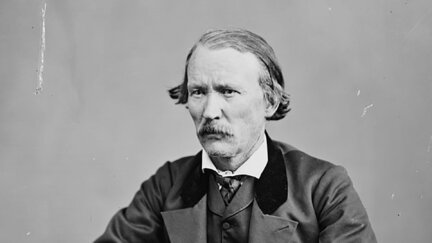
I was ordered to accompany this expedition. We struck the south fork
of the Canadian river, or Rio Colorado, at a point a few miles above
the old adobe walls, which at one time had composed a fort, and was
the place where Kit Carson once had a big Indian fight. We were now
within twelve miles of a new supply depot, called Camp Evans, which
had been established for the Third Cavalry and Evans' Expedition from
New Mexico. The scouts who had brought in this information also
reported that they expected the arrival at Camp Evans of a bull-train
from New Mexico with a large quantity of beer for the soldiers This
news was grateful to Wild Bill and myself, and we determined to lie
low for that beer outfit. That very evening it came along, and the
beer that was destined for the soldiers at Camp Evans never reached
its destination. It went straight down the thirsty throats of General
Carr's command. It appears that the Mexicans living near Fort Union
had manufactured the beer, and were taking it through to Camp Evans
to sell to the troops, but it struck a lively market without going so
far. It was sold to our boys in pint cups, and as the weather was
very cold we warmed the beer by putting the ends of our picket-pins
heated red hot into the cups. The result was one of the biggest beer
jollifications I ever had the misfortune to attend.
One evening General Carr summoned me to his tent, and said he
wished to send some scouts with dispatches to Camp Supply, which were
to be forwarded from there to Sheridan. He ordered me to call the
scouts together at once at his headquarters, and select the men who
were to go. I asked him if I should not go myself, but he replied
that he wished me to remain with the command, as he could not spare
me. The distance to Camp Supply was about two hundred miles, and
owing to the very cold weather it was anything but a pleasant trip.
Consequently none of the scouts were anxious to undertake it. It was
finally settled, however, that Wild Bill, a half-breed called Little
Geary, and three other scouts should carry the dispatches, and they
accordingly took their departure next day, with instructions to
return to the command as soon as possible.
For several days we scouted along the Canadian river, but found no
signs of Indians. General Carr then went back to his camp, and soon
afterwards our wagon train came in from Fort Lyon with a fresh load
of provisions. Our animals being in poor condition, we remained in
different camps along San Francisco Creek and the north fork of the
Canadian until Wild Bill and his scouts returned from Camp Supply.
A FREE FlGHT AMONG THE SCOUTS
Among the scouts of Penrose's command were fifteen Mexicans, and
between them and the American scouts there had existed a feud; when
General Carr took command of the expeditions &emdash;uniting it with
his own &emdash;and I was made chief of all the scouts, this feud
grew more intense, and the Mexicans often threatened to clean us out;
but they postponed the undertaking from time to time, until one day,
while we were all at the cutlery store, the long-expected fight took
place, and resulted in the Mexicans getting severely beaten.
General Carr upon hearing of the row, sent for Wild Bill and
myself, he having concluded, from the various statements which had
been made to him, that we were the instigators of the affair. But
after listening to what we had to say, he thought that the Mexicans
were as much to blame as we were.
It is not to be denied that Wild Bill and myself had been
partaking too freely of "tangle-foot" that evening; and General Carr
said to me: "Cody, there are plenty of antelopes in the country, and
you can do some hunting for the camp while we stay here."
"All right, General, I'll do it."
After that I put in my time hunting, and with splendid success,
killing from fifteen to twenty antelopes a day, which kept the men
well supplied with fresh meat.
At length, our horses and mules having become sufficiently
recruited to travel, we returned to Fort Lyon, arriving there in
March, 1869, where the command was to rest and recruit for thirty
days, before proceeding to the Department of the Platte, whither it
had been ordered.
The
Autobiography of Buffalo Bill Continued
Show
Autobiography Contents
|