
|
|

THE LIFE AND ADVENTURES
OF BUFFALO BILL
CHAPTER XVI
SOME PLEASING NOVELTIES
Remaining at Fort Sedgwick during the winter, early in the
following spring I returned to Fort McPherson under orders to report
to Major-General Emory, of the Fifth Cavalry, who had been appointed
commandant of the district of the Republican, with headquarters at
that post.
As the command had been continually in the field, it was generally
thought that we were to have a long rest; and it looked as if this
post was to be my home and headquarters for some time to come. I
accordingly sent to St. Louis for my wife and daughter to join me
there. General Emory promised to build a house for me, but before the
building was completed my family arrived.
During the fall of 1869 there were two or three scouting
expeditions sent out; but nothing of very great importance was
accomplished by them. I found Fort McPherson to be a lively and
pleasant post to be stationed at, especially as there was plenty of
game in the vicinity, and within a day's ride there were large herds
of deer, antelope and elk.
During the winter of 1869-70 I spent a great deal of time in
pursuit of game, and during the season we had two hunting parties of
Englishmen there; one party being that of Mr. Flynn, and the other
that of George Boyd Houghton, of London &emdash;the well-known
caricaturist. Among the amusements which I arranged for the party's
entertainment were several horse races, in which, however, Tall Bull
and Powder Face were invariably the winners, much to my profit. Tall
Bull by this time had such a reputation as a running horse, that it
was difficult to make a race for him. I therefore had recourse to a
novel proposition in order to run him against a horse in Captain
Spaulding's company of the Second Cavalry.
This race was an interesting affair. I made a bet that Tall Bull
would beat the Second Cavalry horse around a one mile track, and that
during the time he was running, I would jump off and on the horse
eight times. I rode the horse bareback, seized his mane with my left
hand, rested my right on his withers, and while he was going at full
speed, I jumped to the ground, and sprang again upon his back, eight
times in succession. Such feats I had seen performed in the circus
and I had practiced considerably at it with Tall Bull, so that I was
certain of winning the race in the manner agreed upon.
IN PURSUIT OF INDIAN HORSE THIEVES
Early one morning, in the spring of 1870, the Indians, who had
approached during the night, stole some twenty-one head of horses
from Mr. John Burke &emdash;a government contractor &emdash;Ben
Gallagher and Jack Waite. They also ran off some horses from the
post, among the number being my pony Powder Face. The commandant at
once ordered out Lieutenant Thomas with Company I of the Fifth
Cavalry, and directed me to accompany them as trailer. We discovered
the trail after some little difficulty, as the Indians were
continually trying to hide it, and followed it sixty miles, when
darkness set in.
We were now within about four miles of Red Willow creek and I felt
confident the Indians would camp that night in that vicinity.
Advising Lieutenant Thomas to halt his company and "lay low" I
proceeded on to the creek, where moving around cautiously, I suddenly
discovered horses feeding in a bend of the stream on the opposite
side. I hurried back to the troops with the information, and
Lieutenant Thomas moved his company to the bank of the creek, with
the intention of remaining there until daylight, and then, if
possible, surprise the Indians.
Just at break of day we mounted our horses, and after riding a
short distance we ascended a slight elevation, when, not over one
hundred yards distant, we looked down into the Indian camp. The
Indians, preparing to make an early start, had driven up their horses
and were in the act of mounting, when they saw us charging down upon
them. In a moment they sprang upon their ponies and dashed away. Had
it not been for the creek, which lay between us and them, we would
have got them before they could have mounted their horses; but as it
was rather miry, we were unexpectedly delayed. The Indians fired some
shots sat us while we were crossing, but as soon as we got over we
went for them in hot pursuit. A few of the red-skins had not had time
to mount and had started on foot down the creek towards the brush.
One of these was killed.
TWO INDIANS BAGGED AT A SlNGLE SHOT
A number of our soldiers, who had been detailed before the charge to
gather up any of the Indian horses that might be stampeded, succeeded
in capturing thirty-two. I hurriedly looked over them to see if
Powder Face was among them; but he was not there. Starting in pursuit
of the fugitives I finally espied an Indian mounted on my favorite,
dashing away and leading all the others. We continued the chase for
two or three miles, overtaking a couple who were mounted on one
horse. Coming up behind them I fired my rifle, when about thirty feet
distant; the ball passed through the backs of both, and they fell
headlong to the ground; but I made no stop however just then, for I
had my eye on the gentleman who was riding Powder Face. It seemed to
be fun for him to run away from us, and run away he did, for the last
I saw of him was when he went over a divide, about three miles away.
I bade him adieu. On my way back to the Indian camp I stopped and
secured the war bonnets and accoutrements of the pair I had killed,
and at the same time gently "raised their hair."
We were feeling rather tired and hungry, as we had started out on
the trail thirty-six hours before without a breakfast or taking any
food with us; but not a murmur or complaint was heard among the men.
In the abandoned Indian camp, however, we found enough dried buffalo
meat to give us all a meal, and after remaining there for two hours,
to rest our animals, we started on our return to Fort McPherson,
where we arrived at night, having traveled 130 miles in two days.
This being the first fight Lieutenant Thomas had ever commanded
in, he felt highly elated over his success, and hoped that his name
would be mentioned in the special orders for gallantry; sure enough,
when we returned both he, myself and the whole command received
complimentary mention in a special order. This he certainly deserved
for he was a brave, energetic, dashing little officer. The war
bonnets which I had captured I turned over to General Carr, with the
request that he present them to General Augur, whose daughters were
visiting at the post at the time.
A TOUGH OFFICER
Shortly after this, another expedition was organized at Fort
McPherson for the Republican river country. It was commanded by
General Duncan, who was a jolly, blustering old fellow, and the
officers who knew him well said that we would have a good time, as he
was very fond of hunting. He was a good fighter, and one of the
officers said that an Indian bullet never could hurt him, as he had
been shot in the head with a cannon ball which had not injured him in
the least; another said the ball glanced off and killed one of the
toughest mules in the army.
The Pawnee scouts, who had been mustered out of service during the
winter of 1869 and '70 we reorganised to accompany this expedition. I
was glad of this, as I had become quite attached to one of the
officers, Major North, and to many of the Indians. The only white
scout we had at the post, besides myself at that time, was John Y.
Nelson, whose Indian name was Sha-Cha-Cha-Opoyeo,* which interpreted
means Red-Willow-Fill-the-Pipe. [*Who is still shooting Indians from
the top of the old Deadwood stage coach in the Wild West show.] This
man is a character in his way; he has a Sioux squaw for a wife, and
consequently a half-breed family.
We started out from the post with the regimental band playing the
lively air of "The Girl I Left Behind Me." We made but a short march
that day, and camped at night at the head of Fox creek. Next morning
General Duncan sent me word by his orderly that I was to bring up my
gun and shoot at a mark with him; but I can assure the reader that I
did not feel much like shooting anything except myself, for on the
night before I had returned to Fort McPherson and spent several hours
in interviewing the sutler's store in company with Major Brown. I
looked around for my gun and found that I had left it behind. The
last I could remember about it was that I had it at the sutler's
store. I informed Major Brown of my loss, who said that I was a nice
scout to start out without a gun. I replied that that was not the
worst of it, as General Duncan had sent for me to shoot a match with
him, and I did not know what to do; for if the old gentleman
discovered my predicament, he would very likely severely reprimand
me.
"Well, Cody," said he, "the best you can do is to make some
excuse, and then go and borrow a gun from some of the men, and tell
the General that you lent yours to some man to go hunting with
to-day. While we are waiting here, I will send back to the post and
get your rifle for you." I succeeded in obtaining a gun from John
Nelson, and then marching up to the General's headquarters I shot the
desired match with him, which resulted in his favor.
This was the first scout the Pawnees had been out on under command
of General Duncan, and in stationing his guards around the camp he
posted them in a manner entirely different from that of General Carr
and Colonel Royal, as he insisted that the different posts should
call out the hour of the night thus:
THE PAWNEE INDIAN ON GUARD DUTY
"Post No. 1, nine o'clock, all is well! Post No. 2, nine o'clock, all
is well!" etc.
The Pawnees, who had their regular turns at standing upon guard,
were ordered to call the hour the same as the white soldiers. This
was very difficult for them to do, as there were but few of them who
could express themselves in English. Major North explained to them
that when the man on post next to them should call out the hour, they
must call it also as nearly like him as possible. It was very amusing
to hear them do this. They would try to remember what the other man
had said on the post next to them. For instance, a white soldier
would call out: "Post No. 1, half-past nine o'clock, all is well!"
The Indian standing next to him knew that he was bound to say
something in English, and he would sing out something like the
following:
"Poss number half pass five cents &emdash;go to &emdash;! I don't
care!"
This system was really so ridiculous and amusing that the General
had to give it up, and the order was accordingly countermanded.
Nothing of any great interest occurred on this march, until one
day, while proceeding up Prairie Dog creek,* [*Near the lonely camp
where I had so long been laid up with a broken leg, when trapping
years before with Dave Harrington.] Major North and myself went out
in advance of the command several miles and killed a number of
buffaloes. Night was approaching, and I began to look around for a
suitable camping ground for the command. Major North dismounted from
his horse and was resting, while I rode down to the stream to see if
there was plenty of grass in the vicinity. I found an excellent
camping spot, and returning to Major North told him that I would ride
over the hill a little way, so that the advance guard could see me.
This I did, and when the advance came in sight I dismounted and laid
down upon the grass to rest.
A RED HOT SITUATION
Suddenly I heard three or four shots, and in a few moments Major
North came dashing up towards me, pursued by eight or ten Indians. I
instantly sprang into my saddle, and fired a few shots at the
Indians, who by this time had all come in sight, to the number of
fifty. We turned our horses and ran, the bullets flying after us
thick and fast &emdash;my whip being shot from my hand and daylight
being put through the crown of my hat. We were in close quarters,
when suddenly Lieutenant Valkmar came galloping up to our relief with
several soldiers, and the Indians seeing them whirled and retreated.
As soon as Major North got in sight of his Pawnees, he began riding
in a circle. This was a sign to them that there were hostile Indians
in front, and in a moment the Pawnees broke ranks pell-mell and, with
Major North at their head, started for the flying warriors. The rest
of the command pushed rapidly forward also, and chased the enemy for
three or four miles, killing three of them.
But this was a wrong move on our part, as their village was on
Prairie Dog creek, while they led us in a different direction; one
Indian only kept straight on up the creek &emdash;a messenger to the
village. Some of the command who had followed him, stirred up the
village and accelerated its departure. We finally got back to the
main force, and then learned that we had made a great mistake. Now
commenced another stern chase.
The second day that we had been following these Indians we came
upon an old squaw, whom they had left on the prairie to die. Her
people had built for her a little shade or lodge, and had given her
some provisions, sufficient to last her on her trip to the Happy
Hunting grounds. This the Indians often do when pursued b y a n
enemy, and one of their number becomes too old and feeble to travel
any longer. This squaw was recognized by John Nelson who said she was
a relative of his wife. From her we learned that the Indians were
known as Pawnee-Killer's band, and that they had lately killed Buck's
surveying party, consisting of eight or nine men; the massacre having
occurred a few days before on Beaver creek. We knew that they had had
a fight with the surveyors, as we found quite a number of surveying
instruments, which had been left in the abandoned camp. We drove
these Indians across the Platte river and then returned to Fort
McPherson, bringing the old squaw with us; from there she was sent to
the Spotted Tail agency.
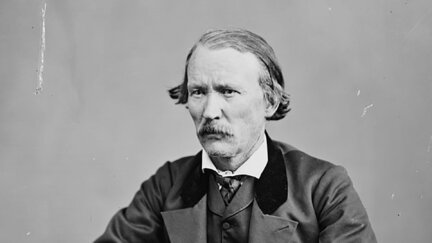
During my absence, my wife had given birth to a son, and he was
several weeks old when I returned. No name had yet been given to him
and I selected that of Elmo Judson, in honor of Ned Buntline; but
this the officers and scouts objected to. Major Brown proposed that
we should call him Kit Carson, and it was finally settled that that
should be his name.
During the summer we made one or two more scouts and had a few
skirmishes with the Indians: but nothing of any great importance
transpired. In the fall of 1870, while I was a witness in a
court-martial at Fort D. A. Russell I woke up one morning and found
that I was dead broke, &emdash;this is not an unusual occurrence to a
frontiersman, or an author I may add, especially when he is
endeavoring to kill time &emdash;and to raise necessary funds I sold
my race-horse Tall Bull to Lieutenant Mason, who had long wanted him.
In the winter of 1870 and 1871 I first met George Watts Garland,
an English gentleman, and a great hunter, whom I had the pleasure of
guiding on several hunts and with whom I spent some weeks. During the
winter I also took several parties out on the Loupe river country
hunting and trapping. Although I was still chief of scouts I did not
have much to do, as the Indians were comparatively quiet, thus giving
me plenty of time for sporting.
In the spring of 1871 several short scouting expeditions were sent
out from Fort McPherson, but all with minor results.
APPOINTED JUSTICE OF THE PEACE
About this time General Emory was considerably annoyed by petty
offences committed in the vicinity of the post, and as there was no
justice of the peace in the neighborhood, he was anxious to have such
an officer there to attend to the civilians; one day he remarked to
me that I would make an excellent justice.
"General, you compliment me rather too highly, for I don't know
any more about law than a government mule does about book-keeping,"
said I.
"That doesn't make any difference," said he, "for I know that you
will make a good 'Squire." He accordingly had the county
commissioners appoint me to the office of justice of the peace, and I
soon received my commission.
One morning a man came rushing up to my house and stated that he
wanted to get out a writ of replevin, to recover possession of a
horse which a stranger was taking out of the country. I had no blank
forms, and had not yet received the statutes of Nebraska to copy
from, so I asked the man:
"Where is the fellow who has got your horse?"
"He is going up the road, and is about two miles way," replied he.
"Very well," said I, "I will get the writ ready in a minute or
two." I saddled up my horse, and then taking my old reliable gun,
"Lucretia," I said to the man: "That's the best writ of replevin that
I can think of; come along, and we'll get that horse, or know the
reason why." We soon overtook the stranger, who was driving a herd of
horses, and as we came up to him, I said: "Hello, sir; I am an
officer, and have an attachment for that horse," and at the same time
I pointed out the animal.
"Well, sir, what are you going to do about it?" he inquired.
"I propose to take you and the horse back to the post," said I.
"You can take the horse," said he, "but I haven't the time to
return with you."
"
"You'll have to take the time, or pay the cost here and now," said
I.
"How much are the costs?"
"Twenty dollars."
"Here's your money," said he, as he handed me the greenbacks.
I then gave him a little friendly advice and told him that he was
released from custody. He went on his way a wiser and a poorer man,
while the owner of the horse and myself returned to the fort. I
pocketed the twenty dollars, of course. Some people might think it
was not a square way of doing business, but I didn't know any better
just then. I had several little cases of this kind, and I became
better posted on the law in the course of time, being assisted by
Lieutenant Burr Reilly, of the Fifth Cavalry, who had been educated
for a lawyer.
PERFORMING A MARRIAGE CEREMONY
One evening I was called upon to perform a marriage ceremony. The
bridegroom was one of the sergeants of the post. I had "braced up"
for the occasion by imbibing rather freely of stimulants, and when I
arrived at the home with a copy of the Statutes of Nebraska, which I
had recently received, I felt somewhat confused. Whether my
bewilderment was owing to the importance of the occasion and the
large assembly, or to the effect of Louis Woodin's "tanglefoot," I
cannot now distinctly remember &emdash;but my suspicions have always
been that it was due to the latter cause. I looked carefully through
the statutes to find the marriage ceremony, but my efforts were
unsuccessful. Finally the time came for the knot to be tied. I told
the couple to stand up and then I said to the bridegroom: "Do you
take this woman to be your lawful wedded wife, to support and love
her through life?"
"I do," was the reply.
Then addressing myself to the bride, I said: "Do you take this man
to be your lawful wedded husband through life, to love, honor and
obey him?"
"I do," was her response.
"Then join hands," said I to both of them; "I now pronounce you to
be man and wife, and whomsoever God and Buffalo Bill have joined
tegether let no man put asunder. May you live long and prosper.
Amen."
This concluded the interesting ceremony, which was followed by the
usual festivities on such occasions. I was highly complimented for
the elegant and eloquent manner in which I had tied the matrimonial
knot.
During the summer of l871, Professor Marsh, of Yale College, came
out to McPherson with a large party of students to have a hunt and to
look for fossils. Professor Marsh had heard of the big bone which had
been found by the Pawnees in the Niobrara country, and he intended to
look for that as well as other bones. He accordingly secured the
services of Major F. North and the Pawnees as an escort. I was also
to accompany the bonehunters, and would have done so had it not been
for the fact that just at that time I was ordered out with a small
scouting party to go after some Indians.
A RUN FOR OUR LIVES.
The day before the Professor arrived at the fort I had been out
hunting on the north side of the North Platte river, near Pawnee
Springs, with several companions, when we were suddenly attacked by
Indians, who wounded one of our number, John Weister. We stood the
Indians off for a little while, and Weister got even with them by
killing one of their party. The Indians, however, outnumbered us, and
at last we were forced to make a run for our lives. In this we
succeeded and reached the fort in safety. The General wanted to have
the Indians pursued and said he could not spare me to accompany
Professor Marsh.
Howevers I had the opportunity to make the acquaintance of the
eminent Professor, whom I found to be not only a well-posted person,
but a very entertaining gentleman. He gave me a geological history of
the country, told me in what section fossils were to be found, and
otherwise entertained me with several scientific yarns, some of which
seemed too complicated and too mysterious to be believed by an
ordinary man like myself; but it was all clear to him. I rode out
with him several miles, as he was starting on his bone-hunting
expedition, and I greatly enjoyed the trip. His party had been
provided with government transportation and his students were all
mounted on government horses. As we rode along he delivered a
scientific lecture and he convinced me that he knew what he was
talking about. I finally bade him good-bye and returned to the post.
While the fossil-hunters were out on their expedition we had several
lively little skirmishes with the Indlans. After having been absent
some little time Professor Marsh and his party came back with their
wagons loaded down with all kinds of bones and the Professor was in
his glory. He had evidently struck a bone-yard, and "gad!" * [*A
favorite expression of the Professor's.] wasn't he happy! But they
had failed to find the big bone which the Pawnees had unearthed the
year before.
The
Autobiography of Buffalo Bill Continued
Show
Autobiography Contents
|