
|
|

THE LIFE AND ADVENTURES
OF BUFFALO BILL
CHAPTER XVII
HELPING TO ENTERTAIN A DISTINGUISHED PARTY
Post McPherson was in the center of a fine game country, in which
buffalo were particularly plentiful, and though fairly surrounded by
hostile Indians, it offered so many attractions for sportsmen that
several hunting parties braved the dangers for the pleasure of
buffalo-chasing. In September, 1871, General Sheridan brought a
number of friends out to the post for a grand hunt, coming by way of
North Platte in a special car, and thence by government wagons to the
fort, which was only eighteen miles from that station.
The party consisted of General Sheridan, Lawrence R. Jerome, James
Gordon Bennett, of the New York Herald; Leonard W. Jerome, Carroll
Livingston, Major J. G. Hecksher, General Fitzhugh, General H. E.
Davies, Captain M. Edward Rogers, Colonel J. Schuyler Crosby, Samuel
Johnson, General Anson Stager, of the Western Union Telegraph
Company; Charles Wilson, editor of the Chicago Evening Journal;
General Rucker, Quartermaster-General, and Dr. Asch &emdash;the two
last named being of General Sheridan's staff. They were met at the
station by General Emory and Major Brown, with a cavalry company as
escort and a sufficient number of vehicles to carry the distinguished
visitors and their baggage.
A brisk drive of less than two hours over a hard and smooth road
brought them to the fort, where they found the garrison, consisting
of five companies of the Fifth Cavalry, under the command of General
Carr, out on parade awaiting their arrival. The band played some
martial music, and the cavalry passed very handsomely in review
before General Sheridan. The guests were then most hospitably
received, and assigned to comfortable quarters.
Lieutenant Hayes, the quartermaster of the expedition, arranged
everything for the comfort of the party. One hundred cavalry under
command of Major Brown were detailed as an escort. A train of sixteen
wagons was provided to carry the baggage, supplies, and forage for
the trip; and, besides these, there were three four-horse ambulances
in which the guns were carried, and in which members of the party who
became weary of the saddle might ride and rest. At General Sheridan's
request I was to accompany the expedition; he introduced me to all
his friends, and gave me a good send-off.
During the afternoon and evening the gentlemen were all
entertained at the post in a variety of ways, including dinner and
supper parties, and music and dancing; at a late hour they retired to
rest in their tents at the camp which they occupied outside the post
&emdash;named Camp Rucker, in honor of General Rucker.
PUTTING ON A LITTLE STYLE FOR THE OCCASION
At five o'clock next morning a cavalry bugle sounded the reveille,
and soon all were astir in the camp, preparatory to pulling out for
the first day's march. I rose fresh and eager for the trip, and as it
was a nobby and high-toned outfit which I was to accompany, I
determined to put on a little style myself. So I dressed in a new
suit of light buckskin, trimmed along the seams with fringes of the
same material; and I put on a crimson shirt handsomely ornamented on
the bosom, while on my head I wore a broad sombrero. Then mounting a
snowy white horse &emdash;a gallant stepper &emdash;I rode down from
the fort to the camp, rifle in hand. I felt first-rate that morning,
and looked well.
The expedition was soon under way. Our road for ten miles wound
through a wooded ravine called Cottonwood cañon, intersecting
the high ground, or divide, as it is called, between the Platte and
Republican rivers. Upon emerging from the cañon we found
ourselves upon the plains. First in the line rode General Sheridan,
followed by his guests, and then the orderlies Then came the
ambulances, in one of which were carried five greyhounds, brought
along to course the antelope and rabbit. With the ambulances marched
a pair of Indian ponies belonging to Lieutenant Hayes
&emdash;captured during some Indian fight &emdash;and harnessed to a
light wagon, which General Sheridan occasionally used. These little
horses, but thirteen hands high, showed more vigor and endurance than
any other of the animals we had with us. Following the ambulances
came the main body of the escort and the supply wagons.
We marched seventeen miles the first day, and went into camp on
Fox creek, a tributary of the Republican. No hunting had as yet been
done; but I informed the gentlemen of the party that we would strike
the buffalo country the next day. A hundred or more questions were
then asked me by this one and that one, and the whole evening was
spent principally in buffalo talk, sandwiched with stories of the
plains &emdash;both of war and of the chase. Several of the party,
who were good vocalists, gave us some excellent music. We closed the
evening by christening the camp, naming it Camp Brown, in honor of
the gallant officer in command of the escort.
At three o'clock next morning the bugle called us to an early
start. We had breakfast at half-past four, and at six were in the
saddle. All were eager to see and shoot the buffaloes, which I
assured them we would certainly meet during the day. After marching
five miles, the advance guard, of which I had the command, discovered
six buffaloes grazing at a distance of about two miles from us. We
returned to the hunters with this information, and they at once
consulted with me as to the best way to attack the "enemy."
AN ATTACK ON THE BUFFALOES
Acting upon my suggestions, Fitzhugh, Crosby, Lawrence Jerome,
Livingston, Hecksher and Rogers, accompanied by myself as guide, rode
through a convenient cañon to a point beyond the buffaloes, so
that we were to the windward of the animals. The rest of the party
made a detour of nearly five miles, keeping behind the crest of a
hill. We charged down upon the buffaloes at full gallop, and just
then the other party emerged from their concealment and witnessed the
exciting chase. The buffaloes started off in a line, single file.
Fitzhugh, after a lively gallop, led us all and soon came alongside
the rear buffalo, at which he fired. The animal faltered, and then
with another shot Fitzhugh brought him to the ground. Crosby dashed
by him and leveled another of the herd, while Livingston dropped a
third. Those who were not directly engaged in the hunt now came up
and congratulated the men upon their success, and Fitzhugh was at
once hailed as the winner of the buffalo-cup, while all sympathised
with Hecksher, whose chance had been the best at the start, but who
lost by reason of his horse falling and rolling over him.
A PRAIRIE-DOG VILLAGE
The hunt being over, the column moved forward on its march, passing
through a prairie-dog town, several miles in extent. These animals
are found throughout the plains, living together in a sort of
society; their numberless burrows in their "towns" adjoin each other,
so that great care is necessary in riding through these places, as
the ground is so undermined as often to fall in under the weight of a
horse. Around the entrance to their holes the ground is piled up
almost a foot high; on these little elevations the prairie-dogs sit
upon their hind legs, chattering to each other and observing whatever
passes on the plains. They will permit a person to approach quite
near, but when they have viewed him closely, they dive into their
dens with wonderful quickness. They are difficult to kill, and if hit
generally succeed in crawling underground before they can be
captured. Rattlesnakes and small owls are generally found in great
numbers in the prairie-dog towns, and live in the same holes with the
dogs on friendly terms. A few of the prairie dogs were killed, and
were found to be very palatable eating.
A short distance beyond the dog town we discovered a settlement of
five white men, who proved to be the Clifford brothers, Arthur Ruff,
Dick Seymour and John Nelson &emdash;the latter already referred to
in these pages. Each of them had a squaw wife and numerous half-breed
children, living in tents of buffalo skins. They owned a herd of
horses and mules and a few cattle, and had cultivated a small piece
of land. Their principal occupation was hunting, and they had a large
number of buffalo hides, which they had tanned in the Indian manner.
Upon reaching Pleasant Valley, on Medicine creek, our party
divided into two detachments &emdash;one hunting along the bank of
the stream for elk or deer, and the other remaining with the main
body of the escort. The elk hunters met with no success whatever, but
the others ran across plenty of buffaloes, and nearly everybody
killed one or more before the day was over. Lawrence Jerome made an
excellent shot; while riding in an ambulance he killed a buffalo
which attempted to cross the line of march. About four o'clock P. M.,
we arrived at Mitchell's fork of the Medicine, having traveled
thirty-five miles during that day, and there we went into camp
&emdash;calling it Camp Jack Hayes, in honor of Lieutenant Hayes.
On the next morning, the 25th, we moved out of camp at eight
o'clock. The party was very successful through the day in securing
game, Hecksher, Fitzhugh, Livingston and Lieutenant Hayes, and in
fact all, doing good shooting.
Lawrence Jerome persuaded me to let him ride Buckskin Joe, the
best buffalo horse in the whole outfit, and on his back he did
wonders among the buffaloes. Leonard Jerome, Bennett and Rogers also
were very successful in buffalo hunting. Our camp of this night was
named Camp Asch to commemorate our surgeon, Dr. Asch. The eveningwas
pleasantly spent around the camp fires in relating the adventures of
the day.
LEONARD JEROME'S PREDICAMENT
Upon crossing the Republican river on the morning of the 26th, we
came upon an immense number of buffaloes scattered over the country
in every direction, as far as the eye could reach, and all had an
opportunity to do as much hunting as they wished. The wagons and
troops moved slowly along in the direction of the next camp, while
the hunters went off separately, or by twos and threes, in different
directions, and all were rewarded with abundant success. Lawrence
Jerome, however, had his career suddenly checked. He had dismounted
to make a steady and careful shot, and thoughtlessly let go of the
bridle. The buffalo failing to take a tumble, as he ought to have
done, started off at a lively gait, followed by Buckskin Joe, the
horse being determined to do some hunting on his own account; the
last seen of him, he was a little ahead of the buffalo, and gaining
slightly, leaving his late rider to his own reflections and the
prospect of a tramp; his desolate condition was soon discovered and
another horse, warranted not to run under any provocation, was sent
to him. It may be stated here that three days afterwards, as I
subsequently learned, Buckskin Joe, all saddled and bridled, turned
up at Fort McPherson.
We pitched our tents for the night in a charming spot on the bank
of Beaver creek. The game was so abundant that we remained there one
day. This stopping place was called Camp Cody, in honor of the
reader's humble servant. The next day was spent in hunting
jack-rabbits, coyotes, elks, antelopes and wild turkeys, and in the
afternoon we sat down to the finest dinner ever spread on the plains.
CHARGED WITH A HEINOUS OFFENSE
In the evening a court-martial was held, at which I presided as chief
justice. We tried one of the gentlemen for aiding and abetting in the
loss of a government horse, and for having something to do with the
mysterious disappearance of a Colt's pistol. He was charged also with
snoring in a manner that was regarded as fiendish, and with
committing a variety of other less offenses too numerous to mention.
The accused made a feeble defense as to the pistol, and claimed
that instead of losing a government horse, the fact was that the
horse had lost him. His statements were all regarded as "too thin,"
and finally failing to prove good character, he confessed all, and
threw himself upon the mercy of the court. The culprit was Lawrence
Jerome.
As chief justice I delivered the opinion of the court, which my
modesty does not prevent me from saying was done in an able and
dignified manner; as an act of clemency I suspended judgment for the
time being, remarking that while the campfire held out to burn, the
vilest sinner might return; and in hope of the accused's amendment, I
would defer pronouncing sentence. The trial afforded us considerable
amusement, and gave me a splendid opportunity to display the legal
knowledge which I had acquired while acting as justice of the peace
at Fort McPherson.
On the morning of the 28th the command crossed the South Beaver,
distant nine miles from Camp Cody, and then striking a fair road we
made a rapid march until we reached our camp on Short Nose or Prairie
Dog creek, about 2 P. M., after having made twenty-four miles. The
remainder of the afternoon was spent in hunting buffaloes and
turkeys. Camp Stager was the name given to this place, in honor of
General Stager, of the Western Union Telegraph Company.
STILL PURSUING THE ENEMY
The next day we made a march of twenty-four miles, and then
halted at about 1 P. M. on the North Solomon river. This day we
killed three buffaloes, two antelopes, two raccoons, and three teal
ducks. Near our camp, which we named Camp Leonard Jerome, was a
beaver dam some six feet high and twenty yards wide; it was near the
junction of two streams, and formed a pond of at least four acres.
On the 30th we traveled twenty-five miles, and during the march
nine turkeys, two rabbits, and three or four buffaloes were killed.
We went into camp on the bank of the South fork of the Solomon river,
and called the place Camp Sam Johnson. We were now but forty-five
miles from Fort Hays, the point at which General Sheridan and his
guests expected to strike the Kansas Pacific Railway and thence
return home. That evening I volunteered to ride to Fort Hays and meet
the party next day bringing with me all the letters that might be at
the post. Taking the best horse in the command I started out,
expecting to make the trip in about four hours.
The next morning the command got an early start and traveled
thirty miles to Saline river, where they made their last camp on the
plains. As some of the party were attacking a herd of buffaloes, I
rode in from Fort Hays and got into the middle of the herd, and
killed a buffalo or two before the hunters observed me. I brought a
large number of letters, which proved welcome reading matter.
CAMP-FIRE CHATS
In the evening we gathered around the camp-fire for the last
time. The duty of naming the camp, which was called Camp Davies,
having been duly performed, we all united in making that night the
pleasantest of all that we had spent together. We had eloquent
speeches, songs, and interesting anecdotes. I was called upon, and
entertained the gentlemen with some lively Indian stories.
The excursionists reached Fort Hays, distant fifteen miles, on the
morning of October 2d, where we pitched our tents for the last time,
and named the camp in honor of Mr. Hecksher. That same afternoon
General Sheridan and his guests took the train for the East, after
bidding Major Brown, Lieutenant Hayes and myself a hearty good-bye,
and expressing themselves as greatly pleased with their hunt, and the
manner in which they had been escorted and guided.
It will be proper and fair to state here that Generat Davies
afterwards wrote an interesting account of this hunt and published it
in a neat volume of sixty-eight pages, under the title of "Ten Days
on the Plains." I would have inserted the volume bodily in this book,
were it not for the fact that the General has spoken in a rather too
complimentary manner of me. However I have taken the liberty in this
chapter to condense from the little volume, and in some places I have
used the identical language of General Davies without quoting the
same; in fact, to do the General justice, I ought to close this
chapter with several lines of quotation marks to be pretty generally
distributed by the reader throughout my account of our ten days'
hunt.
Soon after the departure of General Sheridan's party, we returned
to Fort McPherson and found General Carr about to start out on a
twenty days' scout, not so much for the purpose of finding Indians,
but more for the object of taking some friends on a hunt. His guests
were a couple of Englishmen, &emdash;whose names I cannot now
remember &emdash;and Mr. McCarthy, of Syracuse, New York, who was a
relative of General Emory. The command consisted of three companies
of the Fifth Cavalry, one company of Pawnee Indians, and twenty-five
wagons. Of course I was called on to accompany the expedition.
A LITTLE JOKE ON M'CARTHY
One day, after we had been out from the post for some little time, I
was hunting on Deer creek, in company with Mr. McCarthy, about eight
miles from the command. I had been wishing for several days to play a
joke on him, and had arranged a plan with Captain Lute North to carry
it into execution. I had informed North at about what time we would
be on Deer creek, and it was agreed that he should appear in the
vicinity with some of his Pawnees, who were to throw their blankets
around them, and come dashing down upon us, firing and whooping in
true Indian style, while he was to either conceal or disguise
himself. This programme was faithfully and completely carried out. I
had been talking about Indians to McCarthy, and he had become
considerably excited, when just as we turned a bend of the creek, we
saw not half a mile from us about twenty Indians, who instantly
started for us on a gallop, firing their guns and yelling at the top
of their voices.
"McCarthy, shall we dismount and fight, or run?" said I.
He didn't wait to reply, but wheeling his horse, started at full
speed down the creek, losing his hat and dropping his gun; away he
went, never once looking back to see if he was being pursued. I tried
to stop him by yelling at him and saying that it was all right, as
the Indians were Pawnees. Unfortunately he did not hear me, but kept
straight on, not stopping his horse until he reached the camp.
I knew that he would tell General Carr that the Indians had jumped
him, and that the General would soon start out with the troops. So as
quick as the Pawnees rode up to me I told them to remain there while
I went after my friend. I rode after him as fast as possible, but he
had arrived at the command some time before me and when I got there
the General had, as I had suspected he would do, ordered out two
companies of cavalry to go in pursuit of the Indians. I told the
General that the Indians were only some Pawnees, who had been out
hunting and that they had merely played a joke upon us. I forgot to
inform him that I had put up the trick, but as he was always fond of
a good joke himself, he did not get very angry. I had picked up
McCarthy's hat and gun which I returned to him, and it was some time
afterwards before he discovered who was at the bottom of the affair.
REMAINS OF THE MURDERED BUCK PARTY
When we returned to Fort McPherson we found there Mr. Royal Buck,
whose father had been killed with his entire party by Pawnee Killer's
band of Indlans on the Beaver creek. He had a letter from the
commanding officer of the department requesting that he be furnished
with an escort to go in search of the remains of his father and the
party. Two companies of cavalry were sent with him and I accompanied
them as a gulde. As the old squaw, which we had captured, and of
which mention is made in a previous chapter, could not exactly tell
us the place on Beaver creek where the party had been killed, we
searched the country over for two days and discovered no signs of the
murdered men. At last, however, our efforts were rewarded with
success. We found pieces of their wagons and among other things an
old letter or two which Mr. Buck recognised as his father's
handwriting. We then discovered some of the remains, which we buried;
but nothing further. It was now getting late in the fall and we
accordingly returned to Fort McPherson.
A short time after this the Fifth Cavalry was ordered to Arizona,
a not very desirable country to soldier in. I had become greatly
attached to the officers of the regiment, having been continually
with them for over three years, and had about made up my mind to
accompany them, when a letter was received from General Sheridan
instructing the commanding officer "not to take Cody" with him, and
saying that I was to remain in my old position. In a few days the
command left for its destination, taking the cars at McPherson
Station, where I bade my old friends adieu. During the next few weeks
I had but little to do, as the post was garrisoned by infantry,
awaiting the arrival of the Third Cavalry.
HUNTING WITH A GRAND DUKE
About the first of January, 1872, General Forsyth and Dr. Asch,
of Sheridan's staff came out to Fort McPherson to make preparations
for a big buffalo hunt for the Grand Duke Alexis, of Russia; and as
this was to be no ordinary affair, these officers had been sent by
General Sheridan to have all the necessary arrangements perfected by
the time the Grand Duke should arrive. They learned from me that
there were plenty of buffaloes in the vicinity, and especially on the
Red Willow, sixty miles distant. They said they would like to go over
on the Red Willow and pick out a suitable place for the camp; they
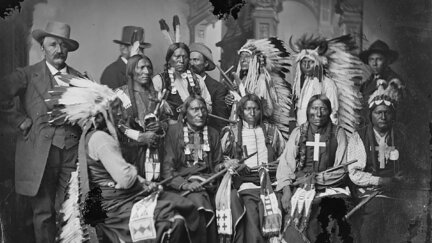
also inquired the location of the camp of Spotted Tail, chief of the
Sioux Indians. Spotted Tail had permission from the Government to
hunt the buffalo with his people during the winter, in the Republican
river country. It was my opinion that they were located somewhere on
the Frenchman's fork, about one hundred and fifty miles from Fort
McPherson.
General Sheridan's commissioner informed me that he wished me to
visit Spotted Tail's camp, and induce about one hundred of the
leading warriors and chiefs to come to the point where it should be
decided to locate the Alexis hunting camp, and to be there by the
time the Grand Duke should arrive, so that he could see a body of
American Indians and observe the manner in which they killed
buffaloes. The Indians would also be called upon to give a grand war
dance in honor of the distinguished visitor.
Next morning General Forsyth and Dr. Asch, accompanied by Captain
Hays, who had been left at Fort McPherson in charge of the Fifth
Cavalry horses, taking an ambulance and a light wagon, to carry their
tents and provisions sufficient to last them two or three days,
started, under my guidance, with a small escort, for Red Willow
creek, arriving there at night. The next day we selected a pleasant
camping place on a little knoll in the valley of the Red Willow.
General Forsyth and his party returned to the post the next day while
I left for Spotted Tail's camp.
The weather was very cold and I found my journey by no means a
pleasant one as I was obliged to camp out with only my
saddle-blankets; and besides, there was more or less danger from the
Indians themselves; for, although Spotted Tail himself was friendly,
I was afraid I might have difficulty in getting into his camp. I was
liable at any moment to run into a party of his young men who might
be out hunting, and as I had many enemies among the Sioux, I would be
running considerable risk in meeting them.
A VISIT TO SPOTTED TAIL.
At the end of the first day I camped on Stinking Water, a tributary
of the Frenchman's fork. where I built a little fire in the timber;
but it was so very cold I was not able to sleep much. Getting an
early start in the morning I followed up the Frenchman's fork and
late in the afternoon I could see, from the fresh horse tracks and
from the dead buffaloes lying here and there, recently killed, that I
was nearing Spotted Tail's camp. I rode on for a few miles further,
and then hiding my horse in a low ravines I crawled up a high hill,
where I obtained a good view of the country. I could see for four or
five miles up the creek, and got sight of a village and of two or
three hundred ponies in its vicinity. I waited until night came and
then I succeeded in riding into the Indian camp unobserved.
I had seen Spotted Tail's camp when he came from the North and I
knew the kind of lodge he was living in. As I entered the village I
wrapped a blanket around my head so that the Indians could not tell
whether I was a white or a red man. In this way I rode around until I
found Spotted Tail's lodge. Dismounting from my horse I opened his
tent door and looking in, saw the old chief lying on some robes. I
spoke to him and he recognised me at once and invited me to enter.
Inside the lodge I found a white man, an old frontiersman, Todd
Randall, who was Spotted Tail's agent and who had lived a great many
years with the Indians. He understood their language perfectly and
did all the interpreting for Spotted Tail. Through him I readily
communicated with the chief and informed him of my errand. I told him
that the warriors and chiefs would greatly please General Sheridan if
they would meet him about ten sleeps at the old Government crossing
of the Red Willow. I further informed him that there was a great
chief from across the water who was coming there to visit him.
Spotted Tail replied that he would be very glad to go; that the
next morning he would call his people together and select those who
would accompany him. I told Spotted Tail how I had entered his camp.
He replied that I had acted wisely; that although his people were
friendly, yet some of his young men had a grudge against me, and I
might have had difficulty with them had I met them away from the
village. He directed his squaw to get me something to eat, and
ordered that my horse be taken care of and upon his invitation I
spent the remainder of the night in his lodge.
THEY WANTED TO LIFT MY HAIR
Next morning the chiefs and warriors assembled according to orders,
and to them was stated the object of my visit. They were asked: "Do
you know who this man is?"
"Yes, we know him well," replied one, "that is Pa-he-has-ka,"
(that being my name among the Sioux, which translated means
"Long-Hair") "that is our old enemy;" a great many of the Indians,
who were with Spotted Tail at this time, had been driven out of the
Republican country.
"That is he," said Spotted Tail. "I want all my people to be kind
to him and treat him as my friend."
I noticed that several of them were looking daggers at me. They
appeared as if they wished to raise my hair then and there. Spotted
Tail motioned and I followed him into his lodge, and thereupon the
Indians dispersed Having the assurance of Spotted Tail that none of
the young men would follow me I started back for the Red Willow,
arriving the second night.
There I found Captain Egan with a company of the second Cavalry
and a wagon train loaded with tents, grain, provisions, etc. The men
were leveling off the ground and were making preparations to put up
large wall tents for the Grand Duke Alexis and his suite, and for
General Sheridan, his staff and other officers, and invited guests of
the party. Proceeding to Fort McPherson I reported what had been
done. Thereupon Quartermaster Hays selected from the five or six
hundred horses in his charge seventy-five of the very best, which
were sent to the Red Willow, to be used by Alexis and his party at
the coming hunt. In a day or two a large supply of provisions,
liquors, etc., arrived from Chicago, together with bedding and
furniture for the tents; all of which were sent over to Camp Alexis.
ARRIVAL OF THE GRAND DUKE
At last, on the morning of the 12th of January, 1872, the Grand
Duke and party arrived at North Platte by special train, in charge of
a Mr. Francis Thompson. Captain Hays and myself, with five or six
ambulances, fifteen or twenty extra saddle horses and a company of
cavalry under Captain Egan, were at the depot in time to receive
them. Presently General Sheridan and a large, fine looking young man,
whom we at once concluded to be the Grand Duke, came out of the cars
and approached us. General Sheridan at once introduced me to the
Grand Duke as Buffalo Bill, for he it was, and said that I was to
take charge of him and show him how to kill buffalo.
In less than half an hour the whole party were dashing away
towards the south, across the South Platte and towards the Medicine,
upon reaching which point we halted for a change of horses and a
lunch. Resuming our ride we reached Camp Alexis in the afternoon.
General Sheridan was well pleased with the arrangements that had been
made and was delighted to find that Spotted Tail and his Indians had
arrived on time. They were objects of great curiosity to the Grand
Duke, who spent considerable time in looking at them, and watching
their exhibitions of horsemanship, sham fights, etc. That evening the
Indians gave the grand war dance, which I had arranged for.
GlVlNG DUKE ALEXIS THE CUE
General Custer, who was one of the hunting party, carried on a
mild fiirtation with one of Spotted Tail's daughters, who had
accompanied her father thither, and it was noticed also that the Duke
Alexis paid considerable attention to another handsome red-skin
maiden. The night passed pleasantly, and all retired with great
expectations of having a most enjoyable and successful buffalo hunt.
The Duke Alexis asked me a great many questions as to how we shot
buffaloes, and what kind of a gun or pistol we used, and if he was
going to have a good horse. I told him that he was going to have my
celebrated buffalo horse Buckskin Joe, and when we went into a
buffalo herd all he would have to do was to sit on the horse's back
and fire away.
At nine o'clock next morning we were all in our saddles and in a
few minutes were galloping over the prairies in search of a buffalo
herd. We had not gone far before we observed a herd some distance
ahead of us crossing our way; after that we proceeded cautiously, so
as to keep out of sight until we were ready to make a charge.
In a moment the Duke became very much excited and anxious to
charge directly toward the buffaloes, but I restrained him for a
time, until getting around to windward and keeping behind the sand
hills the herd was gradually approached.
"Now," said I, "is your time; you must ride as fast as your horse
will go, and don't shoot until you get a good opportunity."
Away we went, tearing down the hill and throwing up a sandstorm in
the rear, leaving the Duke's retinue far behind. When within a
hundred yards of the fleeing buffaloes the Duke fired, but
unfortunately missed, being unused to shooting from a running horse.
I now rode up close beside him and advised him not to fire until
he could ride directly upon the flank of a buffalo, as the sport was
most in the chase. We dashed off together and ran our horses on
either flank of a large bull, a g a i n s t the side of which the
Duke thrust his gun and fired a fatal shot. He was very much elated
at his success, taking off his cap and waving it vehemently, at the
same time shouting to those who were fully a mile in the rear. When
his retinue came up there were congratulations and every one drank to
his good health with over-flowing glasses of champagne. The hide of
the dead buffalo was carefully removed and dressed, and the royal
traveler in his journeying over the world has no doubt often rested
himself upon this trophy of his skill ( ?) on the plains of America.
An encampment was now made, as the party was quite fatigued, and
the evening passed with song and story. On the following day, by
request of Spotted Tail, the Grand Duke hunted for a while beside
"Two Lance," a celebrated chief, who claimed he could send an arrow
entirely through the body of the largest buffalo. This feat seemed so
incredulous that there was a general denial of his ability to perform
it; nevertheless, the Grand Duke and also several others who
accompanied the chief, witnessed, with profound astonishment, an
accomplishment of the feat, and the arrow that passed through the
buffalo was given to the Duke as a memento of Two Lance's skill and
power. On the same day of this performance the Grand Duke killed a
buffalo at a distance of one hundred paces with a heavy navy
revolver. The shot was a marvelous &emdash;scratch.
When the Grand Duke was satisfied with the sport, orders were
given for the return to the railroad. The conveyance provided for the
Grand Duke and General Sheridan was a heavy double-seated open
carriage, or rather an Irish dog-cart, and it was drawn by six
spirited cavalry horses which were not much used to the harness. The
driver was Bill Reed, an old overland stage driver and wagon-master;
on our way in, the Grand Duke frequently expressed his admiration of
the skillful manner in which Reed handled the reins. General Sheridan
informed the Duke that I also had been a stage driver in the Rocky
Mountains, and thereupon His Royal Highness expressed a desire to see
me drive. I was in advance at the time, and General Sheridan sang out
to me:
"Cody, get in here and show the Duke how you can drive. Mr. Reed
will exchange places with you and ride your horse."
"All right, General," said I, and in a few moments I had the reins
and we were rattling away over the prairie. When we were approaching
Medicine creek, General Sheridan said: "Shake 'em up a little Bill,
and give us some old-time stage driving."
GIVING THE DUKE A SHAKING UP
I gave the horses a crack or two of the whip, and they started off at
a very rapid gait. They had a light load to pull, and kept increasing
their speed at every jump, and I found it difficult to hold them.
They fairly flew over the ground, and at last we reached a steep
hill, or divide, which led down into the valley of the Medicine.
There was no brake on the wagon, and the horses were not much on the
hold back. I saw that it would be impossible to stop them. All I
could do was to keep them straight in the track and let them go it
down the hill, for three miles, which distance, I believe, was made
in about six minutes. Every once in a while the hind wheels would
strike a rut and take a bound, and not touch the ground again for
fifteen or twenty feet. The Duke and the General were kept rather
busy in holding their positions on the seats, and when they saw that
I was keeping the horses straight in the road, they seemed to enjoy
the dash which we were making. I was unable to stop the team until
they ran into the camp where we were to obtain a fresh relay, and
there I succeeded in checking them. The Grand Duke said he didn't
want any more of that kind of driving, as he preferred to go a little
slower.
On arriving at the railroad, the Duke invited me into his car, and
made me some valuable presents, at the same time giving me a cordial
invitation to visit him, if ever I should come to his country. At the
same time General Sheridan took occasion to remind me of an
invitation to visit New York which I had received from some of the
gentlemen who accompanied the General on the hunt from Fort McPherson
to Hays City, in September of the previous year. Said he: "You will
never have a better opportunity to accept that invitation than now. I
have had a talk with General Ord concerning you, and he will give you
leave of absence whenever you are ready to start. Write a letter to
general Stager, of Chicago, that you are now prepared to accept the
invitation, and he will send you a pass." Thanking the GeneraI for
his kindness, I then bade him and the Grand Duke good-bye, and soon
their train was out of sight.
The
Autobiography of Buffalo Bill Continued
Show
Autobiography Contents
|