
|
|

THE LIFE AND ADVENTURES
OF BUFFALO BILL
CHAPTER XXII
DANGEROUS WORK
One evening while we were in camp on the Yellowstone at the mouth of
Powder river, I was informed that the commanding officer had selected
Louis Richard, a half breed and myself to accompany General Mills on
a souting expedition on the steamer Far West, down the Yellowstone as
far as Glendive creek. We were to ride on the pilot house and keep a
sharp lookout on both sides of the river for Indian trails that might
have crossed the stream. The idea of scouting on a steamboat was
indeed a novel one to me, and I anticipated a pleasant trip.
At daylight next morning we reported on board the steamer to
General Mills, who had with him four or five companies of his
regiment. We were somewhat surprised when he asked us where our
horses were, as we had not supposed that horses would be needed if
the scouting was to be done on the steamer. He said we might need
them before we got back, and thereupon we had the animals brought on
board. In a few minutes we were booming down the river at the rate of
about twenty miles an hour.
The steamer Far West was commanded by Captain Grant Marsh, whom I
found to be an interesting character. I had often heard of him, for
he was and is yet one of the best known river captains in the
country. He it was who, with his steamer the Far West, transported
the wounded men from the battle of the Little Big Horn to Fort
Abraham Lincoln on the Missouri river, and on that trip he made the
fastest steamboat time on record. He was a skillful and experienced
pilot, handling his boat with remarkable dexterity.
While Richard and myself were at our stations on the pilot house,
the steamer with a full head of steam went flying past islands,
around bends over sand-bars, at a rate that was exhilarating.
Presently I thought I could see horses grazing in a distant bend of
the river and I reported the fact to General Mills, who asked Captain
Marsh if he could land the boat near a large tree which he pointed
out to him. "Yes, sir; I can land her there, and make her climb the
tree if necessary," said he.
On reaching the spot designated, General Mills ordered two
companies ashore, while Richard and myself were instructed to take
our horses off the boat and push out as rapidly as possible to see if
there were Indians in the vicinity. While we were getting ashore,
Captain Marsh remarked that if there was only a good heavy dew on the
grass he would shoot the steamer ashore and take us on the scout
without the trouble of leaving the boat.
It was a false alarm however, as the objects we had seen proved to
be Indian graves. Quite a large number of braves who had probably
been killed in some battle, were laid on scaffolds, according to the
Indian custom, and some of their clothing had been torn loose from
the bodies by the wolves and was waving in the air.
On arrivingat Glendive creek we found that Colonel Rice and his
company of the Fifth Infantry who had been sent there by General
Mills, had built quite a good little fort with their trowel bayonets
&emdash;a weapon which Colonel Rice was the inventor of, and which
is, by the way, a very useful implement of war, as it can be used for
a shovel in throwing up intrenchments and can be profitably utilized
in several other ways. On the day previous to our arrival, Colonel
Rice had a fight with a party of Indians, and had killed two or three
of them at long range with his Rodman cannon.
A RIDE THROUGH THE BAD LANDS.
The Far West was to remain at Glendive over night, and General Mills
wished to send dispatches back to General Terry at once. At his
request I took the dispatches and rode seventy-five miles that night
through the bad lands of the Yellowstone, and reached General Terry's
camp next morning, after having nearly broken my neck a dozen times
or more.
There being but little prospect of any more fighting, I determined
to go East as soon as possible to organlze a new "Dramatic
Combination," and have a new drama written for me based upon the
Sioux war. This I knew would be a paying investment as the Sioux
campaign had excited considerable interest. So I started down the
river on the steamer Yellowstone en route to Fort Beauford. On the
same morning Generals Terry and Crook pulled out for Powder river, to
take up the old Indian trail which we had recently left.
The steamer had proceeded down the stream about twenty miles when
it was met by another boat on its way up the river, having on board
General Whistler and some fresh troops for General Terry's command
Both boats landed, and almost the first person I met was my old
friend and partner, Texas Jack, who had been sent out as a dispatch
carrier for the New York Herald.
General Whistler, upon learning that General Terry had left the
Yellowstone, asked me to carry to him some important dispatches from
General Sheridan, and although I objected, he insisted upon my
performing this duty, saying that it would only detain me a few hours
longer; as an extra inducement he offered me the use of his own
thoroughbred horse, which was on the boat. I finally consented to go,
and was soon speeding over the rough and hilly country towards Powder
river, and I delivered the dispatches to General Terry the same
evening. General Whistler's horse, although a good animal was not
used to such hard riding, and was far more exhausted by the journey
than I was.
After I had taken a lunch, General Terry asked me if I would carry
some dispatches back to General Whistler, and I replied that I would.
Captain Smith, General Terry's aid-de-camp, offered me his horse for
the trip and it proved to be an excellent animal; for I rode him that
same night forty miles over the bad lands in four hours, and reached
General Whistler's steamboat at one o'clock. During my absence the
Indians had made their appearance on the different hills in the
vicinity, and the troops from the boat had had several skirmishes
with them. When General Whistler had finished reading the dispatches,
he said: "Cody, I want to send information to General Terry
concerning the Indians who have been skirmishing around here all day.
I have been trying all the evening long to induce some one to carry
my dispatches to him, but no one seems willing to undertake the trip,
and I have got to fall back on you. It is asking a great deal, I
know, as you have just ridden eighty railes; but it is a case of
necessity, and if you'll go Cody, I'll see that you are well paid for
it."
"Never mind about the pay," said I, "but get your dispatches ready
and I'll start at once."
A TERRIBLE JOURNEY
In a few minutes he handed me the package and, mounting the same
horse which I had ridden from General Terry's camp, I struck out for
my destination. It was two o'clock in the morning when I left the
boat, and at eight o'clock I rode into General Terry's camp, just as
he was about to march &emdash;having made one hundred and twenty
miles in twenty-two hours.
General Terry, after reading the dispatches, halted his command
and then rode on and overtook General Crook, with whom he held a
council; the result was that Crook's command moved on in the
direction which they had been pursuing, while Terry's forces marched
back to the Yellowstone and crossed the river on steamboats. At the
urgent request of General Terry I accompanied the command on a scout
in the direction of the Dry fork of the Missouri, where it was
expected we would strike some Indians.
The first march out from the Yellowstone was made in the night, as
we wished to get into the hills without being discovered by the Sioux
scouts. After marching three days, a little to the east of north, we
reached the buffalo range and discovered fresh signs of Indians, who
had evidently been killing buffaloes General Terry now called on me
to carry dispatches to Colonel Rice, who was still camped at the
mouth of Glendive creek, on the Yellowstone &emdash;distant about
eighty miles from us.
Night had set in with a storm and a drizzling rain was falling
when, at ten o'clock, I started on this ride through a section of
country with which I was entirely unacquainted. I traveled through
the darkness a distance of about thirty-five miles, and at daylight I
rode into a secluded spot at the head of a ravine where stood a bunch
of ash trees and there I concluded to remain till night, for I
considered it a dangerous undertaking to cross the wide prairies in
broad daylight &emdash;especially as my horse was a poor one. I
accordingly unsaddled my animal and ate a hearty breakfast of bacon
and hard tack which I had stored in the saddlepockets; then, after
taking a smoke, I lay down to sleep, with my saddle for a pillow. In
a few minutes I was in the land of dreams.
LYING LOW
After sleeping some time &emdash;I can't tell how long &emdash;I was
suddenly awakened by a roaring, rumbling sound. I instantly seized my
gun, sprang to my horse and hurriedly secreted him in the brush. Then
I climbed up the steep side of the bank and cautiously looked over
the summit; in the distance I saw a large herd of buffaloes which
were being chased and fired at by twenty or thirty Indians.
Occasionally a buffalo would drop out of the herd, but the Indians
kept on until they had killed ten or fifteen. They then turned back
and began to cut up their game.
I saddled my horse and tied him to a small tree where I could
reach him conveniently in case the Indians should discover me by
finding my trail and following it. I then crawled carefully back to
the summit of the bluff, and in a concealed position watched the
Indians for two hours, during which time they were occupied in
cutting up the buffaloes and packing the meat on their pollies. When
they had finished this work they rode off in the direction whence
they had come and on the line which I had proposed to travel. It
appeared evident to me that their camp was located somewhere between
me and Glendive creek, but I had no idea of abandoning the trip on
that account.
I waited till nightfall before resuming my journey, and then I
bore off to the east for several miles, and by making a semi-circle
to avoid the Indians, I got back on my original courses and then
pushed on rapidly to Colonel Rice's camp, which l reached just at
daylight.
Colonel Rice had been fighting Indians almost every day since he
had been encamped at this point, and he was very anxious to notify
General Terry of the fact. Of course I was requested to carry his
dispatches. After remaining at Glendive a single day I started back
to find General Terry, and on the third day I overhauled him at the
head of Deer creek while on his way to Colonel Rice's camp. He was
not, however, going in the right direction, but bearing too far to
the east, and I so informed him. He then asked me to guide the
command and I did so.
On arriving at Glendive I bade good-bye to the General and his
officers and took passage on the steamer Far West, which was on her
way down the Missouri. At Bismark I left the steamer, and proceeded
by rail to Rochester, New York, where I met my family. Mr. J. Clinton
Hall, manager of the Rochester Opera House was very anxious to have
me play an engagement at his theater, so I agreed to open the season
with him as soon as I had got my drama written; and I did so, meeting
with an enthusiastic reception.
My new drama was arranged for the stage by J. V. Arlington, the
actor. It was a five-act play, without head or tail, and it made no
difference at which act we commenced the performance. Before we had
finished the season several newspaper critics, I have been told, went
crazy in trying to follow the plot. It afforded us, however, ample
opportunity to give a noisy, rattling, gunpowder entertainment, and
to present a succession of scenes in the late Indian war, all of
which seemed to give general satisfaction.
RETURN TO THE MIMIC STAGE
From Rochester I went to New York and played a very successful
engagement at the Grand Opera House under the management of Messrs.
Poole and Donnelly. Thence my route took me to all the principal
cities in the Eastern, Western and Middle States, and I everywhere
met with crowded houses. I then went to the Pacific Coast, against
the advice of friends who gave it as their opinion that my style of
plays would not take very well in California. I opened for an
engagement of two weeks at the Bush Street Theater, in San Francisco,
in a season when the theatrical business was dull and Ben DeBar and
the Lingards were playing there to empty seats. I expected to play to
a slim audience on the opening night, but instead of that I had a
fourteen hundred dollar house. Such was my success that I continued
my engagement for five weeks, and the theater was crowded at every
performance. Upon leaving San Francisco I made a circuit of the
interior towns and closed the season at Virginia City, Nevada.
Some time previously I had made arrangements to go into the cattle
business in company with my old friend, Major Frank North, and while
I was in California he had built our ranches on the South fork of the
Dismal river, sixty-five miles north of North Platte, in Nebraska.
Proceeding to Ogallala, the headquarters of the Texas cattle drovers,
I found Major North there awaiting me, and together we bought,
branded and drove to our ranches our first installment of cattle.
This occupied us during the remainder of the summer.
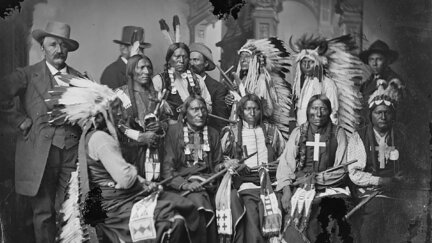
Leaving the cattle in charge of Major North, I visited Red Cloud
Agency early in the fall, and secured some Sioux Indians to accompany
me on my theatrical tour of 1877-78. Taking my family and the Indians
with me, I went directly to Rochester. There I left my oldest
daughter, Arta, at a young ladies' seminary, while my wife and
youngest child traveled with me during the season.
I opened at the Bowery Theater, New York, September 3d, 1877, with
a new border drama entitled, "May Cody, or Lost and Won," from the
pen of Major A. S. Burt, of the United States army. It was founded on
the incidents of the " Mountain Meadow Massacre," and life among the
Mormons. It was the best drama I had yet produced, and proved a grand
success both financially and artistically. The season of 1877-78 was
the most profitable one I had ever had.
In February, 1878, my wife became tired of traveling, and
proceeded to North Platte, Nebraska, where, on our farm adjoining the
town, she personally superintended the erection of a comfortable
family residence, and had it all completed when I reached there,
early in May. In this house we are now living, and we hope to make it
our home for many years to come.
ON A ROUND UP
After my arrival at North Platte, I found that the ranchmen, or
cattlemen, had organized a regular annual "round-up," to take place
in the spring of the year.
The word "round-up" is derived from the fact that during the
winter months the cattle become scattered over a vast tract of land,
and the ranchmen assemble together in the spring to sort out and each
secure his own stock. They form a large circle, often of a
circumference of two hundred miles, and drive the cattle toward a
common center, where, all stock being branded, each owner can readily
separate his own from the general herd, and then he drives them to
his own ranch.
In this cattle driving business is exhibited some most magnificent
horsemanship, for the "cow-boys," as they are called, are invariably
skillful and fearless horsemen &emdash;in fact only a most expert
rider could be a cow-boy, as it requires the greatest dexterity and
daring in the saddle to cut a wild steer out of the herd. Major North
was awaiting me, upon my arrival at North Platte, having with him our
own horses and men. Other cattle owners, such as Keith and Barton,
Coe and Carter, Jack Pratt, the Walker brothers, Guy and Sim Lang,
Arnold and Ritchie and a great many others with their outfits, were
assembled and were ready to start on the round-up.
As there is nothing but hard work on these round-ups, having to be
in the saddle all day, and standing guard over the cattle at night,
rain or shine, I could not possibly find out where the fun came in
that North had promised me. But it was an exciting life, and the days
sped rapidly by; in six weeks we found ourselves at our own ranch on
Dismal river, the round-up having proved a great success, as we had
found all our cattle and driven them home. This work being over, I
proposed to spend a few weeks with my family at North Platte, for the
purpose of making their better acquaintance, for my long and
continued absence from home made me a comparative stranger under my
own roof. One great source of pleasure to me was that my wife was de
lighted with the home I had given her amid the prairies of the far
West. Soon after my arrival, my sisters, Nellie and May, came to make
us a visit, and a delightful time we had during their stay. When they
left us I accompanied them to their home in Denver, Colorado, where I
passed several days visiting old friends and scenes. Proceeding
thence to Ogallala I purchased from Bill Phant, an extensive cattle
drover from Texas, a herd of cattle, which I drove to my ranch on the
Dismal river, after which I bade my partner and the boys good-bye,
and started for the Indian Territory to procure Indians for my
Dramatic Combination for the season of 1878-79.
PUTTING REAL INDIANS ON THE STAGE
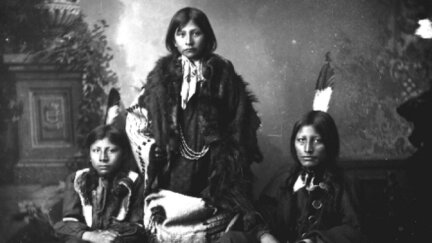
Having secured my Indian actors, and along with them Mr. C. A.
Burgess, a government interpreter, and Ed. A. Burgess, known as the
"Boy Chief of the Pawnees," I started for Baltimore, where I
organised my combination, and which was the largest troupe I had had
yet on the road, opening in that city at the Opera House, under the
management of Hon. John T. Ford, and then started on a southern tour,
playing in Washington, Richmond and as far south as Savannah,
Georgia, where we were brought to a sudden halt, owing to the yellow
fever which was then cruelly raging in the beautiful cities of the
"Land of the cotton and the cane."
The
Autobiography of Buffalo Bill Continued
Show
Autobiography Contents
|