
|
|

RANCH LIFE AND THE HUNTING TRAIL
by Theodore Roosevelt
CHAPTER 1
THE CATTLE COUNTRY OF THE FAR WEST
The great grazing lands of the West lie in what is known as the
arid belt, which stretches from British America on the north to
Mexico on the south, through the middle of the United States. It
includes New Mexico, part of Arizona, Colorado, Wyoming, Montana, and
the western portion of Texas, Kansas, Nebraska, and Dakota. It must
not be understood by this that more cattle are to be found here than
elsewhere, for the contrary is true, it being a fact often lost sight
of that the number of cattle raised on the small, thick-lying farms
of the fertile Eastern States is actually many times greater than
that of those scattered over the vast, barren ranches of the far
West; for stock will always be most plentiful in districts where corn
and other winter food can be grown. But in this arid belt, and in
this arid belt only -- save in a few similar tracts on the Pacific
slope -- stock-raising is almost the sole industry, except in the
mountain districts where there is mining. The whole region is one
vast stretch of grazing country, with only here and there spots of
farmland, in most places there being nothing more like agriculture
than is implied in the cutting of some tons of wild hay or the
planting of a garden patch for home use. This is especially true of
the northern portion of the region, which comprises the basin of the
Upper Missouri, and with which alone I am familiar. Here there are no
fences to speak of, and all the land north of the Black Hills and the
Big Horn Mountains and between the Rockies and the Dakota
wheat-fields might be spoken of as one gigantic, unbroken pasture,
where cowboys and branding-irons take the place of fences.
The country throughout this great Upper Missouri basin has a
wonderful sameness of character; and the rest of the arid belt, lying
to the southward, is closely akin to it in its main features. A
traveler seeing it for the first time is especially struck by its
look of parched, barren desolation; he can with difficulty believe
that it will support cattle at all. It is a region of light rainfall;
the grass is short and comparatively scanty; there is no timber
except along the beds of the streams, and in many places there are
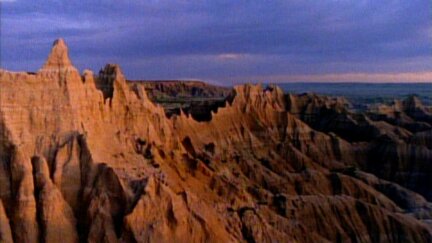
alkali deserts where nothing grows but sage-brush and cactus. Now the
land stretches out into level, seemingly endless plains or into
rolling prairies; again it is broken by abrupt hills and deep,
winding valleys; or else it is crossed by chains of buttes, usually
bare, but often clad with a dense growth of dwarfed pines or gnarled,
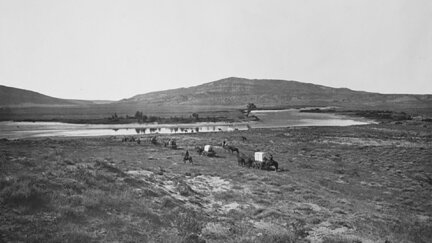
stunted cedars. The muddy rivers run in broad, shallow beds, which
after heavy rainfalls are filled to the brim by the swollen torrents,
while in droughts the larger streams dwindle into sluggish trickles
of clearer water, and the smaller ones dry up entirely, save in
occasional deep pools.
All through the region, except on the great Indian reservations,
there has been a scanty and sparse settlement, quite peculiar in its
character. In the forest the woodchopper comes first; on the fertile
prairies the granger is the pioneer; but on the long, stretching
uplands of the far West it is the men who guard and follow the horned
herds that prepare the way for the settlers who come after. The high
plains of the Upper Missouri and its tributary rivers were first
opened, and are still held, by the stockmen, and the whole
civilisation of the region has received the stamp of their marked and
individual characteristics. They were from the South, not from the
East, although many men from the latter region came out along the
great transcontinental railway lines and joined them in their
northern migration.
They were not dwellers in towns, and from the nature of their
industry lived as far apart from each other as possible. In choosing
new ranges, old cow-hands, who are also seasoned plainsmen, are
invariably sent ahead, perhaps a year in advance, to spy out the land
and pick the best places. One of these may go by himself, or more
often, especially if they have to penetrate little known or entirely
unknown tracts, two or three will go together, the owner or manager
of the herd himself being one of them. Perhaps their herds may
already be on the border of the wild and uninhabited country: in that
case they may have to take but a few days' journey before finding the
stretches of sheltered, long-grass land that they seek. For instance,
when I wished to move my own elkhorn steer brand on to a new ranch I
had to spend barely a week in traveling north among the Little
Missouri Bad Lands before finding what was then untrodden ground far
outside the range of any of my neighbors' cattle. But if a large
outfit is going to shift its quarters it must go much farther; and
both the necessity and the chance for long wanderings were especially
great when the final overthrow of the northern Horse Indians opened
the whole Upper Missouri basin at one sweep to the stockmen. Then the
advanceguards or explorers, each on one horse and leading another
with food and bedding, were often absent months at a time, threading
their way through the trackless wastes of plain, plateau, and
river-bottom. If possible they would choose a country that would be
good for winter and summer alike; but often this could not be done,
and then they would try to find a well watered tract on which the
cattle could be summered, and from which they could be driven in fall
to their sheltered winter range-for the cattle in winter eat snow,
and an entirely waterless region, if broken, and with good pasturage,
is often the best possible winter ground, as it is sure not to have
been eaten off at all during the summer; while in the bottoms the
grass is always cropped down soonest. Many outfits regularly shift
their herds every spring and fall; but with us in the Bad Lands all
we do, when cold weather sets in, is to drive our beasts off the
scantily grassed riverbottom back ten miles or more among the broken
buttes and plateaus of the uplands to where the brown hay, cured on
the stalk, stands thick in the winding coulees.
These lookouts or forerunners having returned, the herds are set
in motion as early in the spring as may be, so as to get on the
ground in time to let the travel-worn beasts rest and gain flesh
before winter sets in. Each herd is accompanied by a dozen, or a
score, or a couple of score, of cowboys, according to its size, and
beside it rumble and jolt the heavy four-horse wagons that hold the
food and bedding of the men and the few implements they will need at
the end of their journey. As long as possible they follow the trails
made by the herds that have already traveled in the same direction,
and when these end they strike out for themselves. In the Upper
Missouri basin, the pioneer herds soon had to scatter out and each
find its own way among the great dreary solitudes, creeping carefully
along so that the cattle should not be overdriven and should have
water at the halting-places. An outfit might thus be months on its
lonely journey, slowly making its way over melancholy, pathless
plains, or down the valleys of the lonely rivers. It was tedious,
harassing work, as the weary cattle had to be driven carefully and
quietly during the day and strictly guarded at night, with a
perpetual watch kept for Indians or white horse-thieves. Often they
would skirt the edges of the streams for days at a time, seeking for
a ford or a good swimming crossing, and if the water was up and the
quicksand deep the danger to the riders was serious and the risk of
loss among the cattle very great.
At last, after days of excitement and danger and after months of
weary, monotonous toil, the chosen ground is reached and the final
camp pitched. The footsore animals are turned loose to shift for
themselves, outlying camps of two or three men each being established
to hem them in. Meanwhile the primitive ranch-house, out-buildings,
and corrals are built, the unhewn cottonwood logs being chinked with
moss and mud, while the roofs are of branches covered with dirt,
spades and axes being the only tools needed for the work. Bunks,
chairs, and tables are all home-made, and as rough as the houses they
are in. The supplies of coarse, rude food are carried perhaps two or
three hundred miles from the nearest town, either in the ranch-wagons
or else by some regular freighting outfit, the huge canvas-topped
prairie schooners of which are each drawn by several yoke of oxen, or
perhaps by six or eight mules. To guard against the numerous mishaps
of prairie travel, two or three of these prairie schooners usually go
together, the brawny teamsters, known either as " bull-whackers " or
as " mule-skinners," stalking beside their slow moving teams.
The small outlying camps are often tents, or mere dug-outs in the
ground. But at the main ranch there will be a cluster of log
buildings, including a separate cabin for the foreman or ranchman;
often another in which to cook and eat; a long house for the men to
sleep in; stables, sheds, a blacksmith's shop, etc.,-the whole group
forming quite a little settlement, with the corrals, the stacks of
natural hay, and the patches of fenced land for gardens or horse
pastures. This little settlement may be situated right out in the
treeless, nearly level open, but much more often is placed in the
partly wooded bottom of a creek or river, sheltered by the usual
background of somber brown hills.
When the northern plains began to be settled, such a ranch would
at first be absolutely alone in the wilderness, but others of the
same sort were sure soon to be established within twenty or thirty
miles on one side or the other. The lives of the men in such places
were strangely cut off from the outside world, and, indeed, the same
is true to a hardly less extent at the present day. Sometimes the
wagons are sent for provisions, and the beef-steers are at stated
times driven off for shipment. Parties of hunters and trappers call
now and then. More rarely small bands of emigrants go by in search of
new homes, impelled by the restless, aimless craving for change so
deeply grafted in the breast of the American borderer: the
white-topped wagons are loaded with domestic goods, with sallow,
dispirited-looking women, and with tow-headed children; while the
gaunt, moody frontiersmen slouch alongside, rifle on shoulder, lank,
homely, uncouth, and yet with a curious suggestion of grim strength
underlying it all. Or cowboys from neighboring ranches will ride
over, looking for lost horses, or seeing if their cattle have strayed
off the range. But this is all. Civilization seems as remote as if we
were living in an age long past. The whole existence is patriarchal
in character: it is the life of men who live in the open, who tend
their herds on horseback, who go armed and ready to guard their lives
by their own prowess, whose wants are very simple, and who call no
man master. Ranching is an occupation like those of vigorous,
primitive pastoral peoples, having little in common with the humdrum,
workaday business world of the nineteenth century; and the free
ranchman in his manner of life shows more kinship to an Arab sheik
than to a sleek city merchant or tradesman.
By degrees the country becomes what in a stockraising region
passes for well settled. In addition to the great ranches smaller
ones are established, with a few hundred, or even a few score, head
of cattle apiece; and now and then miserable farmers straggle in to
fight a losing and desperate battle with drought, cold, and
grasshoppers. The wheels of the heavy wagons, driven always over the
same course from one ranch to another, or to the remote frontier
towns from which they get their goods, wear ruts in the soil, and
roads are soon formed, perhaps originally following the deep trails
made by the vanished buffalo. These roads lead down the river-bottoms
or along the crests of the divides or else strike out fairly across
the prairie, and a man may sometimes journey a hundred miles along
one without coming to a house or a camp of any sort. If they lead to
a shipping point whence the beeves are sent to market, the cattle,
traveling in single file, will have worn many and deep paths on each
side of the wheel-marks; and the roads between important places which
are regularly used either by the United States Government, by
stage-coach lines, or by freight teams become deeply worn
landmarks-as, for instance, near us, the Deadwood and the old Fort
Keogh trails.
Cattle-ranching can only be carried on in its present form while
the population is scanty; and so in stack-raising regions, pure and
simple, there are usually few towns, and these are almost always at
the shipping points for cattle. But, on the other hand, wealthy
cattlemen, like miners who have done well, always spend their money
freely; and accordingly towns like Denver, Cheyenne, and Helena,
where these two classes are the most influential in the community,
are far pleasanter places of residence than cities of five times
their population in the exclusively agricultural States to the
eastward.
A true "cow town" is worth seeing, -- such a one as Miles City,
for instance, especially at the time of the annual meeting of the
great Montana Stock-raisers' Association. Then the whole place is
full to overflowing, the importance of the meeting and the fun of the
attendant frolics, especially the horse-races, drawing from the
surrounding ranch country many hundreds of men of every degree, from
the rich stock owner worth his millions to the ordinary cowboy who
works for forty dollars a month. It would be impossible to imagine a
more typically American assemblage, for although there are always a
certain number of foreigners, usually English, Irish, or German, yet
they have become completely Americanized; and on the whole it would
be difficult to gather a finer body of men, in spite of their
numerous shortcomings. The ranch-owners differ more from each other
than do the cowboys; and the former certainly compare very favorably
with similar classes of capitalists in the East. Anything more
foolish than the demagogic outcry against "cattle kings" it would be
difficult to imagine. Indeed, there are very few businesses so
absolutely legitimate as stock-raising and so beneficial to the
nation at large; and a successful stock-grower must not only be
shrewd, thrifty, patient, and enterprising, but he must also possess
qualities of personal bravery, hardihood, and self-reliance to a
degree not demanded in the least by any mercantile occupation in a
community long settled. Stockmen are in the West the pioneers of
civilisation, and their daring and adventurousness make the after
settlement of the region possible. The whole country owes them a
great debt.
The most successful ranchmen are those, usually South-westerners,
who have been bred to the business and have grown up with it; but
many Eastern men, including not a few college graduates, have also
done excellently by devoting their whole time and energy to their
work,- although Easterners who invest their money in cattle without
knowing anything of the business, or who trust all to their
subordinates, are naturally enough likely to incur heavy losses.
Stockmen are learning more and more to act together; and certainly
the meetings of their associations are conducted with a dignity and
good sense that would do credit to any parliamentary body.
But the cowboys resemble one another much more and outsiders much
less than is the case even with their employers, the ranchmen. A town
in the cattle country, when for some cause it is thronged with men
from the neighborhood, always presents a picturesque sight. On the
wooden sidewalks of the broad, dusty streets the men who ply the
various industries known only to frontier existence jostle one
another as they saunter to and fro or lounge lazily in front of the
straggling, cheap looking board houses. Hunters come in from the
plains and the mountains, clad in buckskin shirts and fur caps,
greasy and unkempt, but with resolute faces and sullen, watchful
eyes, that are ever on the alert. The teamsters, surly and
self-contained, wear slouch hats and great cowhide boots; while the
stage-drivers, their faces seamed by the hardship and exposure of
their long drives with every- kind of team, through every kind of
country, and in every kind of weather, proud of their really
wonderful skill as reinsmen and conscious of their high standing in
any frontier community, look down on and sneer at the "skin hunters"
and the plodding drivers of the white-topped prairie schooners.
Besides these there are trappers, and wolfers, whose business is to
poison wolves, with shaggy, knock-kneed ponies to carry their small
bales and bundles of furs -- beaver, wolf, fox, and occasionally
otter; and silent sheep-herders, with cast-down faces, never able to
forget the absolute solitude and monotony of their dreary lives, nor
to rid their minds of the thought of the woolly idiots they pass all
their days in tending. Such are the men who have come to town, either
on business or else to frequent the flaunting saloons and gaudy hells
of all kinds in search of the coarse, vicious excitement that in the
minds of many of them does duty as pleasure-the only form of pleasure
they have ever had a chance to know. Indians too, wrapped in
blankets, with stolid, emotionless faces, stalk silently round among
the whites, or join in the gambling and horseracing. If the town is
on the borders of the mountain country, there will also be sinewy
lumbermen, rough-looking miners, and packers, whose business it is to
guide the long mule and pony trains that go where wagons can not and
whose work in packing needs special and peculiar skill; and mingled
with and drawn from all these classes are desperadoes of every grade,
from the gambler up through the horse-thief to the murderous
professional bully, or, as he is locally called, "bad man"-now,
however, a much less conspicuous object than formerly
But everywhere among these plainsmen and mountain-men, and more
important than any, are the cowboys,-the men who follow the calling
that has brought such towns into being. Singly, or in twos or threes,
they gallop their wiry little horses down the street, their lithe,
supple figures erect or swaying slightly as they sit loosely in the
saddle; while their stirrups are so long that their knees are hardly
bent, the bridles not taut enough to keep the chains from clanking.
They are smaller and less muscular than the wielders of ax and pick;
but they are as hardy and self-reliant as any men who ever
breathed-with bronzed, set faces, and keen eyes that look all the
world straight in the face without flinching as they flash out from
under the broad-brimmed hats. Peril and hardship, and years of long
toil broken by weeks of brutal dissipation, draw haggard lines across
their eager faces, but never dim their reckless eyes nor break their
bearing of defiant self-confidence. They do not walk well, partly
because they so rarely do any work out of the saddle, partly because
their chaperajos or leather overalls hamper them when on the ground;
but their appearance is striking for all that, and picturesque too,
with their jingling spurs, the big revolvers stuck in their belts,
and bright silk handkerchiefs knotted loosely round their necks over
the open collars of the flannel shirts. When drunk on the villainous
whisky of the frontier towns, they cut mad antics, riding their
horses into the saloons, firing their pistols right and left, from
boisterous light heartedness rather than from any viciousness, and
indulging too often in deadly shooting affrays, brought on either by
the accidental contact of the moment or on account of some
long-standing grudge, or perhaps because of bad blood between two
ranches or localities; but except while on such sprees they are
quiet, rather self-contained men, perfectly frank and simple, and on
their own ground treat a stranger with the most whole-souled
hospitality, doing all in their power for him and scorning to take
any reward in return. Although prompt to resent an injury, they are
not at all apt to be rude to outsiders, treating them with what can
almost be called a grave courtesy. They are much better fellows and
pleasanter companions than small farmers or agricultural laborers;
nor are the mechanics and workmen of a great city to be mentioned in
the same breath.
The bulk of the cowboys themselves are South-westerners; but there
are also many from the Eastern and the Northern States, who, if they
begin young, do quite as well as the Southerners. The best hands are
fairly bred to the work and follow it from their youth up. Nothing
can be more foolish than for an Easterner to think he can become a
cowboy in a few months' time. Many a young fellow comes out hot with
enthusiasm for life on the plains, only to learn that his clumsiness
is greater than he could have believed possible; that the cowboy
business is like any other and has to be learned by serving a painful
apprenticeship; and that this apprenticeship implies the endurance of
rough fares hard living, dirt, exposure of every kind, no little
toil, and month after month of the dullest monotony. For cowboy work
there is need of special traits and special training, and young
Easterners should be sure of themselves before trying it: the
struggle for existence is very keen in the far West, and it is no
place for men who lack the ruder, coarser virtues and physical
qualities, no matter how intellectual or how refined and delicate
their sensibilities. Such are more likely to fail there than in older
communities. Probably during the past few years more than half of the
young Easterners who have come West with a little money to learn the
cattle business have failed signally and lost what they had in the
beginning. The West, especially the far West, needs men who have been
bred on the farm or in the workshop far more than it does clerks or
college graduates.
Some of the cowboys are Mexicans, who generally do the actual work
well enough, but are not trustworthy; moreover, they are always
regarded with extreme disfavor by the Texans in an outfit, among whom
the intolerant caste spirit is very strong. Southern-born whites will
never work under them, and look down upon all colored or half-caste
races. One spring I had with my wagon a Pueblo Indian, an excellent
rider and roper, but a drunken, worthless, lazy devil; and in the
summer of 1886 there were with us a Sioux half-breed, a quiet,
hard-working, faithful fellow, and a mulatto, who was one of the best
cow-hands in the whole round-up.
Cowboys, like most Westerners, occasionally show remarkable
versatility in their tastes and pursuits. One whom I know has
abandoned his regular occupation for the past nine months, during
which time he has been in succession a bartender, a school-teacher,
and a probate judge ! Another, whom I once employed for a short
while, had passed through even more varied experiences, including
those of a barber, a sailor, an apothecary, and a buffalo-hunter.
As a rule the cowboys are known to each other only by their first
names, with, perhaps, as a prefix, the title of the brand for which
they are working. Thus I remember once overhearing a casual remark to
the effect that " Bar Y Harry " had married " the Seven Open A girl,"
the latter being the daughter of a neighboring ranchman. Often they
receive nicknames, as, for instance, Dutch Wannigan, Windy Jack, and
Kid Williams, all of whom are on the list of my personal
acquaintances.
No man traveling through or living in the country need fear
molestation from the cowboys unless he himself accompanies them on
their drinking-bouts, or in other ways plays the fool, for they are,
with us at any rate, very good fellows, and the most determined and
effective foes of real law-breakers, such as horse and cattle
thieves, murderers, etc. Few of the outrages quoted in Eastern papers
as their handiwork are such in reality, the average Easterner
apparently considering every individual who wears a broad hat and
carries a six-shooter a cowboy. These outrages are, as a rule, the
work of the roughs and criminals who always gather on the outskirts
of civilisation, and who infest every frontier town until the decent
citizens become sufficiently numerous and determined to take the law
into their own hands and drive them out. The old buffalo-hunters, who
formed a distinct class, became powerful forces for evil once they
had destroyed the vast herds of mighty beasts the pursuit of which
had been their means of livelihood. They were absolutely shiftless
and improvident; they had no settled habits; they were inured to
peril and hardship, but entirely unaccustomed to steady work; and so
they afforded just the materials from which to make the bolder and
more desperate kinds of criminals. When the game was gone they hung
round the settlements for some little time, and then many of them
naturally took to horse-stealing, cattle-killing, and highway
robbery, although others, of course, went into honest pursuits. They
were men who died off rapidly, however; for it is curious to see how
many of these plainsmen, in spite of their iron nerves and thews,
have their constitutions completely undermined, as much by the
terrible hardships they have endured as by the fits of prolonged and
bestial revelry with which they have varied them.
The "bad men," or professional fighters and man-killers, are of a
different stamp, quite a number of them being, according to their
light, perfectly honest. These are the men who do most of the killing
in frontier communities; yet it is a noteworthy fact that the men who
are killed generally deserve their fate. These men are, of course,
used to brawling, and are not only sure shots, but, what is equally
important, able to "draw" their weapons with marvelous quickness.
They think nothing whatever of murder, and are the dread and terror
of their associates; yet they are very chary of taking the life of a
man of good standing, and will often weaken and back down at once if
confronted fearlessly. With many of them their courage arises from
confidence in their own powers and knowledge of the fear in which
they are held; and men of this type often show the white feather when
they get in a tight place. Others, however, will face any odds
without flinching; and I have known of these men fighting, when
mortally wounded, with a cool, ferocious despair that was terrible.
As elsewhere, so here, very quiet men are often those who in an
emergency show themselves best able to hold their own. These
desperadoes always try to "get the drop" on a foe-that is, to take
him at a disadvantage before he can use his own weapon. I have known
more men killed in this way, when the affair was wholly one-sided,
than I have known to be shot in fair fight; and I have known fully as
many who were shot by accident. It is wonderful, in the event of a
street fight, how few bullets seem to hit the men they are aimed at.
During the last two or three years the stockmen have united to put
down all these dangerous characters, often by the most summary
exercise of lynch law. Notorious bullies and murderers have been
taken out and hung, while the bands of horse and cattle thieves have
been regularly hunted down and destroyed in pitched fights by parties
of armed cowboys; and as a consequence most of our territory is now
perfectly law-abiding. One such fight occurred north of me early last
spring. The horse-thieves were overtaken on the banks of the
Missouri; two of their number were slain, and the others were driven
on the ices which broke, and two more were drowned. A few -months
previously another gang, whose headquarters were near the Canadian
line, were surprised in their hut; two or three were shot down by the
cowboys as they tried to come out, while the rest barricaded
themselves in and fought until the great log-hut was set on fire,
when they broke forth in a body, and nearly all were killed at once,
only one or two making their escape. A little over two years ago one
committee of vigilantes in eastern Montana shot or hung nearly
sixty-not, however, with the best judgment in all cases.
Ranch Life and
the Hunting Trail Continued
Show Ranch Life Contents |