
|
|

RANCH LIFE AND THE HUNTING TRAIL
by Theodore Roosevelt
CHAPTER 3
THE HOME RANCH
Our home ranch lies on both sides of the Little Missouri, the
nearest ranchman above me being about twelve, and the nearest below
me about ten, miles distant. The general course of the stream here is
northerly, but, while flowing through my ranch, it takes a great
westerly reach of some three miles, walled in, as always, between
chains of steep, high bluffs half a mile or more apart. The stream
twists down through the valley in long sweeps, leaving oval wooded
bottoms, first on one side and then on the other; and in an open
glade among the thick-growing timber stands the long, low house of
hewn logs.
Just in front of the ranch veranda is a line of old cottonwoods
that shade it during the fierce heats of summer, rendering it always
cool and pleasant. But a few feet beyond these trees comes the
cut-off bank of the river, through whose broad, sandy bed the shallow
stream winds as if lost, except where a freshet fills it from brim to
brim with foaming yellow water. The bluffs that wall in the
river-valley curve back in semicircles, rising from its alluvial
bottom generally as abrupt cliffs, but often as steep, grassy slopes
that lead up to great level plateaus; and the line is broken every
mile or two by the entrance of a coulee, or dry creek, whose head
branches may be twenty miles back. Above us, where the river comes
round the bend, the valley is very narrow, and the high buttes
bounding it rise, sheer and barren, into scalped hill-peaks and naked
knife-blade ridges.
The other buildings stand in the same open glade with the ranch
house, the dense growth of cottonwoods and matted, thorny underbrush
making a wall all about, through which we have chopped our wagon
roads and trodden out our own bridle-paths. The cattle have now
trampled down this brush a little, but deer still lie in it, only a
couple of hundred yards from the house; and from the door sometimes
in the evening one can see them peer out into the open, or make their
way down, timidly and cautiously, to drink at the river. The stable,
sheds, and other outbuildings, with the hayricks and the pens for
such cattle as we bring in during winter, are near the house; the
patch of fenced garden land is on the edge of the woods; and near the
middle of the glade stands the high, circular horse-corral, with a
snubbing-post in the center, and a wing built out from one side of
the gate entrance, so that the saddle-band can be driven in without
trouble. As it is very hard to work cattle where there is much brush,
the larger cow-corral is some four miles off on an open bottom.
A ranchman's life is certainly a very pleasant one, albeit
generally varied with plenty of hardship and anxiety. Although
occasionally he passes days of severe toil, &emdash;for example, if
he goes on the round-up he works as hard as any of his men,
&emdash;yet he no longer has to undergo the monotonous drudgery
attendant upon the tasks of the cowboy or of the apprentice in the
business. His fare is simple; but, if he chooses, it is good enough.
Many ranches are provided with nothing at all but salt pork, canned
goods, and bread; indeed, it is a curious fact that in traveling
through the cow country it is often impossible to get any milk or
butter; but this is only because the owners or managers are too lazy
to take enough trouble to insure their own comfort. We ourselves
always keep up two or three cows, choosing such as are naturally
tame, and so we invariably have plenty of milk and, when there is
time for churning, a good deal of butter. We also keep hens, which,
in spite of the damaging inroads of hawks, bob-cats, and foxes,
supply us with eggs, and in time of need, when our rifles have failed
to keep us in game, with stewed, roast, or fried chicken also. From
our garden we get potatoes, and unless drought frost, or grasshoppers
interfere (which they do about every second year), other vegetables
as well. For fresh meat we depend chiefly upon our prowess as
hunters.
During much of the time we are away on the different round-ups,
that "wheeled house," the great four-horse wagon, being then our
home; but when at the ranch our routine of life is always much the
same, save during the excessively bitter weather of midwinter, when
there is little to do except to hunt, if the days are fine enough. We
breakfast early &emdash;before dawn when the nights have grown long,
and rarely later than sunrise, even in midsummer. Perhaps before this
meal, certainly the instant it is over, the man whose duty it is
rides off to hunt up and drive in the saddle-band. Each of us has his
own string of horses, eight or ten in number, and the whole band
usually split up into two or three companies. In addition to the
scattered groups of the saddle-band, our six or eight mares, with
their colts, keep by themselves, and are rarely bothered by us, as no
cowboy ever rides anything but horses, because mares give great
trouble where all the animals have to be herded together. Once every
two or three days somebody rides round and finds out where each of
these smaller bands is, but the man who goes out in the morning
merely gathers one bunch. He drives these into the corral, the other
men (who have been lolling idly about the house or stable, fixing
their saddles or doing any odd job) coming out with their ropes as
soon as they hear the patter of the unshod hoofs and the shouts of
the cowboy driver. Going into the corral, and standing near the
center, each of us picks out some one of his own string from among
the animals that are trotting and running in a compact mass round the
circle; and after one or more trials, according to his skill, ropes
it and leads it out. When all have caught their horses the rest are
again turned loose, together with those that have been kept up
overnight. Some horses soon get tame and do not need to be roped; my
pet cutting pony, little Muley, and good old Manitou, my companion in
so many hunting trips, will neither of them stay with the rest of
their fellows that are jamming and jostling each other as they rush
round in the dust of the corral, but they very sensibly walk up and
stand quietly with the men in the middle, by the snubbing-post. Both
are great pets, Manitou in particular; the wise old fellow being very
fond of bread and sometimes coming up of his own accord to the ranch
house and even putting his head into the door to beg for it.
Once saddled, the men ride off on their different tasks; for
almost everything is done in the saddle, except that in winter we cut
our firewood and quarry our coal &emdash;both on the ranch,
&emdash;and in summer attend to the garden and put up what wild hay
we need.
If any horses have strayed, one or two of the men will be sent off
to look for them; for hunting lost horses is one of the commonest and
most irksome of our duties. Every outfit always has certain of its
horses at large; and if they remain out long enough they become as
wild and wary as deer and have to be regularly surrounded and run
down. On one occasion, when three of mine had been running loose for
a couple of months, we had to follow at full speed for at least
fifteen miles before exhausting them enough to enable us to get some
control over them and head them towards a corral. Twice I have had
horses absent nearly a year before they were recovered. One of them,
after being on the ranch nine months, went off one night and traveled
about two hundred miles in a straight line back to its old haunts,
swimming the Yellowstone on the way. Two others were at one time away
nearly eighteen months, during which time we saw them twice, and on
one occasion a couple of the men fairly ran their horses down in
following them. We began to think they were lost for good, as they
were all the time going farther down towards the Sioux country, but
we finally recovered them.
If the men do not go horse-hunting they may ride off over the
range; for there is generally some work to be done among the cattle,
such as driving in and branding calves that have been overlooked by
the round-up, or getting some animal out of a bog-hole. During the
early spring months, before the round-up begins, the chief work is in
hauling out mired cows and steers; and if we did not keep a sharp
lookout, the losses at this season would be very serious. As long as
everything is frozen solid there is, of course, no danger from
miring; but when the thaw comes, along towards the beginning of
March, a period of new danger to the cattle sets in. When the ice
breaks up, the streams are left with an edging of deep bog, while the
quicksand is at its worst. As the frost goes out of the soil, the
ground round every little alkali-spring changes into a trembling
quagmire, and deep holes of slimy, tenacious mud form in the bottom
of all the gullies. The cattle, which have had to live on snow for
three or four months, are very eager for water, and are weak and in
poor condition. They rush heedlessly into any pool and stand there,
drinking gallons of the icy water and sinking steadily into the mud.
When they try to get out they are already too deep down, and are too
weak to make a prolonged struggle. After one or two fits of desperate
floundering, they resign themselves to their fate with dumb apathy
and are lost, unless some one of us riding about discovers and hauls
them out. They may be thus lost in wonderfully small mud-holes; often
they will be found dead in a gulch but two or three feet across, or
in the quicksand of a creek so narrow that it could almost be jumped.
An alkali-hole, where the water oozes out through the thick clay, is
the worst of all, owing to the ropy tenacity with which the horrible
substance sticks and clings to any unfortunate beast that gets into
it.
In the spring these mud-holes cause very serious losses among the
cattle, and are at all times fruitful sources of danger; indeed,
during an ordinary year more cattle die from getting mired than from
any other cause. In addition to this they also often prove very
annoying to the rider himself, as getting his steed mired or caught
in a quicksand is one of the commonest of the accidents that beset a
horseman in the far West. This usually happens in fording a river, if
the latter is at all high, or else in crossing one of the numerous
creeks; although I once saw a horse and rider suddenly engulfed while
leisurely walking over what appeared to be dry land. They had come to
an alkali mud-hole, an old buffalo-wallow, which had filled up and
was covered with a sun-baked crust, that let them through as if they
had stepped on a trap-door. There being several of us along, we got
down our ropes and dragged both unfortunates out in short order.
When the river is up it is a very common thing for a horseman to
have great difficulty in crossing, for the swift, brown water runs
over a bed of deep quicksand that is ever shifting. An inexperienced
horse, or a mule, &emdash;for a mule is useless in mud or quicksand,
&emdash;becomes mad with fright in such a crossing, and, after
speedily exhausting its strength in wild struggles, will throw itself
on its side and drown unless the rider gets it out. An old horse used
to such work will, on the contrary, take matters quietly and often
push along through really dangerous quicksand. Old Manitou never
loses his head for an instant; but, now resting a few seconds, now
feeling his way cautiously forward, and now making two or three
desperate plunges, will go on wherever a horse possibly can. It is
really dangerous crossing some of the creeks, as the bottom may give
way where it seems hardest; and if one is alone he may work hours in
vain before getting his horse out, even after taking off both saddle
and bridle, the only hope being to head it so that every plunge takes
it an inch or two in the right direction.
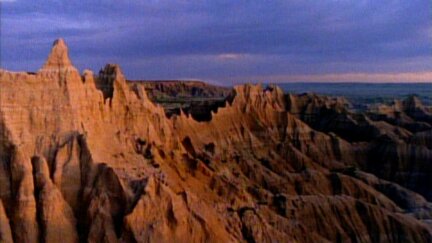
Nor are mud-holes the only danger the horseman has to fear; for in
much of the Bad Lands the buttes are so steep and broken that it
needs genuine mountaineering skill to get through them, and no horse
but a Western one, bred to the business, could accomplish the feat.
In many parts of our country it is impossible for a horseman who does
not know the land to cross it, and it is difficult enough even for an
experienced hand. For a stretch of nearly ten miles along the Little
Missouri above my range, and where it passes through it, there are
but three or four places where it is possible for a horseman to get
out to the eastern prairie through the exceedingly broken country
lying back from the river. In places this very rough ground comes
down to the water; elsewhere it lies back near the heads of the
creeks. In such very bad ground the whole country seems to be one
tangled chaos of canyon-like valleys, winding gullies and washouts
with abrupt, unbroken sides, isolated peaks of sandstone, marl, or
"gumbo" clay, which rain turns into slippery glue, and hill chains
the ridges of which always end in sheer cliffs. After a man has made
his way with infinite toil for half a mile, a point will be reached
around which it is an absolute impossibility to go, and the
adventurer has nothing to do but painfully retrace his steps and try
again in a new direction, as likely as not with the same result. In
such a place the rider dismounts and leads his horse, the latter
climbing with cat-like agility up seemingly inaccessible heights,
scrambling across the steep, sloping shoulders of the bluffs, sliding
down the faces of the clay cliffs with all four legs rigid, or
dropping from ledge to ledge like a goat, and accepting with
unruffled composure an occasional roll from top to bottom. But, in
spite of the climbing abilities of the ponies, it is diffficult, and
at times &emdash;for our steeds, at any rate &emdash;dangerous work
to go through such places, and we only do it when it cannot be
avoided. Once I was overtaken by darkness while trying to get through
a great tract of very rough land, and, after once or twice nearly
breaking my neck, in despair had to give up all attempts to get out,
and until daybreak simply staid where I was, in a kind of ledge or
pocket on the side of the cliff, luckily sheltered from the wind. It
was midsummer and the nights were short, but this particular one
seemed quite long enough; and though I was on the move by dawn, it
was three hours later before I led the horse, as hungry, numb, and
stiff as myself, out on the prairie again.
Occasionally it is imperatively necessary to cross some of the
worst parts of the Bad Lands with a wagon, and such a trip is
exhausting and laborious beyond belief. Often the wagon will have to
be taken to pieces every few hundred yards in order to get it over a
ravine, lower it into a valley, or drag it up a cliff. One outfit,
that a year ago tried to take a short cut through some of the Bad
Lands of the Powder River, made just four miles in three days, and
then had to come back to their starting-point after all. But with
only saddle-horses we feel that it must be a very extraordinary
country indeed if, in case of necessity, we cannot go through it.
The long forenoon's work, with its attendant mishaps to man and
beast, being over, the men who have been out among the horses and
cattle come riding in, to be joined by their fellows &emdash;if any
there be &emdash;who have been hunting, or haying, or chopping wood.
The midday dinner is variable as to time, for it comes when the men
have returned from their work; but, whatever be the hour, it is the
most substantial meal of the day, and we feel that we have little
fault to find with a table on the clean cloth of which are spread
platters of smoked elk meat, loaves of good bread, jugs and bowls of
milk, saddles of venison or broiled antelope steaks, perhaps roast
and fried prairie chickens, with eggs, butter, wild plums, and tea or
coffee.
The afternoon's tasks are usually much the same as the morning's,
but this time is often spent in doing the odds and ends; as, for
instance, it may be devoted to breaking-in a new horse. Large outfits
generally hire a bronco-buster to do this; but we ourselves almost
always break our own horses, two or three of my men being pretty good
riders, although none of them can claim to be anything out of the
common. A first-class flash rider or bronco-buster receives high
wages, and deserves them, for he follows a most dangerous trade, at
which no man can hope to grow old; his work being infinitely harder
than that of an Eastern horsebreaker or rough-rider, because he has
to do it in such a limited time. A good rider is a good rider all the
world over; but an Eastern or English horse-breaker and Western
bronco-buster have so little in common with each other as regards
style or surroundings, and are so totally out of place in doing each
other's work, that it is almost impossible to get either to admit
that the other has any merits at all as a horseman, for neither could
sit in the saddle of the other or could without great difficulty
perform his task. The ordinary Eastern seat, which approaches more or
less the seat of a cross-country rider or fox-hunter, is nearly as
different from the cowboy's seat as from that of a man who rides
bareback. The stirrups on a stock saddle are much farther back than
they are on an ordinary English one (a difference far more important
than the high horn and cantle of the former), and the man stands
nearly erect in them, instead of having his legs bent; and he grips
with the thighs and not with the knees, throwing his feet well out.
Some of the things he teaches his horse would be wholly useless to an
Eastern equestrian: for example, one of the first lessons the
newly-caught animal has to learn is not to "run on a rope "; and he
is taught this by being violently snubbed up, probably turning a
somersault, the first two or three times that he feels the noose
settle round his neck, and makes a mad rush for liberty. The
snubbingpost is the usual adjunct in teaching such a lesson; but a
skillful man can do without any help and throw a horse clean over by
holding the rope tight against the left haunch, at the same time
leaning so far back, with the legs straight in front, that the heels
dig deep into the ground when the strain comes, and the horse,
running out with the slack of the rope, is brought up standing, or
even turned head over heels by the shock. Cowboys are probably the
only working-men in the world who invariably wear gloves, buckskin
gauntlets being preferred, as otherwise the ropes would soon take
every particle of skin off their hands.
A bronco-buster has to work by such violent methods in consequence
of the short amount of time at his command. Horses are cheap, each
outfit has a great many, and the wages for breaking an animal are but
five or ten dollars. Three rides, of an hour or two each, on as many
consecutive days, are the outside number a bronco-buster deems
necessary before turning an animal over as "broken." The average
bronco-buster, however, handles horses so very rudely that we prefer,
aside from motives of economy, to break our own; and this is always
possible, if we take enough time. The best and quietest horses on the
ranch are far from being those broken by the best riders; on the
contrary, they are those that have been handled most gently, although
firmly, and that have had the greatest number of days devoted to
their education.
Some horses, of course, are almost incurably vicious, and must be
conquered by main force. One pleasing brute on my ranch will at times
rush at a man open-mouthed like a wolf, and this is a regular trick
of the range-stallions. In a great many &emdash;indeed, in most
&emdash;localities there are wild horses to be found, which, although
invariably of domestic descent, being either themselves runaways from
some ranch or Indian outfit, or else claiming such for their sires
and dams, yet are quite as wild as the antelope on whose domain they
have intruded. Ranchmen run in these wild horses whenever possible,
and they are but little more difficult to break than the so-called
"tame" animals. But the wild stallions are, whenever possible, shot;
both because of their propensity for driving off the ranch mares, and
because their incurable viciousness makes them always unsafe
companions for other horses still more than for men. A wild stallion
fears no beast except the grizzly, and will not always flinch from an
encounter with it; yet it is a curious fact that a jack will almost
always kill one in a fair fight. The particulars of a fight of this
sort were related to me by a cattle man who was engaged in bringing
out blooded stock from the East. Among the animals under his charge
were two great stallions, one gray and one black, and a fine jackass,
not much over half the size of either of the former. The animals were
kept in separate pens, but one day both horses got into the same
inclosure, next to the jack-pen, and began to fight as only enraged
stallions can, striking like boxers with their fore feet, and biting
with their teeth. The gray was getting the best of it; but while
clinched with his antagonist in one tussle they rolled against the
jack-pen, breaking it in. No sooner was the jack at liberty than,
with ears laid back and mouth wide open, he made straight for the two
horses, who had for the moment separated. The gray turned to meet
him, rearing on his hind legs and striking at him with his fore feet;
but the jack slipped in, and in a minute grasped his antagonist by
the throat with his wide-open jaws, and then held on like a bull-dog,
all four feet planted stiffly in the soil. The stallion made
tremendous efforts to shake him off: he would try to whirl round and
kick him, but for that the jack was too short; then he would rise up,
lifting the jack off the ground, and strike at him with his fore
feet; but all that he gained by this was to skin his foe's front legs
without making him loose his hold. Twice they fell, and twice the
stallion rose, by main strength dragging the jack with him; but all
in vain. Meanwhile the black horse attacked both the combatants, with
perfect impartiality, striking and kicking them with his hoofs, while
his teeth, as they slipped off the tough hides, met with a snap like
that of a bear-trap. Undoubtedly the jack would have killed at least
one of the horses had not the men come up, and with no small
difficulty separated the maddened brutes.
If not breaking horses, mending saddles, or doing something else
of the sort, the cowboys will often while away their leisure moments
by practicing with the rope. A man cannot practice too much with this
if he wishes to attain even moderate proficiency; and as a matter of
fact he soon gets to wish to practice the whole time. A cowboy is
always roping something, and it especially delights him to try his
skill at game. A friend of mine, a young ranchman in the Judith
basin, about four years ago roped a buffalo, and by the exercise of
the greatest skill, both on his own part and on his steed's, actually
succeeded, by alternate bullying and coaxing, in getting the huge
brute almost into camp. I have occasionally known men on fast horses
to rope deer, and even antelope, when circumstances all joined to
favor them; and last summer one of the cowboys on a ranch about
thirty miles off ran into and roped a wounded elk. A forty-foot
lariat is the one commonly used, for the ordinary range at which a
man can throw it is only about twenty-five feet. Few men can throw
forty feet; and to do this, taking into account the coil, needs a
sixty-foot rope.
When the day's work is over we take supper, and bed-time comes
soon afterward, for the men who live on ranches sleep well and
soundly. As a rule, the nights are cool and bracing, even in
midsummer; except when we occasionally have a spell of burning
weather, with a steady, hot wind that blows in our faces like a
furnace blast, sending the thermometer far up above a hundred and
making us gasp for breath, even at night, in the dry-baked heat of
the air. But it is only rarely that we get a few days of this sort;
generally, no matter how unbearable the heat of the day has been, we
can at least sleep pleasantly at night.
A ranchman's work is, of course, free from much of the sameness
attendant upon that of a mere cowboy. One day he will ride out with
his men among the cattle, or after strayed horses; the next he may
hunt, so as to keep the ranch in meat; then he can make the tour of
his outlying camps; or, again, may join one of the round-ups for a
week or two, perhaps keeping with it the entire time it is working.
On occasions he will have a good deal of spare time on his hands,
which, if he chooses, he can spend in reading or writing. If he cares
for books, there will be many a worn volume in the primitive little
sitting-room, with its log walls and huge fire-place; but after a
hard day's work a man will not read much, but will rock to and fro in
the flickering firelight, talking sleepily over his success in the
day's chase and the difficulty he has had with the cattle; or else
may simply lie stretched at full length on the elk-hides and
wolf-skins in front of the hearthstone, listening in drowsy silence
to the roar and crackle of the blazing logs and to the moaning of the
wind outside.
In the sharp fall weather the riding is delicious all day long;
but even in the late spring, and all through the summer, we try, if
we can, to do our work before the heat of the day, and if going on a
long ride, whether to hunt or for other purposes, leave the ranch
house by dawn.
The early rides in the spring mornings have a charm all their own,
for they are taken when, for the one and only time during the year,
the same brown landscape of these high plains turns to a vivid green,
as the new grass sprouts and the trees and bushes thrust forth the
young leaves; and at dawn, with the dew glittering everywhere, all
things show at their best and freshest. The flowers are out and a man
may gallop for miles at a stretch with his horse's hoofs sinking at
every stride into the carpet of prairie roses, whose short stalks
lift the beautiful blossoms but a few inches from the ground. Even in
the waste places the cactuses are blooming; and one kind in
particular, a dwarfish, globular plant, with its mass of splendid
crimson flowers glows against the sides of the gray buttes like a
splash of flame.
The ravines, winding about and splitting into a labyrinth of
coulees, with chains of rounded hills to separate them, have groves
of trees in their bottoms, along the sides of the water courses. In
these are found the blacktail deer, and his cousin, the whitetail,
too, with his flaunting flag; but in the spring-time, when we are
after antelope only, we must go out farther to the flat prairie land
on the divide. Here, in places, the level, grassy plains are strewn
with mounds and hillocks of red or gray scoria, that stand singly or
clustered into little groups, their tops crested, or their sides
covered, by queer detached masses of volcanic rock, wrought into
strange shapes by the dead forces whose blind, hidden strength long
ago called them into being. The road our wagons take, when the water
is too high for us to come down the river bottom, stretches far ahead
&emdash;two dark, straight, parallel furrows which merge into one in
the distance. Quaint little horned frogs crawl sluggishly along in
the wheel tracks, and the sickle-billed curlews run over the ground
or soar above and around the horsemen, uttering their mournful,
never-ceasing clamor. The grassland stretches out in the sunlight
like a sea, every wind bending the blades into a ripple, and flecking
the prairie with shifting patches of a different green from that
around, exactly as the touch of a light squall or wind-gust will
fleck the smooth surface of the ocean. Our Western plains differ
widely in detail from those of Asia; yet they always call to mind
The Scythian
On the wide steppe, unharnessing
His wheel'd house at noon.
He tethers his beast down, and makes his meal&emdash;
Mares' milk, and bread
Baked on the embers;&emdash;all around
The boundless, waving grass-plains stretch . . .
. . .; before him, for long miles,
Alive with bright green lizards
And the springing bustard fowl,
The track, a straight black line,
Furrows the rich soil; here and there
Clusters of lonely mounds
Topp'd with rough hewn,
Gray, rain-blear'd statues, overpeer
The sunny waste.
In the spring mornings the rider on the plains will hear bird
songs unknown in the East. The Missouri skylark sings while soaring
above the great plateaus so high in the air that it is impossible to
see the bird; and this habit of singing while soaring it shares with
some sparrow-like birds that are often found in company with it. The
white-shouldered lark-bunting, in its livery of black, has rich, full
notes, and as it sings on the wing it reminds one of the bobolink;
and the sweet-voiced lark-finch also utters its song in the air.
These birds, and most of the sparrows of the plains, are
characteristic of this region.
But many of our birds, especially those found in the wooded river
bottoms, answer to those of the East; only almost each one has some
marked point of difference from its Eastern representative. The
bluebird out West is very much of a blue bird indeed, for it has no
"earth tinge" on its breast at all; while the indigo-bird, on the
contrary, has gained the ruddy markings that the other has lost. The
flicker has the shafts of its wing and tail quills colored orange
instead of yellow. The towhee has lost all title to its name, for its
only cry is a mew like that of a cat-bird; while, most wonderful of
all, the meadow-lark has found a rich, strong voice, and is one of
the sweetest and most incessant singers we have.
Throughout June the thickets and groves about the ranch house are
loud with bird music from before dawn till long after sunrise. The
thrashers have sung all the night through from among the thorn-bushes
if there has been a moon, or even if there has been bright starlight;
and before the first glimmer of gray the bell-like, silvery songs of
the shy woodland thrushes chime in; while meadow-lark, robin,
bluebird, and song sparrow, together with many rarer singers, like
the grosbeak, join in swelling the chorus. There are some would-be
singers whose intention is better than their execution. Blackbirds of
several kinds are plenty round the house and stables, walking about
with a knowing air, like so many dwarf crows; and now and then a
flock of yellow-heads will mix for a few days with their purple or
rusty-colored brethren. The males of these yellow-headed grakles are
really handsome, their orange and yellow heads contrasting finely
with the black of the rest of their plumage; but their voices are
discordant to a degree. When a flock has done feeding it will often
light in straggling order among the trees in front of the veranda,
and then the males will begin to sing, or rather to utter the most
extraordinary collection of broken sounds &emdash;creakings,
gurglings, hisses, twitters, and every now and then a liquid note or
two. It is like an accentuated representation of the noise made by a
flock of common blackbirds. At nightfall the poor-wills begin to
utter their boding call from the wooded ravines back in the hills;
not "whip-poor-will," as in the East, but with two syllables only.
They often come round the ranch house. Late one evening I had been
sitting motionless on the veranda, looking out across the water and
watching the green and brown of the hill-tops change to purple and
umber and then fade off into shadowy gray as the somber darkness
deepened. Suddenly a poor-will lit on the floor beside me and stayed
some little time; now and then uttering its mournful cries, then
ceasing for a few moments as it flitted round after insects, and
again returning to the same place to begin anew. The little owls,
too, call to each other with tremulous, quavering voices throughout
the livelong night, as they sit in the creaking trees that overhang
the roof. Now and then we hear the wilder voices of the wilderness,
from animals that in the hours of darkness do not fear the
neighborhood of man: the coyotes wail like dismal ventriloquists, or
the silence may be broken by the strident challenge of a lynx, or by
the snorting and stamping of a deer that has come to the edge of the
open.
In the hot noontide hours of midsummer the broad ranch veranda,
always in the shade, is almost the only spot where a man can be
comfortable; but here he can sit for hours at a time, leaning back in
his rocking-chair, as he reads or smokes, or with half-closed, dreamy
eyes gazes across the shallow, nearly dry river-bed to the wooded
bottoms opposite, and to the plateaus lying back of them. Against the
sheer white faces of the cliffs, that come down without a break, the
dark green tree-tops stand out in bold relief. In the hot, lifeless
air all objects that are not near by seem to sway and waver. There
are few sounds to break the stillness. From the upper branches of the
cottonwood trees overhead, whose shimmering, tremulous leaves are
hardly ever quiet, but if the wind stirs at all, rustle and quiver
and sigh all day long, comes every now and then the soft, melancholy
cooing of the mourning dove, whose voice always seems far away and
expresses more than any other sound in nature the sadness of gentle,
hopeless, never-ending grief. The other birds are still; and very few
animals move about. Now and then the black shadow of a wheeling
vulture falls on the sun-scorched ground. The cattle, that have
strung down in long files from the hills, lie quietly on the
sand-bars, except that some of the bulls keep traveling up and down,
bellowing and routing or giving vent to long, surly grumblings as
they paw the sand and toss it up with their horns. At times the
horses, too, will come down to drink, and to splash and roll in the
water.
The prairie-dogs alone are not daunted by the heat, but sit at the
mouths of their burrows with their usual pert curiosity. They are
bothersome little fellows, and most prolific, increasing in spite of
the perpetual war made on them by every carnivorous bird and beast.
One of their worst foes is the black-footed ferret, a handsome,
rather rare animal, somewhat like a mink, with a yellow-brown body
and dark feet and mask. It is a most bloodthirsty little brute,
feeding on all small animals and ground birds. It will readily master
a jack-rabbit, will kill very young fawns if it finds them in the
mother's absence, and works extraordinary havoc in a dog town, as it
can follow the wretched little beasts down into the burrows. In one
instance, I knew of a black-footed ferret making a succession of
inroads on a ranchman's poultry, killing and carrying off most of
them before it was trapped. Coyotes, foxes, swifts, badgers, and
skunks also like to lurk about the dog towns. Of the skunks, by the
way, we had last year altogether too much; there was a perfect plague
of them all along the river, and they took to trying to get into the
huts, with the stupid pertinacity of the species. At every ranch
house dozens were killed, we ourselves bagging thirty-three, all
slain near the house, and one, to our unspeakable sorrow, in it.
In making a journey over ground we know, during the hot weather we
often prefer to ride by moonlight. The moon shines very brightly
through the dry, clear night air, turning the gray buttes into
glimmering silver; and the horses travel far more readily and easily
than under the glaring noonday sun. The road between my upper and
lower ranch houses is about forty miles long, sometimes following the
river-bed, and then again branching off inland, crossing the great
plateaus and winding through the ravines of the broken country. It is
a five-hours' fair ride; and so, in a hot spell, we like to take it
during the cool of the night, starting at sunset. After nightfall the
face of the country seems to alter marvelously, and the clear
moonlight only intensifies the change. The river gleams like running
quicksilver, and the moonbeams play over the grassy stretches of the
plateaus and glance off the wind-rippled blades as they would from
water. The Bad Lands seem to be stranger and wilder than ever, the
silvery rays turning the country into a kind of grim fairyland. The
grotesque, fantastic outlines of the higher cliffs stand out with
startling clearness, while the lower buttes have become formless,
misshapen masses, and the deep gorges are in black shadow; in the
darkness there will be no sound but the rhythmic echo of the
hoof-beats of the horses, and the steady, metallic clank of the steel
bridle-chains.
But the fall is the time for riding; for in the keen, frosty air
neither man nor beast will tire, though out from the dawn until the
shadows have again waxed long and the daylight has begun to wane,
warning all to push straight for home without drawing rein. Then
deer-saddles and elk-haunches hang from the trees near the house; and
one can have good sport right on the sand of the river-bed, for we
always keep shot-gun or rifle at hand, to be ready for any prairie
chickens, or for such of the passing water-fowl as light in the river
near us. Occasionally we take a shot at a flock of waders, among
which the pretty avocets are the most striking in looks and manners.
Prairie fowl are quite plenty all round us, and occasionally small
flocks come fairly down into the yard, or perch among the trees near
by. At evening they fly down to the river to drink, and as they sit
on the sand-bars offer fine marks for the rifles. So do the geese and
ducks when they occasionally light on the same places or paddle
leisurely down stream in the middle of the river; but to make much of
a bag of these we have to use the heavy No. 10, choke-bore shot-gun,
while the little 16-bore fowling-piece is much the handiest for
prairie fowl. A good many different kinds of water-fowl pass, ranging
in size from a teal duck to a Canada goose, and all of them at times
help to eke out our bill of fare. Last fall a white-fronted goose
lighted on the river in front of the ranch house, and three of us,
armed with miscellaneous weapons, went out after him; we disabled
him, and then after much bad shooting, and more violent running
through thick sand and thick underbrush, finally overtook and most
foully butchered him. The snow geese and common wild geese are what
we usually kill, however.
Sometimes strings of sandbill cranes fly along the river, their
guttural clangor being heard very far off. They usually light on a
plateau, where sometimes they form rings and go through a series of
queer antics, dancing and posturing to each other. They are
exceedingly wide-awake birds, and more shy and wary than antelope, so
that they are rarely shot; yet once I succeeded in stalking up to a
group in the early morning, and firing into them rather at random, my
bullet killed a full-grown female. Its breast, when roasted, proved
to be very good eating.
Sometimes we vary our diet with fish &emdash;wall-eyed pike, ugly,
slimy catfish, and other uncouth finny things, looking very fit
denizens of the mud-choked water; but they are good eating withal, in
spite of their uncanny appearance. We usually catch them with set
lines, left out overnight in the deeper pools.
The cattle are fattest and in best condition during the fall, and
it is then that the bulk of the beef steers are gathered and shipped
&emdash;four-year-olds as a rule, though some threes and fives go
along with them. Cattle are a nuisance while hunting on foot, as they
either take fright and run off when they see the hunter, scaring all
game within sight, or else, what is worse, follow him, blustering and
bullying and pretending that they are on the point of charging, but
rarely actually doing so. Still, they are occasionally really
dangerous, and it is never entirely safe for a man to be on foot when
there is a chance of meeting the droves of long-horned steers. But
they will always bluster rather than fight, whether with men or
beasts, or with one another. The bulls and some of the steers are
forever traveling and challenging each other, never ceasing their
hoarse rumbling and moaning and their long-drawn, savage bellowing,
tearing up the banks with their horns and sending little spurts of
dust above their shoulders with their fore hoofs; yet they do not
seem especially fond of real fighting, although, of course, they do
occasionally have most desperate and obstinate set-tos with one
another. A large bear will make short work of a bull: a few months
ago one of the former killed a very big bull near a ranch house a
score of miles or so distant, and during one night tore up and
devoured a large part of his victim. The ranchman poisoned the
carcass and killed the bear.
Ranch Life and
the Hunting Trail Continued
Show Ranch Life Contents |