
|
|

RANCH LIFE AND THE HUNTING TRAIL
by Theodore Roosevelt
CHAPTER 5
WINTER WEATHER
When the days have dwindled to their shortest, and the nights seem
never ending, then all the great northern plains are changed into an
abode of iron desolation. Sometimes furious gales blow out of the
north, driving before them the clouds of blinding snowdust, wrapping
the mantle of death round every unsheltered being that faces their
unshackled anger. They roar in a thunderous bass as they sweep across
the prairie or whirl through the naked cañons; they shiver the
great brittle cottonwoods, and beneath their rough touch the icy
limbs of the pines that cluster in the gorges sing like the chords of
an Aolian harp. Again, in the coldest midwinter weather, not a breath
of wind may stir; and then the still, merciless, terrible cold that
broods over the earth like the shadow of silent death seems even more
dreadful in its gloomy rigor than is the lawless madness of the
storms. All the land is like granite; the great rivers stand still in
their beds, as if turned to frosted steel. In the long nights there
is no sound to break the lifeless silence. Under the ceaseless,
shifting play of the Northern Lights, or lighted only by the wintry
brilliance of the stars, the snow-clad plains stretch out into dead
and endless wastes of glimmering white.
Then the great fire-place of the ranch house is choked with
blazing logs, and at night we have to sleep under so many blankets
that the weight is fairly oppressive. Outside, the shaggy ponies
huddle together in the corral, while long icicles hang from their
lips, and the hoar-frost whitens the hollow backs of the cattle. For
the ranchman the winter is occasionally a pleasant holiday, but more
often an irksome period of enforced rest and gloomy foreboding.
In the winter there is much less work than at any other season,
but what there is involves great hardship and exposure. Many of the
men are discharged after the summer is over, and during much of the
cold weather there is little to do except hunt now and then, and in
very bitter days lounge listlessly about the house. But some of the
men are out in the line camps, and the ranchman has occasionally to
make the round of these; and besides that, one or more of the cowboys
who are at home ought to be out every day when the cattle have become
weak, so as to pick up and drive in any beast that will otherwise
evidently fail to get through the season &emdash;a cow that has had
an unusually early calf being particularly apt to need attention. The
horses shift for themselves and need no help. Often, in winter, the
Indians cut down the cottonwood trees and feed the tops to their
ponies; but this is not done to keep them from starving, but only to
keep them from wandering off in search of grass. Besides, the ponies
are very fond of the bark of the young cottonwood shoots, and it is
healthy for them.
The men in the line camps lead a hard life, for they have to be
out in every kind of weather, and should be especially active and
watchful during the storms. The camps are established along some line
which it is proposed to make the boundary of the cattle's drift in a
given direction. For example, we care very little whether our cattle
wander to the Yellowstone; but we strongly object to their drifting
east and south-east towards the granger country and the Sioux
reservation, especially as when they drift that way they come out on
flat, bare plains where there is danger of perishing. Accordingly,
the cowmen along the Little Missouri have united in establishing a
row of camps to the east of the river, along the line where the
broken ground meets the prairie. The camps are usually for two men
each, and some fifteen or twenty miles apart; then, in the morning,
its two men start out in opposite ways, each riding till he meets his
neighbor of the next camp nearest on that side, when he returns. The
camp itself is sometimes merely a tent pitched in a sheltered coulee,
but ought to be either made of logs or else a dug-out in the ground.
A small corral and horse-shed is near by, with enough hay for the
ponies, of which each rider has two or three. In riding over the beat
each man drives any cattle that have come near it back into the Bad
Lands, and if he sees by the hoof-marks that a few have strayed out
over the line very recently, he will follow and fetch them home. They
must be shoved well back into the Bad Lands before a great storm
strikes them; for, if they once begin to drift in masses before an
icy gale it is impossible for a small number of men to hold them, and
the only thing is to let them go, and then to organize an expedition
to follow them as soon as possible. Line riding is very cold work,
and dangerous too, when the men have to be out in a blinding
snow-storm, or in a savage blizzard that takes the spirit in the
thermometer far down below zero. In the worst storms it is impossible
for any man to be out.
But other kinds of work besides line riding necessitate exposure
to bitter weather. Once, while spending a few days over on Beaver
Creek hunting up a lost horse, I happened to meet a cowboy who was
out on the same errand, and made friends with him. We started home
together across the open prairies, but were caught in a very heavy
snow-storm almost immediately after leaving the ranch where we had
spent the night. We were soon completely turned round, the great soft
flakes &emdash;for, luckily, it was not cold &emdash;almost blinding
us, and we had to travel entirely by compass. After feeling our way
along for eight or nine hours, we finally got down into the broken
country near Sentinel Butte and came across an empty hut, a welcome
sight to men as cold, hungry, and tired as we were. In this hut we
passed the night very comfortably, picketing our horses in a
sheltered nook near by, with plenty of hay from an old stack. To
while away the long evening, I read Hamlet aloud, from a little
pocket Shakspere. The cowboy, a Texan, &emdash;one of the best riders
I have seen, and also a very intelligent as well as a thoroughly good
fellow in every way, &emdash;was greatly interested in it and
commented most shrewdly on the parts he liked, especially Polonius's
advice to Laertes, which he translated into more homely language with
great relish, and ended with the just criticism that "old Shakspere
saveyed human natur' some" &emdash;savey being a verb presumably
adapted into the limited plains' vocabulary from the Spanish.
Even for those who do not have to look up stray horses, and who
are not forced to ride the line day in and day out, there is apt to
be some hardship and danger in being abroad during the bitter
weather; yet a ride in midwinter is certainly fascinating. The great
white country wrapped in the powdery snow-drift seems like another
land; and the familiar landmarks are so changed that a man must be
careful lest he lose his way, for the discomfort of a night in the
open during such weather is very great indeed. When the sun is out
the glare from the endless white stretches dazzles the eyes; and if
the gray snow-clouds hang low and only let a pale, wan light struggle
through, the lonely wastes become fairly appalling in their
desolation. For hour after hour a man may go an and see no sign of
life except, perhaps, a big white owl sweeping noiselessly by, so
that in the dark it looks like a snow-wreath; the cold gradually
chilling the rider to the bones, as he draws his fur cap tight over
his ears and mufffles his face in the huge collar of his wolf-skin
coat, and making the shaggy little steed drop head and tail as it
picks its way over the frozen soil. There are few moments more
pleasant than the home-coming, when, in the gathering darkness, after
crossing the last chain of ice-covered buttes, or after coming round
the last turn in the wind-swept valley, we see, through the leafless
trees, or across the frozen river, the red gleam of the firelight as
it shines through the ranch windows and flickers over the trunks of
the cottonwoods outside, warming a man's blood by the mere hint of
the warmth awaiting him within.
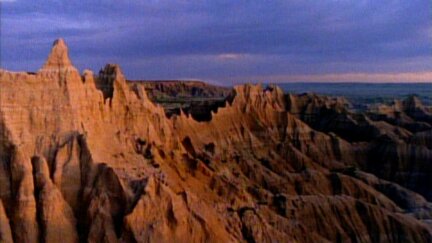
The winter scenery is especially striking in the Bad Lands, with
their queer fantastic formations. Among the most interesting features
are the burning mines. These are formed by the coal seams that get on
fire. They vary greatly in size. Some send up smoke-columns that are
visible miles away, while others are not noticeable a few rods off.
The old ones gradually burn away, while new ones unexpectedly break
out. Thus, last fall, one suddenly appeared but half a mile from the
ranch house. We never knew it was there until one cold moonlight
night, when we were riding home, we rounded the corner of a ravine
and saw in our path a tall white column of smoke rising from a rift
in the snowy crags ahead of us. As the trail was over perfectly
familiar ground, we were for a moment almost as startled as if we had
seen a ghost.
The burning mines are uncanny places, anyhow. A strong smell of
sulphur hangs round them, the heated earth crumbles and cracks, and
through the long clefts that form in it we can see the lurid glow of
the subterranean fires, with here and there tongues of blue or cherry
colored flame dancing up to the surface.
The winters vary greatly in severity with us. During some seasons
men can go lightly clad even in January and February, and the cattle
hardly suffer at all; during others there will be spells of bitter
weather, accompanied by furious blizzards, which render it impossible
for days and weeks at a time for men to stir out-of-doors at all,
save at the risk of their lives. Then line rider, ranchman, hunter,
and teamster alike all have to keep within doors. I have known of
several cases of men freezing to death when caught in shelterless
places by such a blizzard, a strange fact being that in about half of
them the doomed man had evidently gone mad before dying, and had
stripped himself of most of his clothes, the body when found being
nearly naked. On our ranch we have never had any bad accidents,
although every winter some of us get more or less frost-bitten. My
last experience in this line was while returning by moonlight from a
successful hunt after mountain sheep. The thermometer was
26°below zero, and we had had no food for twelve hours. I became
numbed, and before I was aware of it had frozen my face, one foot,
both knees, and one hand. Luckily, I reached the ranch before serious
damage was done.
About once every six or seven years we have a season when these
storms follow one another almost without interval throughout the
winter months, and then the loss among the stock is frightful. One
such winter occurred in 1880-81. This was when there were very few
ranchmen in the country. The grass was so good that the old range
stock escaped pretty well; but the trail herds were almost destroyed.
The next severe winter was that of 1886-87, when the rush of incoming
herds had overstocked the ranges, and the loss was in consequence
fairly appalling, especially to the outfits that had just put on
cattle.
The snow-fall was unprecedented, both for its depth and for the
way it lasted; and it was this, and not the cold, that caused the
loss. About the middle of November the storms began. Day after day
the snow came down, thawing and then freezing and piling itself
higher and higher. By January the drifts had filled the ravines and
coulees almost level. The snow lay in great masses on the plateaus
and river bottoms; and this lasted until the end of February. The
preceding summer we had been visited by a prolonged drought, so that
the short, scanty grass was already well cropped down; the snow
covered what pasturage there was to the depth of several feet, and
the cattle could not get at it at all, and could hardly move round.
It was all but impossible to travel on horseback &emdash;except on a
few well-beaten trails. It was dangerous to attempt to penetrate the
Bad Lands, whose shape had been completely altered by the great white
mounds and drifts. The starving cattle died by scores of thousands
before their helpless owners' eyes. The bulls, the cows who were
suckling calves, or who were heavy with calf, the weak cattle that
had just been driven up on the trail, and the late calves suffered
most; the old range animals did better, and the steers best of all;
but the best was bad enough. Even many of the horses died. An outfit
near me lost half its saddle-band, the animals having been worked so
hard that they were very thin when fall came.
In the thick brush the stock got some shelter and sustenance. They
gnawed every twig and bough they could get at. They browsed the
bitter sage brush down to where the branches were the thickness of a
man's finger. When near a ranch they crowded into the outhouses and
sheds to die, and fences had to be built around the windows to keep
the wildeyed, desperate beasts from thrusting their heads through the
glass panes. In most cases it was impossible either to drive them to
the haystacks or to haul the hay out to them. The deer even were so
weak as to be easily run down; and on one or two of the plateaus
where there were bands of antelope, these wary creatures grew so
numbed and feeble that they could have been slaughtered like rabbits.
But the hunters could hardly get out, and could bring home neither
hide nor meat, so the game went unharmed.
The way in which the cattle got through the winter depended
largely on the different localities in which the bands were caught
when the first heavy snows came. A group of animals in a bare valley,
without underbrush and with steepish sides, would all die, weak and
strong alike; they could get no food and no shelter, and so there
would not be a hoof left. On the other hand, hundreds wintered on the
great thickly wooded bottoms near my ranch house with little more
than ordinary loss, though a skinny sorry-looking crew by the time
the snow melted. In intermediate places the strong survived and the
weak perished. It would be impossible to imagine any sight more
dreary and melancholy than that offered by the ranges when the snow
went off in March. The land was a mere barren waste; not a green
thing could be seen; the dead grass eaten off till the country looked
as if it had been shaved with a razor. Occasionally among the
desolate hills a rider would come across a band of gaunt,
hollow-flanked cattle feebly cropping the sparse, dry pasturage, too
listless to move out of the way; and the blackened carcasses lay in
the sheltered spots, some stretched out, others in as natural a
position as if the animals had merely lain down to rest. It was small
wonder that cheerful stockmen were rare objects that spring.
Our only comfort was that we did not, as usual, suffer a heavy
loss from weak cattle getting mired down in the springs and mud-holes
when the ice broke up &emdash;for all the weak animals were dead
already. The truth is, ours is a primitive industry, and we suffer
the reverses as well as enjoy the successes only known to primitive
peoples. A hard winter is to us in the north what a dry summer is to
Texas or Australia &emdash;what seasons of famine once were to all
peoples. We still live in an iron age that the old civilized world
has long passed by. The men of the border reckon upon stern and
unending struggles with their iron-bound surroundings; against the
grim harshness of their existence they set the strength and the
abounding vitality that come with it. They run risks to life and limb
that are unknown to the dwellers in cities; and what the men freely
brave, the beasts that they own must also sometimes suffer.
Ranch Life and
the Hunting Trail Continued
Show Ranch Life Contents |