
|
|

RANCH LIFE AND THE HUNTING TRAIL
by Theodore Roosevelt
CHAPTER 10
THE WAPITI, OR ROUND-HORNED ELK
This stately and splendid deer, the lordliest of its kind
throughout the world, is now fast vanishing. In our own neighborhood
it is already almost a thing of the past. But a small band yet
lingers round a great tract of prairie and Bad Lands some thirty-five
miles from the ranch house.
One fall I killed a good bull out of the lot. I was hunting on
horseback, and roused the elk out of a deep, narrow coulee, heavily
timbered, where he was lying by himself. He went straight up the
steep side directly opposite to where I stood, for I had leaped off
my horse when I heard the crash of the underbrush. When on a level
with me, he halted and turned half round to gaze at me across the
ravine, and then I shot him.
The next season, when we were sorely in need of meat for smoking
and drying, we went after these elk again. At the time most of the
ponies were off on one of the round-ups, which indeed I had myself
just left. However, my two hunting-horses, Manitou and Sorrel Joe,
were at home. The former I rode myself, and on the latter I mounted
one of my men who was a particularly good hand at finding and
following game. With much difficulty we got together a scrub wagon
team of four as unkempt, dejected, and vicious-looking broncos as
ever stuck fast in a quicksand or balked in pulling up a steep pitch.
Their driver was a crack whip, and their load light, consisting of
little but the tent and the bedding; so we got out to the
hunting-ground and back in safety; but as the river was high and the
horses were weak, we came within an ace of being swamped at one
crossing, and the country was so very rough that we were only able to
get the wagon up the worst pitch by hauling from the saddle with the
ridinganimals.
We camped by an excellent spring of cold, clear water &emdash;not
a common luxury in the Bad Lands. We pitched the tent beside it,
getting enough timber from a grove of ash to make a large fire, which
again is an appreciated blessing on the plains of the West, where we
often need to carry along with us the wood for cooking our supper and
breakfast, and sometimes actually have to dig up our fuel, making the
fire of sage-brush roots, eked out with buffalo chips. Though the
days were still warm, the nights were frosty. Our camp was in a deep
valley, bounded by steep hills with sloping, grassy sides, one of
them marked by a peculiar shelf of rock. The country for miles was of
this same character, much broken, but everywhere passable for
horsemen, and with the hills rounded and grassy, except now and then
for a chain of red scoria buttes or an isolated sugar-loaf cone of
gray and brown clay. The first day we spent in trying to find the
probable locality of our game; and after beating pretty thoroughly
over the smoother country, towards nightfall we found quite fresh elk
tracks leading into a stretch of very rough and broken land about ten
miles from camp.
We started next morning before the gray was relieved by the first
faint flush of pink, and reached the broken country soon after
sunrise. Here we dismounted and picketed our horses, as the ground we
were to hunt through was very rough. Two or three hours passed before
we came upon fresh signs of elk. Then we found the trails that two,
from the size presumably cows, had made the preceding night, and
started to follow them, carefully and noiselessly, my companion
taking one side of the valley in which we were and I the other. The
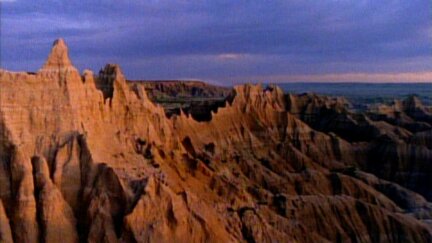
tracks led into one of the wildest and most desolate parts of the Bad
Lands. It was now the heat of the day, the brazen sun shining out of
a cloudless sky, and not the least breeze stirring. At the bottom of
the valley, in the deep, narrow bed of the winding water-course, lay
a few tepid little pools, almost dried up. Thick groves of stunted
cedars stood here and there in the glen-like pockets of the high
buttes,, the peaks and sides of which were bare, and only their
lower, terrace-like ledges thinly clad with coarse, withered grass
and sprawling sage-brush; the parched hill-sides were riven by deep,
twisted gorges, with brushwood in the bottoms; and the cliffs of
coarse clay were cleft and seamed by sheer-sided, canon-like gullies.
In the narrow ravines, closed in by barren, sun-baked walls, the hot
air stood still and sultry; the only living beings were the
rattlesnakes, and of these I have never elsewhere seen so many. Some
basked in the sun, stretched out at their ugly length of mottled
brown and yellow; others lay half under stones or twined in the roots
of the sage-brush, and looked straight at me with that strange,
sullen, evil gaze, never shifting or moving, that is the property
only of serpents and of certain men; while one or two coiled and
rattled menacingly as I stepped near.
Yet, though we walked as quietly as we could, the game must have
heard or smelt us; for after a mile's painstaking search we came to a
dense thicket in which were two beds, evidently but just left, for
the twigs and bent grass-blades were still slowly rising from the
ground to which the bodies of the elk had pressed them. The long,
clean hoof-prints told us that the quarry had started off at a
swinging trot. We followed at once, and it was wonderful to see how
such large, heavy beasts had gone up the steepest hill-sides without
altering their swift and easy gait, and had plunged unhesitatingly
over nearly sheer cliffs down which we had to clamber with careful
slowness.
They left the strip of rugged Bad Lands and went on into the
smoother country beyond, luckily passing quite close to where our
horses were picketed. We thought it likely that they would halt in
some heavily timbered coulees six or seven miles off; and as there
was no need of hurry, we took lunch and then began following them up
&emdash;an easy feat, as their hoofs had sunk deep into the soft
soil, the prints of the dew-claws showing now and then. At first we
rode, but soon dismounted, and led our horses.
We found the elk almost as soon as we struck the border of the
ground we had marked as their probable halting-place. Our horses were
unshod, and made but little noise; and coming to a wide, long coulee
filled with tall trees and brushwood, we as usual separated, I going
down one side and my companion the other. When nearly half-way down
he suddenly whistled sharply, and I of course at once stood still,
with my rifle at the ready. Nothing moved, and I glanced at him. He
had squatted down and was gazing earnestly over into the dense laurel
on my side of the coulee. In a minute he shouted that he saw a red
patch in the brush which he thought must be the elk, and that it was
right between him and myself. Elk will sometimes lie as closely as
rabbits, even when not in very good cover; still I was a little
surprised at these not breaking out when they heard human voices.
However, there they staid; and I waited several minutes in vain for
them to move. From where I stood it was impossible to see them, and I
was fearful that they might go off down the valley and so offer me a
very poor shot. Meanwhile, Manitou, who is not an emotional horse,
and is moreover blessed with a large appetite, was feeding greedily,
rattling his bridle-chains at every mouthful; and I thought that he
would act as a guard to keep the elk where they were until I shifted
my position. So I slipped back, and ran swiftly round the head of the
coulee to where my companion was still sitting. He pointed me out the
patch of red in the bushes, not sixty yards distant, and I fired into
it without delay, by good luck breaking the neck of a cow elk, when
immediately another one rose up from beside it and made off. I had
five shots at her as she ascended the hill-side and the gentle slope
beyond; and two of my bullets struck her close together in the flank,
ranging forward &emdash;a very fatal shot. She was evidently mortally
hit, and just as she reached the top of the divide she stopped,
reeled, and fell over, dead.
We were much pleased with our luck, as it secured us an ample
stock of needed fresh meat; and the two elk lay very handily, so that
on the following day we were able to stop for them with the wagon on
our way homeward, putting them in bodily, and leaving only the
entrails for the vultures that were already soaring in great circles
over the carcasses.*
[*No naturalist ever described the way vultures gather with more
scientific accuracy than Longfellow:
" Never stoops the soaring vulture
On his quarry in the desert,
On the sick or wounded bison,
But another vulture, watching
From his high aerial lookout,
Sees the downward plunge, and follows
And a third pursues the second,
Coming from the invisible ether,
First a speck, and then a vulture,
Till the air is dark with pinions."]
Much the finest elk antlers I ever got, as a trophy of my own
rifle, were from a mighty bull that I killed far to the west of my
ranch, in the eastern chains of the Rockies. I shot him early one
morning, while still-hunting through the open glades of a great pine
forest, where the frosty dew was still heavy on the grass. We had
listened to him and his fellows challenging each other all night
long. Near by the call of the bulls in the rutting season
&emdash;their " whistling," as the frontiersmen term it
&emdash;sounds harsh and grating; but heard in the depths of their
own mountain fastnesses, ringing through the frosty night, and
echoing across the ravines and under the silent archways of the
pines, it has a grand, musical beauty of its own that makes it, to
me, one of the most attractive sounds in nature.
At this season the bulls fight most desperately, and their combats
are far more often attended with fatal results than is the case with
deer. In the grove back of my ranch house, when we first took
possession, we found the skulls of two elk with interlocked antlers;
one was a royal, the other had fourteen points. Theirs had been a
duel to the death.
In hunting, whether on the prairie or in the deep woods, a man
ought to pay great heed to his surroundings, so as not to get lost.
To an old hand, getting lost is not so very serious; because, if he
has his rifle and some matches, and does not lose his head, the worst
that can happen to him is having to suffer some temporary discomfort.
But a novice is in imminent danger of losing his wits, and therefore
his life. To a man totally unaccustomed to it the sense of utter
loneliness is absolutely appalling: the feeling of being lost in the
wilderness seems to drive him into a state of panic terror that is
frightful to behold, and that in the end renders him bereft of
reason. When he realizes that he is lost he often will begin to
travel very fast, and finally run until he falls exhausted
&emdash;only to rise again and repeat the process when he has
recovered his strength. If not found in three or four days, he is
very apt to become crazy; he will then flee from the rescuers, and
must be pursued and captured as if he were a wild animal.
Since I884, when I went to the Big Horn Mountains, I have killed
no grizzlies. There are some still left in our neighborhood, but they
are very shy, and live in such inaccessible places, that, though I
have twice devoted several days solely to hunting them, I was
unsuccessful each time. A year ago, however, two cowboys found a bear
in the open, and after the expenditure of a great number of
cartridges killed it with their revolvers, the bear charging gamely
to the last.
But this feat sinks into insignificance when compared with the
deed of General W. H. Jackson, of Bellemeade, Tennessee, who is
probably the only man living who ever, single-handed, killed a
grizzly bear with a cavalry saber. It was many years ago, when he was
a young officer in the United States service. He was with a column of
eight companies of mounted infantry under the command of Colonel
Andrew Porter, when by accident a bear was roused and lumbered off in
front of them. Putting spurs to his thoroughbred, he followed the
bear, and killed it with the saber, in sight of the whole command.
Ranch Life and
the Hunting Trail Continued
Show Ranch Life Contents |