
|
|

RANCH LIFE AND THE HUNTING TRAIL
by Theodore Roosevelt
CHAPTER 11
THE BIG-HORN SHEEP
It has happened that I have generally hunted big-horn during weather
of arctic severity; so that in my mind this great sheep is
inseparably associated with snow-clad, desolate wastes, ice-coated
crags, and the bitter cold of a northern winter; whereas the sight of
a prong-buck, the game that we usually hunt early in the season,
always recalls to me the endless green of the midsummer prairies as
they shimmer in the sunlight.
Yet in reality the big-horn is by no means confined to any one
climatic zone. Along the interminable mountain chains of the Great
Divide it ranges south to the hot, dry table-lands of middle Mexico,
as well as far to the northward of the Canadian boundary, among the
towering and tremendous peaks where the glaciers are fed from fields
of everlasting snow. There exists no animal more hardy, nor any
better fitted to grapple with the extremes of heat and cold.
Droughts, scanty pasturage, or deep snows make it shift its ground,
but never mere variation of temperature. The lofty mountains form its
favorite abode, but it is almost equally at home in any large tract
of very rough and broken ground. It is by no means an exclusively
alpine animal, like the white goat. It is not only found throughout
the main chains of the Rockies, as well as on the Sierras of the
south and the coast ranges of western Oregon, Washington, and British
Columbia, but it also exists to the east among the clusters of high
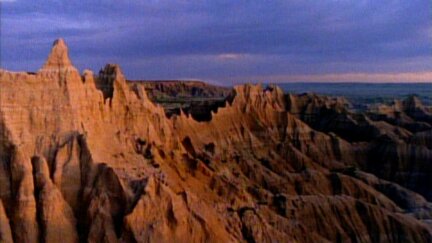
hills and the stretches of barren Bad Lands that break the monotonous
level of the great plains.
Throughout most of its range the big-horn is a partly migratory
beast. In the summer it seeks the highest mountains, often passing
above timber-line; and when the fall snows deepen it comes down to
the lower spurs or foot-hills, or may even travel some distance
southward. If there is a large tract of Bad Lands near the mountains,
sheep may be plentiful in them throughout the severe weather, while
in the summer not a single individual will be found in its winter
haunts, all having then retired to the high peaks.
Sometimes big-horn wander widely for reasons unconnected with the
weather: all of those in a district may suddenly leave it and perhaps
not return for several years. Such is often the result of a district
being settled, or being exposed to incessant hunting. After a certain
number of sheep have been killed the remainder may all disappear,
possibly one or two small bands only staying behind; but it is quite
likely that two or three years later the bulk of the vanished host
will come back again.
But where the region that they inhabit is cut off from the
mountains by settled districts, or by great stretches of plain and
prairie, then the sheep that dwell therein can make no such
migrations. Thus they live all the year round in the Little Missouri
Bad Lands; and though the different bands wander away and to and fro
for scores of miles, especially in the fall, &emdash;for big-horn are
far more restless than deer, &emdash;yet they do not shift their
positions much on account of the season, and are often found in
precisely the same places both summer and winter. They thus bear with
indifference exposure to the extremes of heat and cold in a climate
where the yearly variation reaches the utmost possible limit, the
thermometer sometimes covering a range of a hundred and seventy
degrees in the course of twelve months. There are few spots on earth
much hotter than these Bad Lands during a spell of fierce summer
weather, and, unlike the deer, the sheep cannot seek the shade of the
dense thickets. In the glare of midday the naked angular hills yield
no shelter whatever; the barren ravines between them turn into ovens
beneath the brazen sun. The still, lifeless, burning air stifles
those who breathe it, while the parched and heat-cracked canon walls
are intolerable to the touch.
But though the mountain sheep can stand this, and in fact do so
with even less protection than the deer, yet they certainly dislike
it more than do the latter. If mountains are near, they go up them
far sooner and far higher than the deer. On the other hand, they bear
the winter blizzards much better, caring less for shelter, and
keeping their strength pretty well. Ordinarily when in the Bad Lands
they do not shift their ground save to get on the lee side of the
cliffs, though the deep snows of course drive them from the
mountains. A very heavy fall of snow, if they are high up on the
hills, occasionally forces a band to enter the evergreen woods and
make a regular yard, as deer do, beneath the overhanging cover-giving
branches; then they subsist on the scanty browse until they can get
back to pasture lands. But this is rare. Generally they stay in the
open, and bid defiance to the elements; yet, like other game, they
often seem to have the knack of foretelling any storm or cold spell
of unusual severity and length. On the eve of such a storm they
frequently retreat to some secure haven of refuge. This may be a nook
or cranny in the rocks, or merely a slight hollow to leeward of a
little grove of stunted pines; and there the band may have to stay
without food for several days, until the storm is over. Occasionally
they succumb to the deep snow; but if they have any kind of chance
for their lives, this happens less often than with either deer or
antelope.
The big-horn, or cimarron sheep, as the Mexicans call it, is the
sole American representative of the different kinds of mountain sheep
that are found in the Old World. It is fourfold the weight of the
Mediterranean moufflon. Its nearest relative, from which it is with
diffficulty distinguished, is the huge argali, three or four
varieties &emdash;some say species &emdash;of which are to be found
in the high lands of central Asia. The American and Asiatic animals
seem to grade into one another as regards size; the north Asiatic
argali is said to be no larger than the big-horn, but the giant
Himalayan sheep, or nyan, averages heavier, both in body and horns,
and especially in length of legs. The horns of the argali have more
outward twist. The largest big-horn of which I have ever been able to
get authentic record was one killed in Montana by a ranch friend of
mine, and carefully weighed and measured at the time. At the shoulder
he stood just three feet eight inches; he weighed very nearly four
hundred pounds; and his single unbroken horn was in girth nineteen
inches, and in length along the curve forty-two. But such a ram is a
giant. The largest I have myself shot I had no means of weighing: it
was just after the rutting season, and he was as gaunt as a
greyhound. At the shoulder he stood three feet five inches; and his
horns, which were thick for their length, were in girth sixteen and a
half inches, and in length thirty. The nyan of Thibet, on the other
hand, stands four feet high; and exceptional rams have horns
twenty-three inches round the base and upwards of fifty in length,
while the average full-grown one will perhaps have them seventeen
inches by thirty-eight. The nyan thus certainly stands before the
big-horn, although even among full-grown animals many heads of the
latter would be above the average of the former. The difference in
the habits of the two animals is very marked, for according to the
English sportsmen the nyan keeps exclusively to the high, open
plains, or barren, gently sloping hills; whereas the big-horn, like
the Old World ibex, is a beast of the crags and precipices, and
though sometimes venturing into the level country, yet at the first
alarm it invariably dashes for the broken ground.
Our American mountain sheep usually go in bands of from fifteen to
thirty individuals, occasionally of many more; while often small
parties of two or three will stay by themselves. In the winter, or
sometimes not until the early spring, the old rams separate. The
oldest and finest are often found entirely alone, retiring to the
most inaccessible solitudes; the younger ones keep in little flocks
of perhaps half a dozen or so. The main band then consists only of
the ewes, the yearlings, and now and then a two-year-old; and this
also is soon broken up, leaving merely the yearlings and the barren
ewes, for about the middle of May the ewes that are heavy with young
leave the rest, each by herself. Like the old rams, they now seek the
most inaccessible and far-off places &emdash;high up the mountains,
if possible; otherwise, in the barren and unfrequented portions of
the Bad Lands, where the steep hills and abrupt valleys are twisted
into a mere tangle of precipitous crests and cañons. Here the
ewe makes her lying-in bed &emdash;oval in shape, like that of a
prong-horn or black-tail doe, but made by pawing out, or perhaps
merely wearing out, a slight hollow in the bare soil; whereas the doe
crushes down with her weight the long grass of the prairie or
thicket. This bed is usually made on the ledge of a cliff, on the
side where there is most shelter from the prevailing winds; perhaps
it is beneath a great rock or clay bowlder, with not so much as a
blade of grass around, or it may be partly screened by a few
wind-beaten sage-bushes. Generally only one, but sometimes two, young
are brought forth at a birth. The young lamb matches his surroundings
wonderfully in color, and the ewe is very careful in going to him to
be sure that she is unobserved. For the first day or two the lamb
trusts for his safety solely to not being seen by the beasts and
birds of prey. He crouches flat down, like an antelope fawn, and it
is next to impossible for human eyes to discover him save by
accident. Once only I stumbled across a newly born lamb. It was about
the first of June, and I found him lying by the bed of the mother as
I was going along a ledge, scantily covered with sage brush, in the
heart of some high, wild hills, about fifteen miles from my ranch.
The little fellow was too young to show much alarm when I handled and
petted him and with much diffficulty persuaded him to stand up on his
helplessly weak and awkward little legs. The mother was about two
hundred yards distant, and was greatly frightened when I drew near
her offspring; she hung about in the distance for a short time and
then dashed off. However, she must have returned when I left; for two
or three days later, when from curiosity I came back, the little
fellow was gone.
When the young are able to clamber about for short distances
almost as well as the old, then the nursing ewes and their lambs
rejoin the band, some time in July. The band now keeps in the
neighborhood of water and where the feed is good
&emdash;comparatively good, at least, for the scanty pasturage that
grows on the mountains and barren hills haunted by the sheep would
hardly please more luxury-loving animals. The flocks of ewes and
lambs are at this time quite easily discovered, but of course no man
but a game butcher would dream of molesting them. In September the
young rams begin to join them, and soon afterwards the old patriarchs
likewise come down from their remote fastnesses.
The rams now fight desperately among themselves for the possession
of the ewes, rushing together with a shock that would shatter their
skulls were they less strong; while the battered horns, with
splintered ends, bear witness to the violence of the contests. These
contests are free from one danger, however; the horns do not get
interlocked, and thus cause the death of both combatants. This is not
only a common accident among deer and elk, but it even happens to
antelope; I knew of one instance where two prong-horn bucks, who had
evidently been battling for a doe, were found dead, side by side,
partly eaten by the coyotes. The right horn of one and the left horn
of the other had become locked together so firmly, thanks to the
prong and the hook at the end, that they could not be drawn apart,
and the two beasts had died miserably in consequence. Each herd has
some acknowledged master ram, but he may tolerate the presence of
three or four others of lesser degree, together with the ewes, lambs,
and yearlings that go to make up the rest of the flock; or else, if a
cross old fellow, the master ram may turn out all the others, or may
content himself with a little bunch of merely three or four ewes. So
that even at this season several young rams may be found by
themselves; or a morose old veteran, time-worn and battle-scarred,
may keep entirely alone. As soon as the rutting season is over many
of these exiles rejoin the band; and at this time, when the rams are
of course in very poor condition, they are all apt to come down on
the levels more boldly than at any other season, to get at the good
grass, although even now rarely venturing very far from the hills.
While thus on the edges of the plains, their natural wariness seems
to increase tenfold.
But at all times their habits are very variable; for they are
restless, wandering beasts, with something whimsical in their
tempers, and given at times to queer freaks. If the fit seize them,
and especially if they have been alarmed or annoyed, they may at any
time leave their accustomed dwelling-places, or act in a manner
absolutely contrary to their usual conduct. About noon one hot
midsummer day, three great rams crossed the river just below our
ranch, stopping to drink, and spending some time on the sand-bars,
occasionally playfully butting at each other. They trotted off before
they could be stalked. To get down to the river they had to pass over
a level plain half a mile wide; and once across, they went through a
dense wood choked with underbrush for nearly half a mile more before
again coming to the steep bluffs. On another occasion, in the rutting
season, one of my cowboys encountered a mountain-ram crossing a
broad, level river-bottom at midday. Occasionally a ram will join a
flock of ewes, or a ewe and a yearling, in the spring. Two or three
times I have known them to come boldly up to the bluffs that overlook
and skirt a little frontier town, and there to stay grazing or
resting for several hours; but they always made off in plenty of time
to avoid the hunters who finally went after them. Once I shot one
within a few hundred yards of my ranch house. I was returning home,
weary and unsuccessful, after a long day's tramp over hills where
black-tail usually were common. When nearly home I struck into a
well-beaten cattle-trail, leading down a deep, narrow ravine which
cleft in two a knot of jagged hills; it was a favorite range for our
horses, and so was frequently ridden over by the cowboys. On turning
round a corner of the ravine, a sudden snort to one side and above me
made me hastily look up, shifting my rifle from my shoulder. On my
right the sheer wall of clay rose up without a break for perhaps two
hundred feet or so, its thin, notched crest showing against the
sky-line as sharply as if cut with a knife; and on a little jutting
pinnacle was perched a mountain sheep, its four hoofs all together on
a space no larger than the palms of a man's hands. It was facing me
and staring down at me, so that the bullet went right into its chest,
splitting its heart fairly open. Yet it did not fall forward over the
cliff, but wheeled on its haunches and went along the crest at a mad,
plunging gallop, finally crossing out of sight. Almost as soon as it
disappeared a column of dust rose from the other side of the ridge,
making me think that it had fallen some distance, striking hard on
the dry clay. The guess was a good one, and when, after a long circle
and some climbing, I reached the spot, I found a fine young barren
ewe lying dead at the foot of a high cut bank.
But all such instances as these are wholly exceptional, and are
chiefly interesting as showing that mountain sheep act more
erratically and less according to rule than do most other kinds of
game. They seem to have fits of restless waywardness, or even of
panic curiosity; and so at times wander into unlooked-for places, or
betray a sudden heedlessness of dangers against which they on
ordinary occasions carefully guard. This last freak, however, is
generally shown only in very wild localities or among young animals.
Where hunters are scarce or almost unknown, all wild animals are very
bold. I have seen deer in remote forests, and even in little-hunted
localities near my ranch, so tame that they would stand looking at
the hunter within fifty yards for several minutes before taking
flight. Mountain sheep under similar circumstances show a lordly
disregard for the human intruder, leaving his presence at a leisurely
gait, in strong contrast to the mad gallop of their more
sophisticated brethren when alarmed.
In fact, much of the wariness among beasts of chase, as well as
much of the courage shown by the more ferocious, depends upon the
degree in which they have been harried by hunters, although much also
depends upon the character of the species. European game is thus
generally wilder than American; but no animal could be more difficult
to approach than a Maine moose. The deer of the Adirondacks and
Alleghanies are almost as wary, and in those parts of the Rockies
where they have been much molested, big-horn are as shy as the
chamois of the Alps, or the ibex of the Pyrenees. So the sloth bear
and leopard of India are now much more vicious and dangerous to man
than are the black bear and cougar of the United States, simply
because of the different race of human beings by whom they are
surrounded.
No animal seems to have been more changed by domestication than
the sheep. The timid, helpless, fleecy idiot of the folds, the most
foolish of all tame animals, has hardly a trait in common with his
self-reliant wild relative who combines the horns of a sheep with the
hide of a deer, whose home is in the rocks and the mountains, and who
is so abundantly able to take care of himself. Wild sheep are as good
mountaineers as wild goats, or as mountain antelopes, and are to the
full as wary and intelligent.
A very short experience with the rifle-bearing portion of mankind
changes the big-horn into a quarry whose successful chase taxes to
the utmost the skill alike of still-hunter and of mountaineer. A
solitary old ram seems to be ever on the watch. His favorite
resting-place is a shelf or terrace-end high up on some cliff, from
whence he can see far and wide over the country round about. The
least sound &emdash;the rattle of a loose stone, a cough, even a
heavy footfall on hard earth &emdash;attracts his attention, making
him at once clamber up on some peak to try for a glimpse of the
danger. His eyes catch the slightest movement. His nose is as keen as
an elk's, and gives him surer warning than any other sense; the
slightest taint in the air produces immediate flight in the direction
away from the danger. But there is one compensation, from the
hunter's stand point, for his wonderfully developed smelling powers;
he lives in such very broken country that the currents of air often
go over his head, so that it is at times possible to hunt him almost
down wind.
A band of sheep is, if anything, even more difficult to approach
than is a single ram; but, on the other hand, it is far easier to get
on the track of and to find out, as there are always some young
members guilty of indiscretions. All of the flock are ever on the
lookout. While the others are grazing there is always at least one
with its head up; and occasionally a particularly watchful ewe will
jump up on some bowlder, or at least stand with her fore-legs against
its side, so as to get a wider view. Any unexplained sight or sound
is announced to the rest of the herd by a kind of hissing snort, or
sometimes by a stamp of the forefoot on the ground. If the intruder
is either smelt or seen, the whole herd instantly break into the
strong but not particularly swift gallop which distinguishes the
species, and go straight away from the danger towards the roughest
ground that they can reach. If, however, only alarmed by a sound, or
if the suspicious object is some distance off, the animals often run
together into a bunch and stand gazing in its direction for a few
seconds prior to making off. Among cliffs and precipices the echoes
are so confusing that if the hunter keeps out of sight the herd
occasionally become utterly bewildered by the firing, and, as a
result, spend several fatal minutes in a futile running to and fro,
uncertain what course will take them out of danger. One day my
cousin, West Roosevelt, after a long and careful stalk, got close up
to three sheep in a very deep and narrow ravine; and although, owing
to their being almost underneath him, he at first overshot, yet all
three of the startled and panic-struck animals were killed before
they recovered their wits sufficiently to run out of range.
But a chance like this may not happen once in a hunter's lifetime.
Of all American game, this is the one in whose pursuit the successful
hunter needs to show most skill, hardihood, and resolution. On
ordinary occasions a big-horn, when menaced by danger, flees beyond
its reach with instant decision and headlong speed, disappearing with
incredible rapidity over ground where it needs an expert cragsman to
so much as follow at a walk. Its wonderful feats of climbing have, as
with the chamois and ibex of the Old World, given rise to many
fables, the most widespread being the belief that the rams, in
plunging down precipices, alight on their horns. So the chamois was
said to hang over ledges by means of its short, hooked horns, and
when cornered on the edge of a sheer precipice, where there was no
escape from the hunter, of its own accord to thrust its body against
his outstretched knife &emdash;as we read and see pictured in the
German hunting-books of two or three centuries ago, such as the
quaint old "Adeliche Weidwerke."
The mountain sheep of America, when the choice is open to them,
actually seem to prefer regions as wild and rugged as they are
sterile. The tufts of grass between the rocks, the scanty blades that
grow on the clay buttes, suffice for their wants, and the amount of
climbing necessary to get at them is literally a matter of
indifference to beasts whose muscles are like whipcord and whose
tendons are like steel. A big-horn is a marvelous leaper, perhaps
even better when the jump is perpendicular than when it is
horizontal. His poise is perfect; his eye and foot work together with
unerring accuracy. One will unhesitatingly bound or drop a dozen feet
on to a little rock pinnacle where there is scarce a hand's breadth
on which to stand. The presence of the tiniest cracks in the
otherwise smooth surface of a sheer rock wall enables a mountain
sheep to go up it with ease. The proud, lordly bearing of an old ram
makes him look exactly what he is, one of the noblest of game
animals; his port is the same whether at rest or in motion. Except
when very badly frightened, his movements are all made with a certain
self-confident absence of hurry, as if he were conscious of a vast
reserve power of strength and activity on which to draw at need. As a
mountaineer he is the embodiment of elastic, sinewy strength and
self-command rather than of mere nervous agility. He hardly ever
makes a mistake, even when rushing at speed over the slippery,
ice-coated crags in winter.
The most difficult of all climbing is to go over rocks when the
ice has filled up all the chinks and crannies, and the flat slabs are
glassy in their hard smoothness. A black-tail buck is no mean
climber; yet under such circumstances I have seen one lose his
footing and tumble head over heels, scraping great handfuls of hair
off his hide; but I have never known a big-horn to make a misstep.
This is undoubtedly largely owing to the difference between the two
animals in the structure of their feet. A sheep's hoof is an elastic
pad, only the rims and the toe-points being hard, and it thus gets a
good grip on the slightest projection, or on any little roughness in
the rock. The tracks are very different from deer tracks, being
nearly square in form, instead of heart-shaped, the prints of the
toes rather deep and wide apart, even when the animal has been
walking.
A band of sheep will often seem to court certain death by plunging
off the brink of what looks like a perpendicular cliff, where there
is not a ledge or a crack yielding foot-hold. In such cases, if the
cliff is high, it will be found on examination that it is not quite
perpendicular, and that the sheep, in making the fearful descent,
from time to time touch or strike the cliff with their hoofs, thus
going down in long bounds, keeping their poise all the time. The
final bound is often made almost head first, as if they were diving.
Narrow ledges, overlooking an abyss the fathomless depths of which
would make even a trained cragsman giddy, are very favorite resorts.
So are the crests of the ridges themselves. If in any patch of Bad
Lands there is an unusually high chain of steep, bare clay buttes,
mountain sheep are sure to select their tops as a regular
parade-ground. After a rain the clay takes their hoof-prints as
clearly as if it were sealing-wax, and all along the top of the crest
they beat out a regular walk from one end to the other, with
occasional little side-paths leading out to some overhanging shoulder
or jutting spur, from whence there is a good view of the surrounding
country.
Generally the band is led by a ewe; but in a case of immediate and
pressing danger the ram assumes the headship. Aside from man,
mountain sheep have fewer foes than most other game. Bears are too
clumsy to catch them; and lynx and fox, inveterate enemies of fawns,
rarely get up to the high, breezy nurseries of the young lambs.
Wolves and cougars, however, harass them greatly. A wolf will not
attack an old ram if he can help it, but sneaks after the ewes and
lambs, waiting until they get on somewhat level ground, and then
running one down by sheer speed before it can take refuge among the
secure fastnesses of the precipices.
The cougar relies on stealth, not on speed, and gets his game
either by fair stalking or else by lying in wait. Sometimes he can
creep up to a band while they are taking their siesta; but generally
they keep too sharp a lookout, and he has to approach them while they
are feeding, or when they have come down to drink. Some fifteen miles
from my ranch is a tract of very rough country, the sides of the
hills falling off into precipices or into dark, cedar-clad gorges.
This was a favorite resort of mountain sheep; but one spring a couple
of cougars took up their abode in the neighborhood, and soon killed
several of the sheep and drove the others away. Judging by the tracks
and by the position of the carcasses, they must have done the killing
in the morning and evening, creeping up to the doomed animals as they
fed on the lower slopes, or lurking round the spring-holes and little
alkali pools where they drank. The great war eagle is one of the
worst enemies of the young lambs.
In the rutting season a ram will make a good fight if he has any
chance at all, and at that time is very bold and pugnacious. If
followed by a dog he will frequently decline to run, turning to bay
at once. One hunter whom I knew killed several in this way by the aid
of a collie. Of course it cannot be done when once the sheep have
begun to realize that the dog is merely an ally of the man, for they
then look out for the latter.
Sheep are easily tamed, if taken young, and make amusing pets. A
friend in Helena, Montana, once owned a tame ram. When young he was a
great favorite. He was an inquisitive, mischievous creature, of
marvelous activity. It was impossible to keep him out of the garden.
A single hop would carry him over the high fence; if an inmate of the
house came to the rescue, another hop carried the intruder once more
into outside safety, and a third took him back again the second the
rescuer had turned around. Whenever he got the chance he would pull
down the clothes that had been hung up to dry. When he could get
inside the house he was fond of walking on the mantel-piece. He was
the terror of the Chinese cook, whom he soon discovered to be afraid
of him, and would lie in wait outside the kitchen door so as to butt
him when he appeared. This was at first done in mere playfulness; but
as he grew older he became morose and quarrelsome, and had to be
disposed of
It is impossible to hunt big-horn successfully without some
knowledge of their habits. They go down to drink in the very late
evening, or some times in the gray of the morning; when the moon is
full they may not go to the water until long after nightfall.
Generally they drink later than any other game; but all game vary
their habits now and then in this regard. The prong-buck, though
diurnal, sometimes comes to a watering-hole during the night; and I
have once or twice seen both deer and sheep drinking at midday.
In ordinary weather they begin to feed early in the morning, and
when the sun has risen some little distance above the horizon they
start to graze their way slowly up to the high spur or ridge crest
where they intend to lie during the day. Here they stay until well on
in the afternoon, and then again descend to their feeding-grounds on
the lower slopes. In very cold weather, however, they are apt to be
found grazing at midday. A raging snow blizzard may keep them lying
close under cover for three days at a time: they naturally get
ravenous, and when there is a lull, or especially if it is succeeded
by a short spell of good weather, they come hastily out to feed, no
matter what the time of day may be.
As with almost all game except antelope, they can be best hunted
in the morning and evening; but, unlike deer, they can also be
followed throughout the day, for whereas elk, black-tail, and
white-tail have then all alike retired to the thickets, the big-horn
take their noontide rest lying out in plain view. If the hunter means
to catch them feeding he should make a very early start. A good pair
of field-glasses is of great service, for the two essential
requisites to success are the capacity to take long walks over rough
ground and painstaking care in scanning the country far and wide, so
as to see the game before it sees the hunter. There is then a chance
to stalk up close, the broken ground frequently yielding good cover.
Often it may be necessary to lie for hours carefully concealed,
watching a flock that is in an unfavorable position, and waiting
until it shifts its ground. This is not very comfortable on a cold
day in November or December, the months in which I have usually
hunted big-horn, devoting the early fall to the chase of elk and
deer. But it is often the only way to secure success: patience and
perseverance are two of the still-hunter's cardinal virtues.
Personally I have always owed whatever success I have had to dogged
perseverance and patient persistence, and on a lamentably large
number of occasions have had to draw heavily on these qualities to
make good a lack of skill, sometimes with the rifle, sometimes in
mountaineering. Among many hunting trips I can recall not a few where
willingness to lie still two or three hours under trying
circumstances in the end got me the game; and one such instance may
serve as a sample of the rest.
I was staying at the line camp of two of my cowboys, a small
dug-out in the side of a butte that marked the edge of the Bad Lands,
the rolling prairie coming up to its base. The quarters were cramped
for three men, an entire side of the little hut being filled by the
two bunks in which we slept, &emdash;I in the upper, my two
companions in the lower, &emdash;while the fireplace occupied one
end, the mess-box served as a table, and the earthcovered roof of
logs was so low that we could hardly stand upright. Window there was
none; but it was snug, and, for a line camp, clean. There was plenty
of fire-wood, and, for a wonder, the chimney did not smoke; so we
were comfortable enough. The butte itself served for three out of the
four walls. No other building is so warm as a dug-out, and in the
terrible winter weather of Dakota and Montana warmth is the one thing
for which all else must be sacrificed.* [* I have camped out when the
thermometer showed 65 degrees of frost; not -65°, as I see I
once put it by a mistake in copying my rough field-notes.]
In such high latitudes the December sun rises late. Long before
daybreak we had finished our breakfast of bread, beans, and coffee.
The two cowboys had saddled their shaggy ponies &emdash;which had
spent the night in the rough log stable &emdash;and had ridden off in
opposite directions along their lonely beat, muffled in their
wolf-skin overcoats and heavy shaps; while I strode off on foot
towards the high hills that lay riverward, my rifle on my shoulder
and my fur cap pulled down well over my ears.
The cold was biting, for even at noon the sun had not power to
thaw the frozen ground. But there was very little snow; just enough
to powder the hills and to lie in patches in the hollows. I walked
rapidly up a long coulee, then climbed up a steep rounded hill and
followed the divide back into the heart of the Bad Lands. By the time
I was on my chosen hunting grounds the sun had topped the horizon
behind me, and his level rays lit up the peaks and crests.
The next hour was spent in hard climbing and incessant
watchfulness. The hills lay in isolated masses. I clambered painfully
up their slippery sides, creeping along the narrow icy ledges that
ran across the faces of the cliffs, and cautiously working my way
over the smooth shoulders. From behind every ridge and spur I
carefully examined the opposite hill-sides, using the field-glasses
if there was scope for them. Sheep, standing still or lying down, are
often very hard to see, their coats assimilating curiously with the
neutral-tinted cliffs and bowlders; but against snow they of course
stand out much more distinctly.
At last, as I lay peeping over the ragged crest of a clay butte, I
made out a small dark object half way up a steep slope some six
hundred yards down the valley; and another look showed me that it was
a ram feeding leisurely up the hill-side. The wind was good for a
direct approach. I got off the butte by carefully letting myself down
from one little ledge or niche to another, and started along the
valley towards the ram, only to find my way barred by a deep chasm
whose straight, ice-coated sides yawned too far apart to permit of
any attempt at crossing. There was no help for it but laboriously to
retrace my steps and make my way round its head with what speed I
could. This I did, the work making me thoroughly warm for the first
time that morning. Once across the walking was better, and I went
down the valley-side at a good pace, until I came to a shoulder some
two hundred yards from where I had seen the sheep. I was a good deal
higher than where he had stood; but in the time I had been out of
sight of him he must have gone up the hill quite a distance, for when
I looked round the shoulder I saw him about as far off as I expected,
but above instead of below me. Slow though my movements had been when
I cautiously looked round the edge, they had not escaped his quick
eye; for when I made him out he was standing motionless, gazing in my
direction. Before I could raise my rifle he gave a great jump
sideways and galloped off, disappearing instantly behind a huge mass
of detached sandstone, and I never saw him again.
A little chagrined at my fruitless stalk I plodded on, doing much
hard climbing but seeing no signs of game until nearly midday. Then
in the snow at the head of a coulee I came across the tracks of a
band evidently made that morning while returning from the
feeding-grounds. I followed them until I became convinced that the
animals had gone to a great tableland or plateau that I could see a
good way ahead; then, as the wind was behind me, I struck off to one
side, made a circle through some very rough country, and clambered
out along the knife-like crests of a line of high hills separated
from the plateau by a broad valley. Every hundred paces or so I would
stop and examine the country far and near with the glasses; often I
had to crawl on all-fours to avoid appearing against the sky-line on
the ridge.
At last I caught sight of the band. There were some fifteen or
twenty of them, and they were lying at the point of a spur that was
thrust out from the plateau, nearly opposite to me and half a mile
off. They were in a position which it was impossible to approach
within six hundred yards without being observed, for they could see
over the level plateau behind them, and from the brink of the lofty
cliff on which they lay they looked up, down, and across the wild,
deep valley beneath.
With the glasses I could make out that there was no good head
among them; but I was out for meat rather than for sport. They were
very watchful, ever on the lookout; and as the afternoon wore on one
of the more restless would now and then get up, walk off a few steps,
or stand gazing intently into the far distance. There was nothing for
me to do except to wait until they grew hungry and shifted their
position to some place which there was a chance of my approaching
unseen. So for three hours I lay on the iron ground, under the lee of
a bowlder that but partly shielded me from the wind, munching the
strip of jerked venison I had carried in my pocket, and peeping at
the sheep through a tuft of tall, coarse grass that grew on top of
the ridge.
At last, when it wanted but little more than an hour of sunset,
the sheep all got on their legs, one after another, and, led by an
old ewe, began to descend into the valley. They went down the cliff
by a sort of break or slide, hopping dexterously from rock to rock.
On coming to the steep slope at its foot they struck into a trot,
which merged into a fast gallop as they got nearly down. I feared
that they would stop before coming to the cañon at the bottom
of the valley; but they did not, crossing it without hesitation, for
all its sheer-sided and slippery depth, and continuing their course
towards the end of the chain of hills on which I was, where they
halted to graze, after going up nearly to the top. It was excellent
ground for a stalk. The ridge went down to the left in the steep,
grassy slopes on which they were feeding, while on the right it broke
abruptly off into a precipice, with a narrow ledge high up along its
face.
This ledge made the approach an easy one. The only difficult
places were those where the ledge was interrupted, and I had either
cautiously to make my way along the face of the cliff, &emdash;a very
unpleasant task, as the slight hollows or knobs which served me as
foot-holds were slippery with ice, the risk of a fall being thus
enormously increased, &emdash;or else was forced to go to the top,
and, sprawling flat on the smooth slope, drag myself along just to
one side of the ridge. I had marked the position of the game by a
dwarfed cedar that grew in a crevice on the very crest. It gave
excellent cover, and on reaching it and peering out through the
branches, I saw the sheep scattered out only some sixty yards below
me, and, choosing out a fine young ram, I fired, breaking both
shoulders. They all rushed together, and then without an instant's
pause raced madly down the hill-side, neither of the two bullets that
I sent after them taking effect. I had no time to lose; so I dressed
the ram hastily, tilted him up so that the blood would run out, and
left him to be called for with the pony next day. Then I made the
best use of the waning light to get to a long divide, furrowed by
many buffalo trails, which I knew I could follow even when it grew
dark, and which came out on the prairie not very far to one side of
the line camp.
The day on which I was lucky enough to shoot my largest and finest
ram was memorable in more ways than one. The shot was one of the best
I ever made, &emdash;albeit the element of chance doubtless entered
into it far more largely than the element of skill, &emdash;and in
coming home from the hunt I got quite badly frozen.
The day before we had come back from a week's trip after deer; for
we were laying in the winter stock of meat. We had been camped far
down the river, and had intended to take two days on the return trip,
as the wagon was rather heavily loaded, for we had killed eight deer.
The morning we broke camp was so mild that I did not put on my
heaviest winter clothing, starting off in the same that I had worn
during the past few days' still-hunting among the hills. Before we
had been gone an hour, however, the sky grew overcast and the wind
began to blow from the north with constantly increasing vigor. The
sky grew steadily more gloomy and lowering, the gusts came ever
harder and harder, and by noon the winter day had darkened and a
furious gale was driving against us. The blasts almost swept me from
my saddle and the teamster from his seat, while we were glad to wrap
ourselves in our huge fur coats to keep out the growing cold. Soon
after midday the wagon suddenly broke down while we were yet in
mid-prairie. It was evident that we were on the eve of a furious
snow-blizzard, which might last a few hours, or else, perhaps, as
many days. We were miles from any shelter that would permit us to
light a fire in the face of such a storm; so we left the wagon as it
was, hastily unharnessed the team horses, and, with the driver riding
one and leading the other, struck off homeward at a steady gallop.
Once fairly caught by the blizzard in a country that we only partly
knew, it would have been hopeless to do more than to try for some
ravine in which to cower till it was over; so we pushed our horses to
their utmost pace. Our object was to reach the head coulees of a
creek leading down to the river but a few miles from the ranch. Could
we get into these before the snow struck us we felt we would be all
right, for we could then find our way home, even in pitch-darkness,
with the wind in the quarter from which it was coming. So, with the
storm on our backs, we rode at full speed through the gathering
gloom, across the desolate reaches of prairie. The tough little
horses, instead of faltering, went stronger mile by mile. At last the
weird rows of hills loomed vaguely up in our front, and we plunged
into the deep ravines for which we had been heading just as the
whirling white wreaths struck us &emdash;not the soft, feathery
flakes of a seaboard snow-storm, but fine ice-dust, driven level by
the wind, choking us, blinding our eyes, and cutting our faces if we
turned towards its The roar of the blizzard drowned our voices when
we were but six feet apart: had it not been on our backs we could not
have gone a hundred yards, for we could no more face it than we could
face a frozen sand-blast. In an instant the strange, wild outlines of
the high buttes between which we were riding were shrouded from our
sight. We had to grope our way through a kind of shimmering dusk; and
when once or twice we were obliged by some impassable cliff or
cañon to retrace our steps, it was all that we could do to
urge the horses even a few paces against the wind-blown snow-grains
which stung like steel filings. But this extreme violence only lasted
about four hours. The moon was full, and its beams struggled through
scudding clouds and snow-drift, so that we reached the ranch without
difficulty, and when we got there the wind had already begun to lull.
The snow still fell thick and fast; but before we went to bed this
also showed signs of stopping. Accordingly we determined that we
would leave the wagon where it was for a day or two, and start early
next morning for a range of high hills some ten miles off, much
haunted by sheep; for we did not wish to let pass the chance of
tracking the game offered by the first good snow of the season.
Next morning we started by starlight. The snow lay several inches
deep on the ground; the whole land was a dazzling white. It was very
cold. Within the ranch everything was frozen solid in spite of the
thick log walls; but the air was so still and clear that we did not
realize how low the temperature was. Accordingly, as the fresh horse
I had to take was young and wild, I did not attempt to wear my fur
coat. I soon felt my mistake. The windless cold ate into my marrow;
and when, shortly after the cloudless winter sunrise, we reached our
hunting-grounds and picketed out the horses, I was already slightly
frost-bitten. But the toil of hunting over the snow-covered crags
soon made me warm.
All day we walked and climbed through a white wonderland. On every
side the snowy hills, piled one on another, stretched away, chain
after chain, as far as sight could reach. The stern and iron-bound
land had been changed to a frozen sea of billowy, glittering peaks
and ridges. At last, late in the afternoon, three great big-horn
suddenly sprang up to our right and crossed the table-land in front
of and below us at a strong, stretching gallop. The lengthening
sunbeams glinted on their mighty horns; their great supple brown
bodies were thrown out in bold relief against the white landscape; as
they plowed with long strides through the powdery snow, their hoofs
tossed it up in masses of white spray. On the left of the plateau was
a ridge, and as they went up this I twice fired at the leading ram,
my bullets striking under him. On the summit he stopped and stood for
a moment looking back three hundred and fifty yards off,* [* Actual
pacing, not guesswork.] and my third shot went fairly through his
lungs. He ran over the hill as if unharmed, but lay down a couple of
hundred yards on, and was dead when we reached him.
It was after nightfall when we got back to the horses, and we rode
home by moonlight. To gallop in such weather insures freezing; so the
ponies shambled along at a single-foot trot, their dark bodies white
with hoar-frost, and the long icicles hanging from their lips. The
cold had increased steadily; the spirit thermometer at the ranch
showed 26°Fahrenheit below zero. We had worked all day without
food or rest, and were very tired. On the ride home I got benumbed
before I knew it and froze my face, one foot, and both knees. Even my
companion, who had a great-coat, froze his nose and cheeks. Never was
a sight more welcome than the gleam of the fire-lit ranch windows to
us that night. But the great ram's head was a trophy that paid for
all.
Ranch Life and
the Hunting Trail Continued
Show Ranch Life Contents |