
|
|

RANCH LIFE AND THE HUNTING TRAIL
by Theodore Roosevelt
CHAPTER 12
THE GAME OF THE HIGH PEAKS: THE WHITE GOAT
In the fall of I886 I went far west to the Rockies and took a
fortnight's hunting trip among the northern spurs of the Coeur
d'Alene, between the towns of Heron and Horseplains in Montana. There
are many kinds of game to be found in the least known or still
untrodden parts of this wooded mountain wilderness &emdash;caribou,
elk, ungainly moose with great shovel horns, cougars, and bears. But
I did not have time to go deeply into the heart of the forest-clad
ranges, and devoted my entire energies to the chase of but one
animal, the white antelope-goat, then the least known and rarest of
all American game.
We started from one of those most dismal and forlorn of all
places, a dead mining town, on the line of the Northern Pacific
Railroad. My foreman, Merrifield, was with me, and for guide I took a
tall, lithe, happy-go-lucky mountaineer, who, like so many of the
restless frontier race, was born in Missouri. Our outfit was simple,
as we carried only blankets, a light wagon sheet, the ever-present
camera, flour, bacon, salt, sugar, and coffee: canned goods are very
unhandy to pack about on horseback. Our rifles and ammunition, with
the few cooking-utensils and a book or two, completed the list. Four
solemn ponies and a ridiculous little mule named Walla Walla bore us
and our belongings. The Missourian was an expert packer, versed in
the mysteries of the "diamond hitch," the only arrangement of the
ropes that will insure a load staying in its place. Driving a pack
train through the wooded paths and up the mountain passes that we had
to traverse is hard work anyhow, as there are sure to be accidents
happening to the animals all the time, while their packs receive
rough treatment from jutting rocks and overhanging branches, or from
the half-fallen tree-trunks under which the animals wriggle; and if
the loads are continually coming loose, or slipping so as to gall the
horses' backs and make them sore, the labor and anxiety are increased
tenfold.
In a day or two we were in the heart of the vast wooded
wilderness. A broad, lonely river ran through its midst, cleaving
asunder the mountain chains. Range after range, peak upon peak, the
mountains towered on every side, the lower timbered to the top, the
higher with bare crests of gray crags, or else hooded with fields of
shining snow. The deep valleys lay half in darkness, hemmed in by
steep, timbered slopes and straight rock walls. The torrents, broken
into glittering foam masses, sprang down through the chasms that they
had rent in the sides of the high hills, lingered in black pools
under the shadows of the scarred cliffs, and reaching the rank,
tree-choked valleys, gathered into rapid streams of clear brown
water, that drenched the drooping limbs of the tangled alders Over
the whole land lay like a shroud the mighty growth of the unbroken
evergreen forest &emdash;spruce and hemlock, fir, balsam, tamarack,
and lofty pine.
Yet even these vast wastes of shadowy woodland were once
penetrated by members of that adventurous and now fast vanishing
folk, the American frontiersmen. Once or twice, while walking
silently over the spongy moss beneath the somber archways of the
pines, we saw on a tree-trunk a dim, faint ax-scar, the bark almost
grown over it, showing where, many years before, some fur-trapper had
chopped a deeper blaze than usual in making out a "spotted line"
&emdash;man's first highway in the primeval forest; or on some
hill-side we would come to the more recent, but already
half-obliterated, traces of a miner's handiwork. The trapper and the
miner were the pioneers of the mountains, as the hunter and the
cowboy have been the pioneers of the plains; they are all of the same
type, these sinewy men of the border, fearless and self-reliant, who
are ever driven restlessly onward through the wilderness by the
half-formed desires that make their eyes haggard and eager. There is
no plain so lonely that their feet have not trodden it; no mountain
so far off that their eyes have not scanned its grandeur.
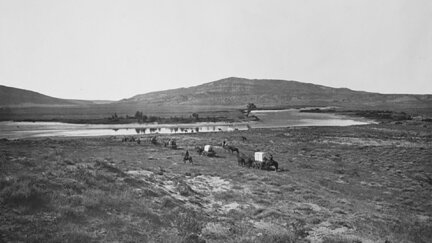
We took nearly a week in going to our hunting-grounds and out from
them again. This was tedious work, for the pace was slow, and it was
accompanied with some real labor. In places the mountain paths were
very steep and the ponies could with diffficulty scramble along them;
and once or twice they got falls that no animals less tough could
have survived, Walla Walla being the unfortunate that suffered most.
Often, moreover, we would come to a windfall, where the fallen trees
lay heaped crosswise on one another in the wildest confusion, and a
road had to be cleared by ax work. It was marvelous to see the
philosophy with which the wise little beasts behaved, picking their
way gingerly through these rough spots, hopping over fallen
tree-trunks, or stepping between them in places where an Eastern
horse would have snapped a leg short off, and walking composedly
along narrow ledges with steep precipice below. They were tame and
friendly, being turned loose at night, and not only staying near by,
but also allowing themselves to be caught without difficulty in the
morning; industriously gleaning the scant food to be found in the
burnt places or along the edges of the brooks, and often in the
evening standing in a patient, solemn semicircle round the camp fire,
just beyond where we were seated. Walla Walla, the little mule, was
always in scrapes. Once we spent a morning of awkward industry in
washing our clothes; having finished, we spread the half-cleansed
array upon the bushes and departed on a hunt. On returning, to our
horror we spied the miserable Walla Walla shamefacedly shambling off
from the neighborhood of the wash, having partly chewed up every
individual garment and completely undone all our morning's labor.
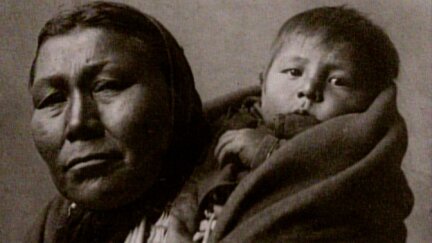
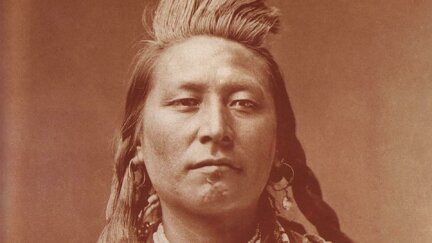
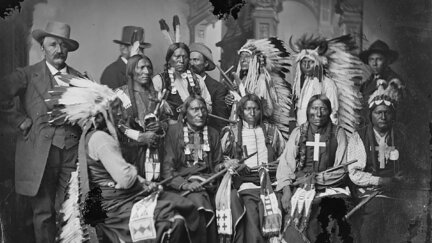
At first we did not have good weather. The Indians, of whom we met
a small band, &emdash;said to be Flatheads or their kin, on a visit
from the coast region, &emdash;had set fire to the woods not far
away, and the smoke became so dense as to hurt our eyes, to hide the
sun at midday, and to veil all objects from our sight as completely
as if there had been a heavy fog. Then we had two days of incessant
rain, which rendered our camp none too comfortable; but when this
cleared we found that it had put out the fire and settled all the
smoke, leaving a brilliant sky overhead.
We first camped in a narrow valley, surrounded by mountains so
tall that except at noonday it lay in the shadow; and it was only
when we were out late on the higher foot-hills that we saw the sun
sink in a flame behind the distant ranges. The trees grew tall and
thick, the underbrush choking the ground between their trunks, and
their branches interlacing so that the sun's rays hardly came through
them. There were very few open glades, and these were not more than a
dozen rods or so across. Even on the mountains it was only when we
got up very high indeed, or when we struck an occasional bare spur,
or shoulder, that we could get a glimpse into the open. Elsewhere we
could never see a hundred yards ahead of us, and like all plainsmen
or mountaineers we at times felt smothered under the trees, and
longed to be where we could look out far and wide on every side; we
felt as if our heads were in hoods. A broad brook whirled and eddied
past our camp, and a little below us was caught in a deep, narrow
gorge, where the strangling rocks churned its swift current into
spray and foam, and changed its murmurous humming and splashing into
an angry roar. Strange little water wrens &emdash;the water-ousel of
the books &emdash;made this brook their home. They were shaped like
thrushes, and sometimes warbled sweetly, yet they lived right in the
torrent, not only flitting along the banks and wading in the edges,
but plunging boldly into midstream, and half walking, half flying
along the bottom, deep under water, and perching on the slippery,
spray-covered rocks of the waterfall or skimming over and through the
rapids even more often than they ran along the margins of the deep,
black pools.
White-tail deer were plentiful, and we kept our camp abundantly
supplied with venison, varying it with all the grouse that we wanted,
and with quantities of fresh trout. But I myself spent most of my
time after the quarry I had come to get &emdash;the white goat.
White goats have been known to hunters ever since Lewis and Clarke
crossed the continent, but they have always ranked as the very rarest
and most difficult to get of all American game. This reputation they
owe to the nature of their haunts, rather than to their own wariness,
for they have been so little disturbed that they are less shy than
either deer or sheep. They are found here and there on the highest,
most inaccessible mountain peaks down even to Arizona and New Mexico;
but being fitted for cold climates, they are extremely scarce
everywhere south of Montana and northern Idaho and the great majority
even of the most experienced hunters have hardly so much as heard of
their existence. In Washington Territory, northern Idaho, and
north-western Montana they are not uncommon, and are plentiful in
parts of the mountain ranges of British America and Alaska. Their
preference for the highest peaks is due mainly to their dislike of
warmth, and in the north &emdash;even south of the Canadian line
&emdash;they are found much lower down the mountains than is the case
farther south. They are very conspicuous animals, with their
snow-white coats and polished black horns, but their pursuit
necessitates so much toil and hardship that not one in ten of the
professional hunters has ever killed one; and I know of but one or
two Eastern sportsmen who can boast a goat's head as a trophy. But
this will soon cease to be the case; for the Canadian Pacific Railway
has opened the haunts where the goats are most plentiful, and any
moderately adventurous and hardy rifleman can be sure of getting one
by taking a little time, and that, too, whether he is a skilled
hunter or not, since at present the game is not difficult to
approach. The white goat will be common long after the elk has
vanished, and it has already outlasted the buffalo. Few sportsmen
henceforth &emdash;indeed, hardly any &emdash;will ever boast a
buffalo head of their own killing; but the number of riflemen who can
place to their credit the prized white fleeces and jet-black horns
will steadily increase.
The Missourian, during his career as a Rocky Mountain hunter, had
killed five white goats. The first he had shot near Canyon City,
Colorado, and never having heard of any such animal before had
concluded afterward that it was one of a flock of recently imported
Angora goats, and accordingly, to avoid trouble, buried it where it
lay; and it was not until fourteen years later, when he came up to
the Coeur d'Alene and shot another, that he became aware of what he
had killed. He described them as being bold, pugnacious animals, not
easily startled, and extremely tenacious of life. Once he had set a
large hound at one which he came across while descending an
ice-swollen river in early spring. The goat made no attempt to flee
or to avoid the hound, but coolly awaited its approach and killed it
with one wicked thrust of the horns; for the latter are as sharp as
needles, and are used for stabbing, not butting. Another time he
caught a goat in a bear trap set on a game trail. Its leg was broken,
and he had to pack it out on pony-back, a two-days' journey, to the
settlement; yet in spite of such rough treatment it lived a week
after it got there, when, unfortunately, the wounded leg mortified.
It fought most determinedly, but soon became reconciled to captivity,
eating with avidity all the grass it was given, recognizing its
keeper, and grunting whenever he brought it food or started to walk
away before it had had all it wished. The goats he had shot lived in
ground where the walking was tiresome to the last degree, and where
it was almost impossible not to make a good deal of noise; and
nothing but their boldness and curiosity enabled him ever to kill
any. One he shot while waiting at a pass for deer. The goat, an old
male, came up, and fairly refused to leave the spot, walking round in
the underbrush and finally mounting a great fallen log, where he
staid snorting and scamping angrily until the Missourian lost
patience and killed him.
For three or four days I hunted steadily and without success, and
it was as hard work as any that I had ever undertaken. Both
Merrifield and I were accustomed to a life in the saddle, and
although we had varied it with an occasional long walk after deer or
sheep, yet we were utterly unable to cope with the Missourian when it
came to mountaineering. When we had previously hunted, in the Big
Horn Mountains, we had found stout moccasins most comfortable, and
extremely useful for still-hunting through the great woods and among
the open glades; but the multitudinous sharp rocks and sheer,
cliff-like slopes of the Coeur d'Alene rendered our moccasins
absolutely useless, for the first day's tramp bruised our feet till
they were sore and slit our foot-gear into ribbons, besides tearing
our clothes. Merrifield was then crippled, having nothing else but
his cowboy boots; fortunately, I had taken in addition a pair of
shoes with soles thickly studded with nails.
We would start immediately after breakfast each morning, carrying
a light lunch in our pockets, and go straight up the mountain sides
for hours at a time, varying it by skirting the broad, terrace-like
ledges, or by clambering along the cliff crests. The climbing was
very hard. The slope was so steep that it was like going upstairs;
now through loose earth, then through a shingle of pebbles or sand,
then over rough rocks, and again over a layer of pine needles as
smooth and slippery as glass, while brittle, dry sticks that snapped
at a touch, and loose stones that rattled down if so much as brushed,
strewed the ground everywhere, the climber stumbling and falling over
them and finding it almost absolutely impossible to proceed without
noise, unless at a rate of progress too slow to admit of getting
anywhere. Often, too, we would encounter dense underbrush, perhaps a
thicket of little burnt balsams, as prickly and brittle as so much
coral; or else a heavy growth of laurel, all the branches pointing
downward, and to be gotten through only by main force. Over all grew
the vast evergreen forest, except where an occasional cliff jutted
out, or where there were great land-slides, each perhaps half a mile
long and a couple of hundred yards across, covered with loose slates
or granite bowlders.
We always went above the domain of the deer, and indeed saw few
evidences of life. Once or twice we came to the round foot-prints of
cougars, which are said to be great enemies of the goats, but we
never caught a glimpse of the sly beasts themselves. Another time I
shot a sable from a spruce, up which the little fox-headed animal had
rushed with the agility of a squirrel. There were plenty of old
tracks of bear and elk, but no new ones; and occasionally we saw the
foot-marks of the great timber wolf.
But the trails at which we looked with the most absorbed interest
were those that showed the large, round hoof-marks of the white
goats. They had worn deep paths to certain clay licks in the slides,
which they must have visited often in the early spring, for the
trails were little traveled when we were in the mountains during
September. These clay licks were mere holes in the banks, and were in
spring-time visited by other animals besides goats; there were old
deer trails to them. The clay seemed to contain something that both
birds and beasts were fond of, for I frequently saw flocks of
cross-bills light in the licks and stay there for many minutes at a
time, scratching the smooth surface with their little claws and
bills. The goat trails led away in every direction from the licks,
but usually went up-hill, zigzagging or in a straight line, and
continually growing fainter as they went farther off, where the
animals scattered to their feeding-grounds. In the spring-time the
goats are clad with a dense coat of long white wool, and there were
shreds and tufts of this on all the twigs of the bushes under which
the paths passed; in the early fall the coat is shorter and less
handsome.
Although these game paths were so deeply worn, they yet showed
very little fresh goat sign; in fact, we came across the recent
trails of but two of the animals we were after. One of these we came
quite close to, but never saw it, for we must have frightened it by
the noise we made; it certainly, to judge by its tracks, which we
followed for a long time, took itself straight out of the country.
The other I finally got, after some heart-breaking work and a
complicated series of faults committed and misfortunes endured.
I had been, as usual, walking and clambering over the mountains
all day long, and in mid-afternoon reached a great slide, with
half-way across it a tree. Under this I sat down to rest, my back to
the trunk, and had been there but a few minutes when my companion,
the Missourian, suddenly whispered to me that a goat was coming down
the slide at its edge, near the woods. I was in a most uncomfortable
position for a shot. Twisting my head round, I could see the goat
waddling down-hill, looking just like a handsome tame billy,
especially when at times he stood upon a stone to glance around, with
all four feet close together. I cautiously tried to shift my
position, and at once dislodged some pebbles, at the sound of which
the goat sprang promptly up on the bank, his whole mien changing into
one of alert, alarmed curiosity. He was less than a hundred yards
off, so I risked a shot, all cramped and twisted though I was. But my
bullet went low; I only broke his left fore-leg, and he disappeared
over the bank like a flash. We raced and scrambled after him, and the
Missourian, an excellent tracker, took up the bloody trail. It went
along the hill-side for nearly a mile, and then turned straight up
the mountain, the Missourian leading with his long, free gait, while
I toiled after him at a dogged trot. The trail went up the sharpest
and steepest places, skirting the cliffs and precipices. At one spot
I nearly came to grief for good and all, for in running along a
shelving ledge, covered with loose slates, one of these slipped as I
stepped on it, throwing me clear over the brink. However, I caught in
a pine top, bounced down through it, and brought up in a balsam with
my rifle all right, and myself unhurt except for the shaking. I
scrambled up at once and raced on after my companion, whose limbs and
wind seemed alike incapable of giving out. This work lasted for a
couple of hours.
The trail came into a regular game path and grew fresher, the goat
having stopped to roll and wallow in the dust now and then. Suddenly,
on the top of the mountain, we came upon him close up to us. He had
just risen from rolling and stood behind a huge fallen log, his back
barely showing above it as he turned his head to look at us. I was
completely winded, and had lost my strength as well as my breath,
while great beadlike drops of sweat stood in my eyes; but I steadied
myself as well as I could and aimed to break the backbone, the only
shot open to me, and not a difficult one at such a short distance.
However, my bullet went just too high, cutting the skin above the
long spinal bones over the shoulders; and the speed with which that
three-legged goat went down the precipitous side of the mountain
would have done credit to an antelope on the level.
Weary and disgusted, we again took up the trail. It led straight
down-hill, and we followed it at a smart pace. Down and down it went,
into the valley and straight to the edge of the stream, but half a
mile above camp. The goat had crossed the water on a fallen
tree-trunk, and we took the same path. Once across, it had again gone
right up the mountain. We followed it as fast as we could, although
pretty nearly done out, until it was too dark to see the blood stains
any longer, and then returned to camp, dispirited and so tired that
we could hardly drag ourselves along, for we had been going at speed
for five hours, up and down the roughest and steepest ground. But we
were confident that the goat would not travel far with such a wound
after he had been chased as we had chased him. Next morning at
daybreak we again climbed the mountain and took up the trail. Soon it
led into others and we lost it, but we kept up the hunt nevertheless
for hour after hour, making continually wider and wider circles. At
last, about midday, our perseverance was rewarded, for coming
silently out on a great bare cliff shoulder, I spied the goat lying
on a ledge below me and some seventy yards off. This time I shot
true, and he rose only to fall back dead; and a minute afterward we
were standing over him, handling the glossy black horns and admiring
the snow-white coat.
After this we struck our tent and shifted camp some thirty miles
to a wide valley through whose pine-clad bottom flowed a river,
hurrying on to the Pacific between unending forests. On one hand the
valley was hemmed in by an unbroken line of frowning cliffs, and on
the other by chains of lofty mountains in whose sides the ravines cut
deep gashes.
The clear weather had grown colder. At night the frost skimmed
with thin ice the edges of the ponds and small lakes that at long
intervals dotted the vast reaches of woodland. But we were very
comfortable, and hardly needed our furs, for as evening fell we
kindled huge fires, to give us both light and warmth; and even in
very cold weather a man can sleep out comfortably enough with no
bedding if he lights two fires and gets in between them, or finds a
sheltered nook or corner across the front of which a single great
blaze can be made. The long walks and our work as cragsmen hardened
our thews, and made us eat and sleep as even our life on the ranch
could hardly do: the mountaineer must always be more sinewy than the
horseman. The clear cold water of the swift streams too was a welcome
change from the tepid and muddy currents of the rivers of the plains;
and we heartily enjoyed the baths, a plunge into one of the icy pools
making us gasp for breath and causing the blood to tingle in our
veins with the shock.
Our tent was pitched in a little glade, which was but a few yards
across, and carpeted thickly with the red kinnikinic berries, in
their season beloved of bears, and from the leaves of which bush the
Indians make a substitute for tobacco. Little three-toed woodpeckers
with yellow crests scrambled about over the trees near by, while the
great log-cocks hammered and rattled on the tall dead trunks. Jays
that were dark blue all over came familiarly round camp in company
with the ever-present moose-birds or whisky jacks. There were many
grouse in the woods, of three kinds, &emdash;blue, spruce, and
huffed, &emdash;and these varied our diet and also furnished us with
some sport with our rifles, as we always shot them in rivalry. That
is, each would take a shot in turn, aiming at the head of the bird,
as it perched motionless on the limb of a tree or stopped for a
second while running along the ground; then if he missed or hit the
bird anywhere but in the head, the other scored one and took the
shot. The resulting tally was a good test of comparative skill; and
rivalry always tends to keep a man's shooting up to the mark.
Once or twice, when we had slain deer, we watched by the
carcasses, hoping that they would attract a bear, or perhaps one of
the huge timber wolves whose mournful, sinister howling we heard each
night. But there were no bears in the valley; and the wolves, those
cruel, crafty beasts, were far too cunning to come to the bait while
we were there. We saw nothing but crowds of ravens, whose hoarse
barking and croaking filled the air as they circled around overhead,
lighted in the trees, or quarreled over the carcass. Yet although we
saw no game it was very pleasant to sit out, on the still evenings,
among the tall pines or on the edge of a great gorge, until the
afterglow of the sunset was dispelled by the beams of the frosty
moon. Now and again the hush would be suddenly broken by the long
howling of a wolf, that echoed and rang under the hollow woods and
through the deep chasms until they resounded again, while it made our
hearts bound and the blood leap in our veins. Then there would be
silence once more, broken only by the rush of the river and the low
moaning and creaking of the pines; or the strange calling of the owls
might be answered by the far-off, unearthly laughter of a loon, its
voice carried through the stillness a marvelous distance from the
little lake on which it was swimming.
One day, after much toilsome and in places almost dangerous work,
we climbed to the very top of the nearest mountain chain, and from it
looked out over a limitless, billowy field of snow-capped ranges. Up
above the timber line were snow-grouse and huge, hoary-white
woodchucks, but no trace of the game we were after; for, rather to
our surprise, the few goat signs that we saw were in the timber. I
did not catch another glimpse of the animals themselves until my
holiday was almost over and we were preparing to break camp. Then I
saw two. I had spent a most laborious day on the mountain as usual,
following the goat paths, which were well-trodden trails leading up
the most inaccessible places; certainly the white goats are marvelous
climbers, doing it all by main strength and perfect command over
their muscles, for they are heavy, clumsy seeming animals, the
reverse of graceful, and utterly without any look of light agility.
As usual, towards evening I was pretty well tired out, for it would
be difficult to imagine harder work than to clamber unendingly up and
down the huge cliffs. I came down along a great jutting spur, broken
by a series of precipices, with flat terraces at their feet, the
terraces being covered with trees and bushes, and running, with many
breaks and interruptions, parallel to each other across the face of
the mountains. On one of these terraces was a space of hard clay
ground beaten perfectly bare of vegetation by the hoofs of the goats,
and, in the middle, a hole, two or three feet in width, that was
evidently in the spring used as a lick. Most of the tracks were old,
but there, was one trail coming diagonally down the side of the
mountain on which there were two or three that were very fresh. It
was getting late, so I did not stay long, but continued the descent.
The terrace on which the lick was situated lay but a few hundred
yards above the valley, and then came a level, marshy plain a quarter
of a mile broad, between the base of the mountain and the woods.
Leading down to this plain was another old goat-trail, which went to
a small, boggy pool, which the goats must certainly have often
visited in the spring; but it was then unused.
When I reached the farther side of the plain and was about
entering the woods, I turned to look over the mountain once more, and
my eye was immediately caught by two white objects which were moving
along the terrace, about half a mile to one side of the lick. That
they were goats was evident at a glance, their white bodies
contrasting sharply with the green vegetation. They came along very
rapidly, giving me no time to get back over the plain, and stopped
for a short time at the lick, right in sight from where I was,
although too far off for me to tell anything about their size. I
think they smelt my footprints in the soil; at any rate they were
very watchful, one of them always jumping up on a rock or fallen log
to mount guard when the other halted to browse. The sun had just set;
it was impossible to advance across the open plain, which they
scanned at every glance; and to skirt it and climb up any other place
than the pass down which I had come &emdash;itself a goat-trai
l&emdash;would have taken till long after nightfall. All that I could
do was to stay where I was and watch them, until in the dark I
slipped off unobserved and made the best of my way to camp, resolved
to hunt them up on the morrow.
Shortly after noon next day we were at the terrace, having
approached with the greatest caution, and only after a minute
examination, with the field-glasses, of all the neighboring mountain.
I wore moccasins, so as to make no noise. We soon found that one of
the trails was evidently regularly traveled, probably every evening,
and we determined to lie in wait by it, so as either to catch the
animals as they came down to feed, or else to mark them if they got
out on some open spot on the terraces where they could be stalked. As
an ambush we chose a ledge in the cliff below a terrace, with, in
front, a breastwork of the natural rock some five feet high. It was
perhaps fifty yards from the trail. I hid myself on this ledge,
having arranged on the rock breastwork a few pine branches through
which to fire, and waited, hour after hour, continually scanning the
mountain carefully with the glasses. There was very little life.
Occasionally a chickaree or chipmunk scurried out from among the
trunks of the great pines to pick up the cones which he had
previously bitten off from the upper branches; a noisy Clarke's crow
clung for some time in the top of a hemlock; and occasionally flocks
of cross-bill went by, with swift undulating flight and low calls.
From time to time I peeped cautiously over the pine branches on the
breastwork; and the last time I did this I suddenly saw two goats,
that had come noiselessly down, standing motionless directly opposite
to me, their suspicions evidently aroused by something. I gently
shoved the rifle over one of the boughs; the largest goat turned its
head sharply round to look, as it stood quartering to me, and the
bullet went fairly through the lungs. Both animals promptly ran off
along the terrace, and I raced after them in my moccasins, skirting
the edge of the cliff, where there were no trees or bushes. As I made
no noise and could run very swiftly on the bare cliff edge, I
succeeded in coming out into the first little glade, or break, in the
terrace at the same time that the goats did. The first to come out of
the bushes was the big one I had shot at, an old she, as it turned
out; while the other, a yearling ram, followed. The big one turned to
look at me as she mounted a fallen tree that lay across a chasm-like
rent in the terrace; the light red frothy blood covered her muzzle,
and I paid no further heed to her as she slowly walked along the log,
but bent my attention towards the yearling, which was galloping and
scrambling up an almost perpendicular path that led across the face
of the cliff above. Holding my rifle just over it, I fired, breaking
the neck of the goat, and it rolled down some fifty or sixty yards,
almost to where I stood. I then went after the old goat, which had
lain down; as I approached she feebly tried to rise and show fight,
but her strength was spent, her blood had ebbed away, and she fell
back lifeless in the effort. They were both good specimens, the old
one being unusually large, with fine horns. White goats are squat,
heavy beasts; not so tall as black-tail deer, but weighing more.
Early next morning I came back with my two men to where the goats
were lying, taking along the camera. Having taken their photographs
and skinned them we went back to camp, hunted up the ponies and
mules, who had been shifting for themselves during the past few days,
packed up our tent, trophies, and other belongings, and set off for
the settlements, well pleased with our trip.
All mountain game yields noble sport, because of the nerve,
daring, and physical hardihood implied in its successful pursuit. The
chase of the white goat involves extraordinary toil and some slight
danger on account of the extreme roughness and inaccessibility of its
haunts; but the beast itself is less shy than the mountain sheep. How
the chase of either compares in difficulty with that of the various
Old World mountain game it would be hard to say. Men who have tried
both say that, though there is not in Europe the chance to try the
adventurous, wandering life of the wilderness so beloved by the
American hunter, yet when it comes to comparing the actual chase of
the game of the two worlds, it needs greater skill, both as cragsman
and still-hunter, to kill ibex and chamois in the Alps or Pyrenees
&emdash;by fair stalking I mean; for if they are driven to the guns,
as is sometimes done, the sport is of a very inferior kind, not
rising above the methods of killing white-tail in the Eastern States,
or of driving deer in Scotland. I myself have had no experience of
Old World mountaineering, beyond two perfectly conventional trips up
the Matterhorn and Jungfrau &emdash;on the latter, by the way, I saw
three chamois a long way off.
My brother has done a good deal of ibex, mountain sheep, and
markmoor shooting in Cashmere and Thibet, and I suppose the sport to
be had among the tremendous mountain masses of the Himalayas must
stand above all other kinds of hill shooting; yet, after all, it is
hard to believe that it can yield much more pleasure than that felt
by the American hunter when he follows the lordly elk and the grizzly
among the timbered slopes of the Rockies, or the big-horn and the
white-fleeced, jet-horned antelope-goat over their towering and
barren peaks.
Show Ranch
Life Contents |