
William Swain Letter
Written from "The Diggings" in California
January 6, 1850
South Fork of Feather River
25 miles from Long's Trading Post, and
16 miles above Bidwell's Trading Post
Dear George,
It is so long a time since I wrote you and I have passed through so
many scenes and changes of condition that I scarcely know what to say
among the multitude of things I wish to write. You have probably all
had much anxiety about my safe arrival in California, and as you have
been unable to hear from me for so long a time, you will be desirous
of having a lexicon of our journey. I wrote from Raft River by John
Root who packed through from that point, and I will commence my
letter at that point. But I can only give you a word in this letter
as there is so much to say about California and its mines of gold....
We arrived at Lawson's Ranch on the 8th day of November, tired and
worn down with toil and exposure but hardy, healthy, and in good
spirits, buoyant with hope. We were in the Sacramento Valley in the
rainy season, destitute of provisions, without shelter, and
everything eatable worth from $1 to $1.50 per pound. In fact, all was
dear but rain and mud which was everywhere.
We rested three days and put out for the Feather River mines,
where we arrived on the 14th of November at Long's Trading Post, the
first mines on this stream.
The swollen river prevented the miners from operating near its bed
where gold is found most abundantly. Generally they were doing no
more than boarding themselves, though occasionally one would make a
lucky hit and find this thousands. During the fall, miners could
average their ounce clear in working with rockers on the bars and
edges of the streams, and those who were lucky enough to make dams
across the streams before the rains often made large sums in a few
days and frequently in a few hours.
Mr. Hutchinson had packed through on his pony from the summit
where we dissolved the joint stock company that we started with from
Independence. He, Mr. Bailey, myself, and Mr. Samuel J. Moore of
Calhoun County, Michigan, a Methodist preacher; and Lt. Franklin
Cannon of Manchester, Michigan, have agreed to work in the mines on
the joint principle.
From all that Mr. Hutchinson had learned and that we could hear,
we judged the South Fork of the Feather River to be the most likely
to yield a pile another summer, for the following reasons: the main
part of the Feather River and all the southern rivers have been
overrun and consequently the best and richest placers found and
worked. The South Fork of the Feather River was reported to be rich,
and the gold on it coarse and not much worked. There is good timber
for building (not the case on many of the streams of California),
which with us is an important consideration as we believed our health
next summer depended upon having dry, warm, and comfortable
habitation during the rainy season.
In late November we bought provisions at Long's Trading Post and
took packs of fifty pounds each. We traveled over the mountains for
twenty--five miles through rain, mud and clouds and arrived on the
South Fork on the third day.
After prospecting two days, we located a spot favorable for
damming and draining the river. We made our claim and then built a
house as soon as possible to shelter our heads from the soaking
rains. So here we are, snug as schoolmarms, working at our race and
dam. Whenever the rain will permit, a fall of the river will enable
us to get into the bed of the river and know what is there. If there
is no gold, we shall be off to another place, for there is an
abundance of gold here, and if we are blessed with health, we are
determined to have a share of it.
You may have some curiosity to know something about our location
and dwelling. Our house is a log cabin, sixteen by twenty feet. It is
covered with boughs of cedar and is made of nut pine logs from one to
two feet in diameter, so that it is quite a blockhouse. It has a good
door made of cedar boards hewn our of cedar logs, but no window. It
faces the south and is on the north side of the river. In the east
end is a family fireplace, in which large backlogs are burning night
and day. At the west end is a bedstead framed into the logs of the
cabin and running from side to side. The cords of the bedstead are
strips of rawhide, crossing at every three inches, thus forming a
bottom tight enough to hold large armfuls of dry breaks gathered from
the sides of the mountains, which make a substitute for feather beds.
On these are our blankets and buffalo skins. Altogether it makes a
comfortable bed. Moore has a bunk in one of the other corners. Over
the fireplace are our rifles, which are ever ready, cocked and
primed, and frequently yield us good venison. In the other corner may
be seen our cupboard with its contents, which consist of a few wooden
and tin dishes, bottles, knives and forks and spoons, tin frying pan,
boiler, and coffee pot.
Around the sides of the cabin at various points are the few
articles of clothing belonging to the different members of the
company. Under the bed are five cakes of tallow, under the bunk are
three or four large bags of flour. Along the point of the roof is a
line of dried beef and sixty or seventy pounds of suet. And out at
the corner of the house in a large trough made of pine may be found
salt beef in the pickle, in abundance.
At ten in the evening you might see in this cabin, while
everything is still, a fire blazing up from the mass of fuel in the
large fireplace, myself and Hutchinson on one end of bedstead, Lt.
Cannon on the other, and Moore in his bunk. On the roof the incessant
rain keeps up its perpetual patter, while the foaming stream howls
out a requiem of the rushing torrent as it dashes on its way to the
valley. And here, wakeful and listless, are the members of other
circles too. But often the mind is far away, filled with other
scenes, far distant homes, and relatives.
In front of our cabin a mountain rises from the edge of the river
two thousand feet and hides the sun till ten o'clock in the day. Its
top is often covered with snow. The live oak and numerous other
mountain evergreens, besides the pine and cedar, green as spring, are
loaded with snow near the mountain top and dripping with rain on its
side and base. And this is only a specimen of the hills and scenery
on all sides of us.
The following is a list of prices current per pound when we
arrived at Long's Bar: pork, $1.25; beans from 75 cents to $1; sugar,
75 cents; coffee, 50 cents; tea, $2.50; saleratus, $6;; vinegar, $5;
pickaxes and tin pans, $8 apiece; coffee pots, $6 to $8; frying pans
$6.
These prices were caused by the rains which commenced six weeks
earlier this year than last and consequently found the merchants in
the mines without having laid in their winter's stock.
At this time a small steamer comes up to the mouth of the Yuba
River and merchandise is brought from there to the mining camps on
pack mules. Since this mode of transportation was adopted in
December, prices have fallen thirty percent.
We found the most extraordinary state of morals in the mines.
Everything in this country is left where the owner wished to leave
it, in any place no matter where, as such a thing as stealing is not
known.
Miners' rights are well protected. Disputes seldom arise and are
settled by referees, as they would be at home.
George, I tell you this mining among the mountains is a dog's
life. A man has to make a jackass of himself packing loads over
mountains that God never designed man to climb, a barbarian by
foregoing all the comforts of civilized life, and a heathen by
depriving himself of all communication with men away from his
immediate circle.
You can judge my feelings when I inform you that I have not had an
opportunity to send to Sacramento City for my letters and papers and
have no tidings from home since I received your last letter at
Independence, and I have not seen a newspaper since I left the
states.
Sutter's Fort changed its name to Sacramento City and postal
arrangements are made to that place from San Francisco. I wish you to
direct your letters to me at that place, for my business may call me
there often during the summer and if not, I can get letters from
there, for persons are going down and back every two weeks and I
shall make arrangements to have my letters brought up.
There was some talk between us of your coming to this country. For
God's sake think not of it. Stay at home. Tell all whom you know that
are thinking of coming that they have to sacrifice everything and
face danger in all its forms, for George, thousands have laid and
will lay their bones along the routes to and in this country. Tell
all that "death is in the pot" if they attempt to cross the plains
and hellish mountains. Say to Playter never to think of the jouney;
and as for you, stay at home, for if my health is spared, I
can get enough for both of us.
My health has been extremely good since I arrived here. I am
fifteen pounds heavier than when I left home and measured six feet
last evening. A slight attack of rheumatism in the left hip has given
me some trouble for a few days.
You may think from the tenor of this letter that I am sick of my
job, but not so. I have not seen the hour yet when I regretted
starting for California, nor have any one of our little party ever
regretted that we undertook the enterprise. I have seen hard times,
face the dangers of disease and exposure and perils of all kinds, but
I count them as nothing if they enable me to place myself and family
in comfortable circumstances.
Now you will think that there is a contradiction in the advice
that I gave you and others about coming to California and the
declaration of my own satisfaction that I have performed the journey.
The fact is that gold is plenty here and the accounts received before
I left home did not exaggerate the reality. Therefore I am glad that
I am here. But the time is past -- if it ever existed -- when
fortunes could be obtained for picking them up. Gold is found in the
most rocky and rough places, and the streams and bars that are rich
are formed of huge rocks and stones. In such places, you will see, it
requires robust labor and hard tugging and lifting to separate the
gold from the rock. But this is nothing to the risk of life run in
traveling to this country. Therefore, if I was at home and knew all
the circumstances, I think I should stay at home; but having passed
those dangers in safety, I thank God that I am here in so favorable
circumstances.
I hope soon to send for my letters, and God grant that they may
bring no sad intelligence from home, for I almost dread to hear from
that happy home, fearing that our neighborhood may have been the
theater of cholera.
You are better acquainted with the state of things around San
Francisco Bay than I am, and therefore I say nothing about them.
I have felt great anxiety about my wife and child, as I left them
no means to live upon for so long a time, expecting to send home
means before this; and also, their necessities might embarass you. I
hope that you will see that they are provided for, and if I can
remunerate you for any trouble you may have, I shall feel willing to
do so and ever feel grateful for your kindness. Give my love to
Mother, if she is yet living, and say to her that I often, very
often, think of her. Tell Sabrina not to be overanxious about me, for
I shall be careful of my health, and as soon as I can get the rocks
in my pocket I shall hasten as fast as steam can carry me.
Write often, for I may sometime or another get your letters.
January 12
We have had heavy rains and high water, but the weather has now
cleared off fine, like Spring. And spring is here, for the mountain
oaks are putting out their leaves and all things are assuming a green
hue. We are in hopes of having dry weather soon -- then, "you see!"
It is just for me to say that if my health is good and I do not
have extraordinary good luck, I may not be home till next Fall. Mr.
Bailey is well and sends his love to his family.
January 16
The rapidity with which this country is settling is only equaled
by the change being made by Yankee enterprise. Three weeks ago but
one steamboat plowed its way across San Francisco Bay and but one
traversed the Sacramento River. Now four steamers may be seen making
their regular trips from San Francisco to Yuba City, and flour which
was then selling at 75 cents is now worth 40 cents per pound, as I
have just heard from Mr. Hutchinson, who has come home from Long's
Trading Post.
When we first located on this stream, no mor than six houses were
built on it. Now, within a distance of ten miles, 150 dwellings are
built.
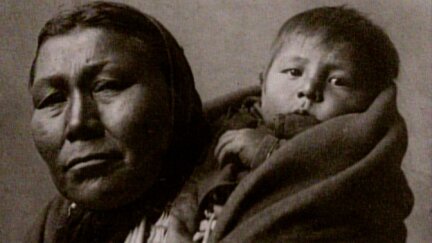
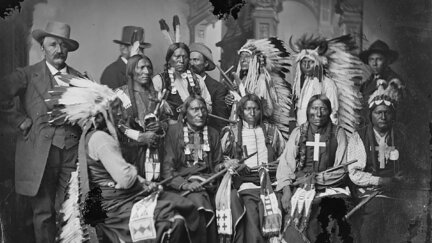
The "redskin" who four months ago roamed in his nakedness, the
undisputed lord of these mountains and valleys, may now be seen on
the hilltops gazing with surprise upon the scenes below -- the
habitations, the deep-dug channels and the dams built. The sound of
the laborer's ax, shovel, pick and pan are sounds new to his ear, and
the sight one to which his eye has never been accustomed.
The natives of these mountains are wild, live in small huts made
of brush and go haked as when they are born. They subsist on acorns
and what game they kill with their bows and arrows. They are small in
stature, and their character is timid and imbecile. When they visit
the camps of the miners, they evince the most timid and friendly
nature. They are charged with killing miners occasionally when they
find one alone, away among the hills hunting. The miners, especially
the Oregon men, are sometimes guilty of the most brutal acts with the
Indians, such as killing the squaws and papooses. Such incidents have
fallen under my notice that would make humanity weep and men disown
their race.
I send this by a man who is going to Sacramento City and to San
Francisco on purpose for mails. He leaves here Saturday and will
return in two weeks, when I shall probably get my letters by him,
paying $2 apiece for bringing them up.
I shall write often as I can and shall fill my engagements to
different persons to whom I promised to write as soon as I have
gained sufficient knowledge of the country to do so understandingly.
Say to Mr. Burge that this climate in the mines requires a
constitution like iron. Often for weeks during the rainy season it is
damp, cold, and sunless, and the labor of getting gold is of the most
laborious kind. Exposure causes sickness to a great extent, for in
most of the mines tents are all the habitation miners have. But with
care I think health can be preserved.
Give my love to Sabrina and kiss little Cub for me.
Goodbye George,
William
P.S. I have wafered in some samples of gold found on the main
branch of the Feather River. The coarse is a fine specimen found on
this fork, but gold found here is often as coarse as a hickory nut.
P.S. An onion in the mines is worth a dollar, and boots $40 per
pair. I have paid $8 for a jar of pickles.
P.S. All well, and I have sent this to San Francisco by a Mr.
Tolles by paying 50 cents.
[TEXT: J. S. Holliday, The World Rushed
In (1981), pp. 312-29.]
|