|
The greatest geographical prize of its day was the search for the
fabled Northwest Passage through the island maze of Arctic Canada.
In 1845, Great Britain mounted an all-out assault with a lavishly
equipped expedition that was never heard from again. Then in the
early 1900s, a little-known Norwegian adventurer set forth in a
secondhand fishing boat and succeeded beyond all expectation. This
two-hour special answers the riddle of why one failed and the other
made it.
Hour one provides new details on the Franklin expedition, whose fate
was one of the great mysteries of the 19th century. Even today, the
manner of the expedition's demise is an ongoing detective story,
with clues and new interpretations still emerging over 150 years
after the explorers inexplicably disappeared. Hour two tells how
Roald Amundsen rewrote the book on Arctic exploration by stressing
simplicity and adaptability, and in the process completed the first
crossing of the Northwest Passage exactly 100 years ago. (To follow
the paths of both expeditions, see
Tracing the Routes.)
For centuries, explorers were convinced that a route could be found
through the islands and ice floes of northern Canada that would cut
months off the arduous sea voyage between Europe and the Pacific.
But every time someone tried, ice blocked the way. Determined to
succeed, the British Navy refitted two warships and assigned its
most experienced Arctic explorer, Sir John Franklin, to command. The
vessels were stocked with every convenience and a three-year
supply of food, much
of it canned—a relatively new technology.
Departing England in 1845, the 129 men seemingly vanished off the
face of the Earth. In 1848, the Navy dispatched the first of many
search parties, which eventually found the site of Franklin's first
wintering camp on Beechey Island in the High Arctic, including the
graves of three seamen. Modern tests show that the sailors died of
tuberculosis but were also suffering from lead poisoning, probably
caused by the solder used to seal their tinned food. The finding
suggests that the entire crew may have been affected to varying
degrees by excessive lead, which causes fatigue, confusion, and
paranoia.
Over the years, more searching has turned up a strange collection of
further clues (see, for one of the most telling,
The Note in the Cairn).
These point to an expedition trapped in the ice, slowly dying off,
desperately devising strategies to escape, and finally resorting to
cannibalism. Ironically, as Franklin's men were perishing, they had
periodic contact with native Inuit, who subsisted quite well in the
High Arctic thanks to their small numbers and highly evolved hunting
and survival skills. There is no evidence that the Franklin party
adopted any Inuit methods.
This lesson was not lost on Roald Amundsen, a young Norwegian whose
study of the Franklin disaster led him to an entirely different
approach. Instead of treating Arctic exploration as a siege, in
which a fully modern world is transported en masse to an unforgiving
place, Amundsen determined to travel light and live like the Inuit
as much as possible (see
My Life as an Explorer).
Where the Franklin expedition comprised over 100 men, Amundsen's
consisted of only seven; where Franklin commanded deep-water ships,
Amundsen piloted a battered, 30-year-old sealer that had proven its
worth at moving nimbly though shallows and ice floes; where
Franklin's men dragged a provision-filled lifeboat across the snow
when they had to go overland, Amundsen used an Inuit-style sled and
dogs.
Success came in August 1905, after two years battling the ice and
weather, when Amundsen encountered a whaling ship sailing from San
Francisco. (He overwintered once more before completing the Passage
in 1906.) Amundsen had proven that a path, albeit a difficult one,
existed across the top of the world—for anyone bold enough to
take it.


|

|
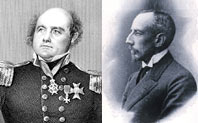
Sir John Franklin (left) and Roald Amundsen took
completely different approaches to tackling the
Northwest Passage, with widely divergent results.

|
|

|
Back to the Arctic
Passage homepage for more features on the Franklin and
Amundsen expeditions.
|
|
|





