Visit Your Local PBS Station PBS Home PBS Home Programs A-Z TV Schedules Watch Video Donate Shop PBS Search PBS

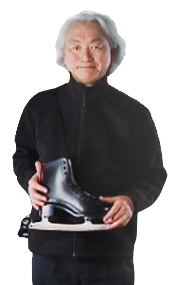
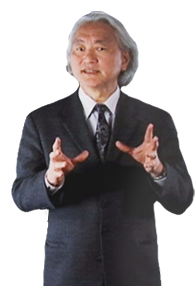
Michio Kaku: Theoretical Physicist Figure Skater

Close X

Copy this code to your website or blog:

To view the full experience of this website, please download and install Adobe Flash Player 9
  • Figure Skating: An Instructional Film [2:15] Figure Skating: An Instructional Film
  • Theory of Everything [1:56] Theory of Everything
  • 10 Questions for Michio [2:08] 10 Questions for Michio
  • You Can Spin Forever [1:33] You Can Spin Forever
  • 30 Second Science: Michio Kaku [0:30] 30 Second Science: Michio Kaku

Q&A with Michio
I want to know how far you can push science until it completely falls apart.
His Science:
Theoretical Physicist

The length of the equation he’d like to create: One inch

What it would explain: Everything

His boyhood hero: Flash Gordon

His Secret:
Figure Skater

Person he most likes to throw in the air: His wife… while they’re skating together

Why he likes skating: It turns klutzes into swans

What he’d like to do forever: Spin on ice

About Michio Kaku

Michio teaches physics at the City University of New York, is a best-selling author, and hosts his own radio and television series on science.

Posts about Michio Kaku

Flora Lichtman

WATCH: “Desktop Diaries” with Michio Kaku

If a messy desk is a sign of an active mind, as E.O. Wilson suggests in another Desktop Diary, then it’s probably safe to say that Michio Kaku’s brain is highly active. Former Science Friday producer Katherine Wells and I spent one afternoon with Dr. Kaku in his office, where he told us how he got interested in science (paging Flash Gordon) and some of his predictions for the future. One thing I wished we had asked him about? Figure skating.


Comments
Caitlin Shure

Secret Lifer Revisited: Smart Phones? Think Smart Walls, says Michio Kaku

Between solving physics equations, writing hit books, and figure skating, Secret Lifer Michio Kaku doesn’t have time to sit around and stare at the wall. But if he did, the wall staring back might be a heck of a lot more interesting than you imagine.

 Michio Kaku talks high-tech, requests high-five.

Kaku recently delivered the keynote speech at Supercomputing 2012 (SC12) in Salt Lake City, where he described endless possibilities of a future where mass-produced computer chips cost close to a penny, and walls are “smart.” HPC Wire explains, “As computer chips are imprinted onto almost everything, from walls to paper, to clothing, to contact lenses, the entire world becomes, in essence, one large, networked computer.”

Kaku’s speech described the many implications of computer chip ubiquity, including an increasingly automated society. To those interpreting such automation as robot world takeover, Michio assuages, “You can mass-produce hardware, you cannot mass-produce software—you cannot mass-produce the human mind.”

Read HPC Wire’s coverage of SC12 here or watch the video of his speech. And be sure to check out Michio’s homepage here!

Comments
Maggie Anderson

Where is Michio Now?

In the latest issue of Newsweek Michio gives a preview from his upcoming book “Physics of the Future.”  Internet contact lenses! He describes some of the most amazing inventions that we can expect in the next few years. I used to think that technologies like invisibility cloaks, internet-ready contact lenses, and LED paper were only possible in science-fiction. I wonder if anyone has started working on a flux capacitor yet!

Comments
Laura Willcox

Spinning Into Oblivion

My mother paid for ice skating lessons for me when I was younger, but when I stepped onto that ice with famous physicist and figure skater Michio Kaku, I couldn’t help but feel like a real amateur.  Know your physics and perfect a double axel! The fact that I struggled to avoid skating into a much more proficient child skater didn’t help shake this feeling. But in true Michio Kaku fashion, he was able to get me on my feet (and off my butt) by explaining the actual physics that make it possible for a human being to gracefully skate (and stop) on a frictionless surface. Check out the video on Michio’s homepage to see how I did, and then you can re-watch all your favorite Michio videos while you’re at it.

Comments
Tom Miller

Michio’s Answers!!

Figuring out one-inch equations, making predictions about the future of the universe, and ice skating can all be extremely time-consuming activities. But our friend, Michio Kaku, has answered some of the gazillion questions you all sent in for him. Because there were so many questions, we had Michio answer 10 that seemed fairly representative of the group. Check out those questions and Michio’s answers after the cut. And many thanks for your patience, Secret Lifers!

Continue >
Comments
Tom Miller

Science Fiction?

If you’ve watched Michio Kaku’s videos, you know that he’s a huge science fiction fan. When he was a boy, Michio, as most kids would, loved Flash Gordon just as much as he loved Albert Einstein. And his excitement about Flash Gordon triggered Michio’s curiosity, his sense of wonder, and his never-ending questions about what was possible. In short, Flash Gordon, helped Michio to become a scientist.

I also love science fiction. And it seems to me that most science fiction represents either our yearnings (“Close Encounters of the Third Kind,” “Star Wars”) or our fears (“Brave New World,” “1984”). And of course, one of the great themes of much science fiction is the idea of the alien. Will creatures from other worlds be loving and peaceful? Or will they be MONSTERS?! Or are there other possibilities that we haven’t even considered?

Always adept at separating science fiction from science facts (at least, as we know them now), here’s Michio’s take on the idea of other life forms in our universe:

Comments
Tobey List

While Visions of Equations Danced in His Head

I can honestly say that visions of sugar plums were more likely to dance in my head…but then again, I’m no Michio Kaku. I loved math and science as a child, but my influences were more in the realm of boy band sensations (NKOTB!) than Nobel Prize Winners, sad as that may seem. I imagine Michio watching this broadcast of Einstein’s death on the news at the impressionable age of 8, the unified field equation beckoning him from his black and white television screen. It would one day permeate his thoughts and career, and provide a window for other equations to steal the dancefloor in his mind. (See Michio’s ‘Theory of Everything’ video….)!

Einstein did not believe in an individual surviving his own physical death, but on April 18, 1955 he certainly passed the baton—or in this case the unfinished manuscript of the unified field theory—and a young Michio took it, ran (er…skated) and never looked back.

Comments
Sherry Austin

Mirror Image

It’s a dark and stormy night. Rod Serling’s familiar voice assures us that Millicent Barnes, the young woman sitting alone on a bench in a drab bus depot, is “not given to even the most temporal flights of fancy.” She glances up at the clock, then walks up to the ticket counter. “Excuse me,” she politely asks the scruffy old ticket agent, “The bus to Cortland? It was due half an hour ago. When will it be in?”  Mirror, mirror on the wall…

She’ll be in when she’ll be in! I told you that the last time you asked!” She denies she’s asked before, and he tells her “You’re either walkin’ in your sleep or hung over or somethin’!”

She steps into the lady’s room. As she washes her hands, the cleaning lady eyes her as if she’s a ghost. “Are you all right, miss?”

Of course I’m all right!” Millicent says.

Well,” the maid says, “it’s just when you were in here before…”

I wasn’t in here before!” Millicent exclaims, anger hardening her face. As she opens the door to step out, she glances in the mirror and sees the momentary reflection of an exact replica of herself sitting on the bench she’d left a moment ago.

Continue >
Comments
Tom Miller

Michio On Conan!

Michio Kaku recently brought string theory to late night television. And he said the word “neutrino,” a favorite of mine since my undergraduate days when I wrote the now-classic, “Where Are The Missing Solar Neutrinos?”  “With time travel, you could still be on NBC…” (at the time I thought “Solar Neutrinos” was the name of an amazing Boston new wave band and I just couldn’t find them anywhere…).

Conan’s embed code isn’t playing nicely, but this link should work.

The clip is most definitely worth the trip and is yet another example of how cool and interesting Michio always is on TV.

Comments
Tom Miller

How To Touch People

The first time I went to Michio Kaku’s website, I remember thinking that he seemed like the “Elvis of Science.” Shiny. Bright. Flashy. I knew he did a lot of radio and TV and wrote best-selling books. Was he really a scientist? Or was he some kind of entertainer? Or could he both? And if so, why would he be both?  Heartbreak Hotel? Or e=mc2? Or both?

I asked Michio about this when we interviewed him. And here’s his excellent answer:

“My attitude is, not enough scientists are in the public domain. I mean for example, think about all the movie stars you know. Rattle them off! You can rattle off scores of movie stars. Okay. Now rattle off how many scientists you know. Well, I once saw a cartoon. And one person was saying, ‘Gee, how come we honor our movie stars, but we don’t honor our scientists?’ And then the other person said, ‘Well, would you pay to see a scientist?’ Well, of course, you wouldn’t pay to see a scientist, because Hollywood movie stars are entertainers. And so we hate to say it, but scientists have to learn how to do a little bit of entertaining. We have to do some special effects. We have to do some gee-whiz stuff on television. Look at Stephen Hawking; he is a research physicist on the cutting edge of science, and yet he has inspired so many young people to go into science—he’s mesmerized so many millions of people. It just goes to show you that the public will be receptive. It used to be said that science doesn’t sell. But you know, look at Einstein. He has generated much more publicity than many Hollywood movie stars, and why is that? Because Einstein was a messenger from the stars. The stars are in our deepest dreams, hopes, and desires. When we look out there at the night’s sky, we feel at one with the cosmos. And here was this funny little man—a messenger from the stars. You see, there is a role for scientists. It’s just that we have to know how to touch people.”

Comments
Shirley Duke

Spinning With Newton

Michio Kaku quoted Albert Einstein, saying, “If a theory can’t be explained to a child, it’s probably worthless.” My job as a writer for children is to explain science ideas in a way they understand. Having just turned in my latest children’s book to Rourke Publishing, Kaku’s comments about Newton and spinning on the ice made a lot of sense to me.  An apple a day keeps the ice skaters at play The book is for grades 4—6 and titled “Forces and Motion at Work.” And I’ve always been fascinated by ice skating.

I enjoyed learning about Sir Isaac Newton during my research for the book. I don’t know theoretical physics much at all, but the idea of putting together the science of Newton and ice skating spins into physical science sounded like great fun.

So what would we call ice skating spins if Sir Newton were to have been a skater? Here’s what I think.

Apple drop spin—skater looks up and then down, sinking to the ice in a sit-spin wearing a puzzled look.

Newton-Hooke pairs attitude spin—two skaters spin in contradictory styles.

Alchemical backspin—skater completes a series of spins, moving backwards across the ice.

The Plague death drop-spin—skater leaps into the air, as if to escape contagious germs, and then sits in a safety spin.

“Principia” spin—the spin with a tendency to never return stop spinning.

Continue >
Comments
Tom Miller

The Wire

Every childhood is made up of roadblocks and opportunities. And interviewing our “Secret Life” subjects, we hear a lot about both. But we’d never heard a story quite like the one Michio Kaku told us:

“My parents were born in California. However, during World War II 100,000 Japanese-Americans were incarcerated in large relocation camps. So my parents never had a chance. Their property was confiscated. They lived behind barbed wires and machine guns from 1942 to 1946. And I was born afterwards, when my parents were dirt poor.”  Michio and his family… he’s the one on the left.

Somehow, after the war, and after their release from the internment camps, Michio’s parents worked to rebuild their lives. They started out with nothing, but put everything they did have into creating a better life for their children. And when Michio began to show that he was more than a little prodigious as a teen scientist, they went along. They went along, even with limited resources and with virtually no idea of what was behind (or could be the consequences) of Michio’s sometimes more-than-a-little-risky boyhood experiments:

Continue >
Comments
Tom Miller

Ask Michio Your Questions

Michio Kaku wants to find a one-inch equation that will explain everything. But you can feel free to ask him questions that are more than one inch long (if you like).

You know the routine, folks!

UPDATE: Michio has set a new “Secret Life” record for questions (78 of ‘em…). Thank you, Secret Lifers!

We’re no longer taking more questions for Michio. Since there are so many questions, Michio will only answer a selection of them. He will be stopping by in the coming weeks to provide those answers (and we’ll create a new post on the homepage to give you a head’s up at that point).

Thanks for all of your interest in Michio!

UPDATE II: Go here.

Comments

All Scientists

close