|
|
Supersonic Dream
|
|
|
|
Classroom Activity
|
Objective
To understand how fuel use affects the mass of different planes
during flight and to determine the per person fuel cost of a
transatlantic flight for seven airplanes.

-
copy of the "Fueling the Burn" student handout (PDF
or
HTML)
-
copy of the "Aircraft Specifications" student handout (PDF
or
HTML)
-
copy of the "Graphing Mass Change" student handout (PDF
or
HTML)
- calculator

-
Passengers on the Concorde could arrive at their transatlantic
destination twice as fast as regular jet travelers. But how much
fuel did the Concorde use to accomplish that feat? How did the
Concorde's fuel use compare to that of other aircraft? How did
the Concorde compare in fuel cost per passenger for a
transatlantic flight to some more common jets? Students will
explore these questions and others in this activity.
-
Organize students into teams. Provide each team with copies of
the student handouts and review the activity with students. (You
may want to note to students that the statistics represent
actual specifications for commercial aircraft.)
-
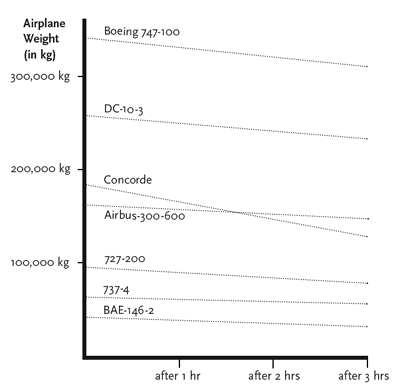
Use the board to complete a sample graph of the data for one
aircraft (see the "Aircraft Specifications" student handout to
find out how to determine the calculations):
-
Calculate how much fuel is burned after one, two, and three
hours and record the mass changes.
-
Plot these points and draw a line that passes through the
points.
-
Calculate the percent change in mass of the aircraft after
three hours of travel.
-
Some students may think that mass is actually lost as a plane's
mass changes during flight. Make sure students understand this
is not true. Explain to students that energy can neither be
created nor destroyed. (Energy present in a system remains
constant.) In terms of this activity, fuel is burned and
converted into energy to fly the plane. Some energy is
dissipated as heat; fuel (mass) is lost from the plane, but not
from the universe.
-
Have students complete their calculations and fill in their data
tables. (Note: If you would like, you can also have students
calculate the slope of the line [slope = rise/run]. The slope
indicates fuel burn in relationship to the mass of the plane.)
-
Now have students consider what it costs per passenger to fly
across the Atlantic. (Figures provided in the charts are based
on presumptions that the planes are flying the same distance
under the same conditions.) As the weight per gallon of jet fuel
varies during different seasons and in different climates,
students are given the conservative estimate for the weight of
one U.S. gallon of jet fuel (2.715 kilograms). Ask teams to
complete the calculations on the "Passenger Counts" chart and
display their results in a bar graph.
-
Discuss the results as a class. Ask students why it is important
to consider how fast an aircraft burns fuel. Why is it important
to consider take-off weight? Why is it important to consider the
percent change in mass of an aircraft in flight? What are some
factors that have an effect on aircraft fuel consumption? Which
plane has the highest per passenger fuel use? Which has the
lowest? (See Activity Answer for more
information.)
-
Note to students that the amount of fuel burned per hour and the
number of passengers are only two of many variables that must be
taken into account when determining a plane's economic
efficiency. Have students name three additional factors that
would contribute to determining if an airplane is an economical
investment for an airline company (i.e., safety record of the
plane, speed at which the plane travels, and repair and
maintenance costs).
-
As an extension, have students compare the fuel burn of military
aircraft. How is it different from that of commercial aircraft?
What might account for the differences in fuel burn?

The Federal Aviation Administration completes calculations for
aircraft hourly fuel burn and considers how fuel burn increases when
there is additional weight on a plane. (Hourly fuel burn
calculations include an average of climb, cruise, and descend fuel
burn rates.) Extra weight can impact fuel burn because the engines
must work harder to maintain flight.
Students can infer from their graph the rate of fuel burn in
relationship to the average take-off mass of an aircraft. The
Concorde's fuel burn rate is greatest.
It is important to consider how fast an aircraft burns fuel because
fuel has mass and alterations in mass impact flight. Because the
mass of the plane has changed after the first hour of flight, there
could be a slight difference in rate of fuel burn after each
successive hour. (This difference is not calculated in this
activity.) The fuel burn rate also has implications for the range in
which an aircraft can fly.
It is important to consider the percent change in mass of an
aircraft in flight because balance is an important aspect of flight.
Changes in mass have an effect on the balance of some planes.
The initial mass of the plane affects how much fuel burn is needed
to produce a increase in percent mass change. A greater amount of
fuel burn per hour is required to increase the percent mass change
for more massive planes than for less massive planes. This is why
the slope of the line for Boeing 747-100 is greater than for Airbus
300-600 even though the percent mass change is the same.
Three major factors that have an effect on aircraft fuel consumption
are the mass of the plane, speed of the plane, and resistance
(wind). Based on fuel calculations alone, the Boeing 737-4 is the
most fuel efficient per passenger; the Concorde is the least fuel
efficient per passenger.
Graphing Mass Change
Fuel Burn
|
Aircraft Type
|
Engines
|
Average Take-off Mass with Fuel (kg)
|
Fuel Burn Rate (gal/h)
|
Weight of Gallon of Fuel (kg)
|
Mass of Fuel Burned (kg/h)
|
Hour 1 Mass of Plane (kg)
|
Hour 2 Mass of Plane (kg)
|
Hour 3 Mass of Plane (kg)
|
|
Boeing 747-100
|
4 |
340,190
|
3,638
|
2.7215
|
9,901
|
330,289
|
320,388
|
310,487
|
|
Boeing DC-10-3
|
3 |
259,450
|
3,130
|
2.7215
|
8,518
|
250,932
|
242,414
|
233,896
|
|
Concorde
|
4 |
185,062
|
6,771
|
2.7215
|
18,427
|
166,635
|
148,208
|
129,781
|
|
Airbus 300-600
|
2 |
161,022
|
1,678
|
2.7215
|
4,567
|
156,455
|
151,888
|
147,321
|
|
Boeing 727-200
|
3 |
95,026
|
1,844
|
2.7215
|
5,018
|
90,008
|
84,990
|
79,972
|
|
Boeing 737-4
|
2 |
64,636
|
792 |
2.7215
|
2,155
|
62,481
|
60,326
|
58,171
|
|
BAE 146-2
|
4 |
40,993
|
817 |
2.7215
|
2,223
|
38,770
|
36,547
|
34,324
|
|
Aircraft Type
|
Mass of Fuel
Burned After
3 Hours (kg)
|
Percent
Mass
Change
|
|
Boeing 747-100
|
29,703
|
8.73 |
|
Boeing DC-10-3
|
25,554
|
9.85 |
|
Concorde
|
55,281
|
29.87
|
|
Airbus 300-600
|
13,701
|
8.51 |
|
Boeing 727-200
|
15,054
|
15.84
|
|
Boeing 737-4
|
6,465
|
10.00
|
|
BAE 146-2
|
6,669
|
16.27
|
Passenger Counts
|
Aircraft Type
|
Fuel Burn Rate (gal/h)
|
Average Airborne Speed (km/h)
|
Amount of Fuel Burned (gal/km)
|
Passengers and Crew
|
Distance per Passenger per Gallon (km/gal)
|
Distance Traveled (km)
|
Gallons per Passenger (London to New York)
|
|
Boeing 747-100
|
3,638
|
825.6
|
4.4 |
423 |
96.1 |
5,547
|
57.7 |
|
Boeing DC-10-3
|
3,130
|
828.8
|
3.8 |
283 |
74.5 |
5,547
|
74.5 |
|
Concorde
|
6,771
|
2,160.0
|
3.1 |
109 |
35.2 |
5,547
|
157.6
|
|
Airbus 300-600
|
1,678
|
740.3
|
2.3 |
274 |
119.1
|
5,547
|
46.6 |
|
Boeing 727-200
|
1,844
|
703.3
|
2.6 |
157 |
60.4 |
5,547
|
91.8 |
|
Boeing 737-4
|
792 |
664.7
|
1.2 |
150 |
125.0
|
5,547
|
44.4 |
|
BAE 146-2
|
817 |
463.5
|
1.8 |
92 |
51.1 |
5,547
|
108.6
|
Gallons Per Passenger


Web Sites
NOVA Web Site—Supersonic Dream
www.pbs.org/nova/concorde/
Find articles, interviews, interactive activities, and resources in
this companion Web site to the program.
How Concordes Work
www.howstuffworks.com/concorde.htm
Describes how the Concorde worked and compares it to other jets.
Last Concorde Flights Touch Down
www.cnn.com/2003/WORLD/europe/04/10/biz.trav.concorde.quest/
Includes a special report that covers the rise and fall of the
Concorde.
Concorde History
www.concordesst.com/history/historyindex.html
Presents a time line and key events section and includes photographs
that span more than 20 years of the plane's history.
Books
Calvert, Brian.
Flying Concorde.
Osceola, Wisconsin: Motorbooks International, 2002.
Portrays the history and production of the Concorde and contains
technical specifications of the aircraft.
Endres, Gunter.
Concorde.
Osceola, Wisconsin: Motorbooks International, 2001.
Examines Concorde's history, design production, and service.
Grant, R.G.
Flight: 100 Years of Aviation.
New York: Dorling Kindersley Publishing, 2002.
Presents an historical view of aviation that includes photos
focusing on aircraft design.
Owen, Kenneth.
Concorde: Story of a Supersonic Pioneer.
London: Science Museum, 2002.
Traces the development of the Concorde.

The "Fueling the Burn" activity aligns with the following National
Science Education Standards and Principles and Standards for School
Mathematics.
Grades 5-8

|
Science Standard B:
Physical Science
|

|
Transfer of Energy:
-
In most chemical and nuclear reactions, energy is transferred
into or out of a system. Heat, light, mechanical motion, or
electricity might be involved in such transfers.
Motions and forces:
Mathematics Standards:
- Algebra
- Data Analysis and Probability
Grades 9-12
|
|
Science Standard B:
Physical Science
|
|
|
Chemical reactions:
Conservation of energy and the increase in disorder:
-
The total energy of the universe is constant. Energy can be
transferred by collisions in chemical and nuclear reactions, by
light waves and other radiations, and in many other ways.
However, it can never be destroyed. As these transfers occur,
the matter involved becomes steadily less ordered.
Mathematics Standards:
- Algebra
- Data Analysis and Probability
Classroom Activity Author
Developed by WGBH Educational Outreach staff.
|
|