|
|
NOVA scienceNOW: 1918 Flu
|
|
|
|
Classroom Activity
|
Activity Summary
Students perform a sequence of six short simulations to model how an
infectious disease can spread through a human population.
Learning Objectives
Students will be able to:
-
state that some diseases are the result of infection.
-
describe the risks associated with biological hazards, such as
viruses.
-
name ways that infectious disease can be prevented, controlled,
or cured.
-
graphically represent data created in a classroom simulation.
-
describe how a disease can spread rapidly among a population.
-
explain how preventive measures help defend against infection.

-
copy of the "Biology of Flu" student handout (
HTML)

-
sheets of self-adhesive stickers (1-cm diameter) in two colors
- stopwatch or timer
Background
Over the course of the past 2,000 years, epidemics have had dramatic
effects on human political and social history. The avian flu
outbreak in 1918, also called the Spanish flu, was possibly the most
devastating, short-duration epidemic in history. It killed an
estimated 30-50 million people worldwide. Other epidemics include
smallpox, human immunodeficiency virus (HIV), which causes acquired
immune deficiency syndrome (AIDS), and severe acute respiratory
syndrome (SARS). All of these epidemics are viral diseases.
A crucial aspect of human epidemics is their link to epidemics
occurring in animal populations. The viruses affecting the animals
somehow make a transition to become transmissible from human to
human. (The first step is to become transmissible from animal to
human, but what causes pandemics is when a virus mutates to become
transmissible from human to human. The current avian flu virus has
so far not done this.) Two recent examples of viruses that made the
jump from animals to humans are HIV (found in wild apes) and SARS
(found in wild cats, bats, and ferrets). There is great concern
among public health experts about the potential for another avian
flu outbreak. Avian flu viruses live in the digestive tracts of
birds. Virus particles are shed from bird feces, which can enter the
human food chain via the water used to irrigate crops. Some avian
flu viruses have the ability to combine with seasonal human flu
viruses. Once this combination occurs, the viruses can spread easily
from human to human. Some avian flu viruses are thought to also
infect pigs. Since pig immune systems are remarkably similar to
those of humans, pig viruses sometimes become infectious to humans.
The recent spread of West Nile virus across North America is another
example of a virus making a transition from birds to humans. In this
case, mosquitoes carry the virus to the human host.
Many epidemics arise because something has disturbed the natural
balance between animal and human populations. For example, the
expansion of lowland farming into areas bordering rivers and
wetlands in Asia has brought wild birds into more frequent contact
with humans. Wild birds are natural hosts for the virus that can
cause encephalitis in humans. Mosquitoes can pick up this virus and
pass it to humans through mosquito bites. In Africa, people are
migrating into the deep jungle. As a consequence, they are exposed
to viruses that are relatively new to humans, such as the HIV virus
that typically infects apes. These previously foreign viruses can
then become established in human populations. In the coming decades,
the human population is projected to grow considerably. This growth
will push people into previously unoccupied lands and ecosystems,
bringing humans and wild animals into more frequent contact. The
concern is that this contact will enable more disease-causing
microbes, such as avian flu viruses, to not only infect humans
directly but to mutate so as to be able to infect from one person to
the next.
To control an epidemic, public health professionals work closely
with a range of specialists, such as epidemiologists (scientists who
study the spread of diseases among animal and human populations),
medical specialists, virologists, and immunologists. Control of
epidemics almost always consists of four types of preventive
measures—quarantine, immunization, mass education about
prevention, and early and aggressive treatment of ill people.
In this activity, students perform a sequence of six short
simulations to model how an infectious disease can spread through a
human population. In some simulations, a portion of the class is
inoculated, and students examine how preventive measures affect the
rate of transmission. They graph the data generated in the
simulations and use it to analyze how a virus can spread among a
population.
Key Terms
avian flu: Avian flu is caused by a virus. The term
avian means bird, and avian flu is adapted to infect birds.
These viruses all belong to a group called Influenza A viruses.
(Note: The "A" does not signify Avian.) Interestingly, the virus
does not typically sicken the wild bird species that carry it.
However, domesticated poultry is highly susceptible to a form of the
virus that is lethal to these birds.
bacterium: A unicellular, microscopic organism that is
capable of living and reproducing outside other living cells, in
contrast to a virus.
epidemic: An infectious disease that spreads rapidly and
sickens a large number of people.
flu: An abbreviation of the term influenza. Flu is an
infectious disease caused by a virus found in birds and mammals.
immune response: The activation of an organism's protective
systems to neutralize an invasive microbial agent. Immune responses
in both plants and animals occur naturally and can be artificially
stimulated in animals by inoculation (i.e., vaccination).
pandemic: An epidemic covering a broad, sometimes worldwide,
geographic area and affecting a large portion of the population.
respiratory tract: The mouth, larynx, pharynx, bronchi, and
lungs in a bird or mammal.
transmission: The way a microbial organism moves from one
host to another.
virus: A sub-microscopic particle that must infect living
plant or animal cells to reproduce. It usually consists of genetic
material and a protective protein covering.

-
Discuss how disease spreads among people. Ask students the
following:
-
How can viruses move from person to person? Make a list of
their ideas on the board.
(Viruses can be transmitted by contact [e.g., blood, body
fluids, and contaminated surfaces], aerosols [e.g.,
droplets from coughing and sneezing], and ingestion [e.g.,
food or water].)
-
What are some ways of preventing viruses from infecting a
person?
(Preventive measures include inoculations, hand washing,
and physical barriers, such as masks.)
-
What shots have you had and for which diseases?
(Answers could include: hepatitis B, meningitis, measles,
mumps, rubella, chicken pox; diphtheria, tetanus, whooping
cough [pertussis], polio, human papillomavirus [HPV], and
flu)
-
Prepare for the activity and establish the ground rules. On the
board, draw a data table similar to the one in the activity
handout. Explain that students will play six one-minute rounds
and collect data after each one. You will be the official
timekeeper and data recorder. Choose a student (or request a
volunteer) to be the virus carrier. Tell the class that they
will be circulating around the room. At some point, you will
give a signal, and the virus carrier will move quickly around
the room and stick a sticker on the arm or hand of random
students. Students should not avoid the virus carrier or
actively seek him or her out.
-
To begin Round 1, give the virus carrier at least one
same-colored sticker for everyone in the class. Have the class
begin to circulate slowly and quietly around the room. Start the
timer and tell the virus carrier to begin applying stickers to
the arm or hand of as many students as possible. After 60
seconds, say "Stop," and have everyone stand still. Ask any
student with a sticker to raise his or her hand. (Any students
with multiple stickers are just counted once.) Tally and record
the number of individuals tagged and then have them remove their
stickers. (If the class has over 25 students, use two virus
carriers to ensure that sufficient numbers of students get
tagged in 60 seconds.)
-
Play Round 2. In this round, the virus carrier will carry three
sheets of stickers of the same color as those in Round 1. The
first three classmates he or she tags will get one of these
sheets. Each of them will, in turn, sticker as many classmates
as possible within the one-minute time. After 60 seconds, tally
and record the number of individuals tagged.
-
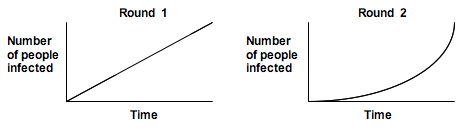
Post the data from both rounds. Have the class enter them into
the table in Step 2 of their handout. Have students sketch lines
on Step 2's axes to generally represent their sense of how the
number of infected people would change over time.
(In Round 1, the virus carrier infects one person at a time,
and the overall number of infected people grows arithmetically
[i.e., 1, 2, 3, 4, 5]. In contrast, the multiple virus
carriers in Round 2 infect the class more quickly, and the
overall number of infected people grows geometrically [i.e.,
1, 2, 4, 8, 16].)
-
Process Rounds 1 and 2 by asking the following questions:
-
What were some of the differences between Rounds 1 and 2?
(In Round 2, there were more carriers transmitting the
virus and more students became infected.)
-
Ask which round more closely represents a real-life epidemic
and why.
(Both rounds resemble real-life epidemics. In their early
stages, all epidemics start with one person infecting
another. Soon, however, there is a critical mass of
infectious people, and the transmission pattern shifts to
resemble the one in Round 2.)
-
The next four rounds explore how a preventive measure
(inoculation) affects how quickly a virus spreads through a
population. Tell students that, once inoculated, they must keep
their inoculation stickers for all remaining rounds in order to
stay protected. Give 20 percent of the class an inoculation
sticker and have them put it on their right shoulder. The
stickers should be a different color from the infection
stickers.
-
Tell students that Round 3 is essentially a rerun of Round 2
(i.e., multiple carriers), except that some students will be
inoculated. Run Round 3 for 60 seconds. Tally the number of
inoculation stickers and how many students became infected,
and record these data in the data table in Step 5 on the
handout.
(If an inoculated student gets an infection sticker, don't
count it as an infection. In real life, even inoculated
people get the virus, but their immune systems are able to
prevent infection.)
-
Round 4 is a repeat of Round 3, except that 40 percent of
the class gets inoculated. Distribute inoculation stickers
to an additional 20 percent of the class. Conduct Round 4,
and then tally and record the total number of inoculation
and infection stickers.
-
Round 5 is a repeat of Round 4, except that 60 percent of
the class gets inoculated. Distribute inoculation stickers
to an additional 20 percent of the class. Conduct Round 5,
and then tally and record the total number of inoculation
and infection stickers.
-
Round 6 is a repeat of Round 5, except that 80 percent of
the class gets inoculated. Distribute inoculation stickers
to an additional 20 percent of the class. Conduct Round 6,
and then tally and record the total number of inoculation
and infection stickers.
-
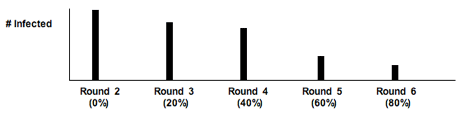
Have students make a bar graph of the class data. Note that
Round 2 serves as the control because no students were
inoculated. The graph should similar to the one below:
-
Divide the class into small groups, and have them discuss the
questions below. Ask students to summarize the main points
discussed in Step 6 of their handout. Conclude the activity by
discussing each question as a class. Record the key points on
the board.
-
As an extension, have groups consider the following scenario and
develop a set of recommendations. Have each group present its
proposal to the class.
You are the Chief Medical/Health officer for a city or a state
and you are trying to keep healthcare costs down to meet a fixed
budget. Describe how would you allocate money to manage a new
flu epidemic. Show how you would appropriate the money (e.g.,
allocate 50 percent to immunize, 25 percent for quarantine, 10
percent for education, and 15 percent for early aggressive
treatment of ill people) and explain your allocations.

Student Handout Questions
-
Which of the game rounds more realistically represents an
epidemic? Explain.
Round 2 more accurately represents what is meant by an
epidemic, in which large numbers of people get infected within
a short time frame.
-
How do different levels of inoculation affect how a virus
spreads through a population?
Inoculating a small percentage of the population leaves a
large number of potential hosts for the virus, and the
infection spreads quickly. However, a critical threshold is
reached when enough people are vaccinated—somewhere
between 60 and 80 percent. At this point, the virus encounters
vulnerable people so infrequently that a rapid spread through
the population is prevented.
-
How could you change the game to make it more realistic?
The game has several shortcomings. One is that, in real life,
certain infected individuals are more able to infect others.
For example, a public transportation worker or doctor can
infect more people than an artist or writer working alone in a
studio. Another shortcoming is that in an everyday setting,
there is a lag time between infections. Students can mimic a
lag time by having "infected" class members count to ten
before "infecting" another person. They could also use a lag
time to represent the use of preventive measures, such as
wearing masks, washing hands, or staying home.
-
List any methods that might help prevent an epidemic from
spreading.
Careful hand washing with soap and water; wearing a mask
while in public and discarding it when returning home;
following safe-sex practices; quarantining people who are ill
and those who have come in contact with them; inoculations, if
available.
-
How do inoculations compare to other preventive measures, such
as wearing a mask or washing hands, when it comes to reducing
infections?
Inoculations stimulate the immune system to recognize and
destroy an infectious microbe. In this way, inoculations
prevent people from getting infected when they are exposed to
the virus. Wearing a mask and hand washing are very effective
preventive measures. However, staying healthy requires
conscientious and repeated behavior to be effective. Even so,
people always run a risk of infection when exposed to a
virus.
-
This activity represents one kind of model used in science
teaching—a simulation of how a virus spreads. List some
other examples of models used in science. Why do people use
models?
Models play an important role in helping people understand
systems, abstract ideas, and processes that are difficult to
experience directly. There are mathematical models, such as
formulas and computer programs, and physical models, such as
DNA, the atom, the solar system, plate tectonics, and the
cell. Simulations like today's activity are also models.
Models contain underlying assumptions. For example, this
activity assumes that each person touched by a virus carrier
gets infected. A question to discuss is what virus load is
needed to create an actual infection and how inoculation or
natural immunity protects a person. Another assumption was
that there was no lag time in infection—as soon as a
participant got a sticker he or she could pass an infection to
someone else. No viruses are that virulent—they need
time to multiply and be transmitted to another host.

Web Sites
NOVA scienceNOW—Pandemic Flu
www.pbs.org/wgbh/nova/sciencenow/3302/04.html
Contrasts the ways bird flu and human flu spread and discusses how
the flu responsible for the 1918 flu pandemic may have started as a
bird flu.
NOVA scienceNOW—1918 Flu Segment
www.pbs.org/wgbh/nova/sciencenow/3318/02.html
Discusses the flu responsible for the 1918 flu pandemic and how it
may have started as a bird flu.
Centers for Disease Control
www.cdc.gov/flu/avian
Discusses different types of avian flu, how epidemics spread, and
how they can be controlled.
Global Security
www.globalsecurity.org/security/ops/hsc-scen-3_pandemic-influenza.htm
Presents overviews of avian flu, epidemics, and the history of flu
pandemics.
New Scientist
www.newscientist.com/channel/health/bird-flu
Summarizes key avian flu issues and provides a timeline and graphics
that show how a flu virus invades tissue.
Pandemic Flu.Gov
www.pandemicflu.gov/
Provides maps of flu outbreaks and information about state-by-state
preparedness for a flu epidemic.
World Health Organization
www.who.int/csr/don/2004_01_15/en/
Offers insight into the international community's concerns about and
response to avian flu.
Books
Epidemics Laid Low: A History of What Happened in Rich
Countries
by Patrice Bourdelais. Johns Hopkins University Press, 2006.
Describes how Europe has responded to a series of epidemics over the
past 800 years and how authorities dealt with the social, political,
economic, and cultural issues the epidemics caused.
The Fourth Horseman: A Short History of Plagues, Scourges, and
Emerging Viruses
by Andrew Nikiforuk. M. Evans and Co., 1993.
Describes in historical terms how conditions need to be optimal for
most epidemics to take hold.
Plague Time
by Paul Ewald. The Free Press, 2000.
Contends that there are epidemic diseases even more important to
track than flu and Ebola.
Rats, Lice and History
By Hans Zinsser. Little Brown and Company, 1984.
Recounts how typhus has affected human history and describes
people's attempts to eradicate it.
When Germs Travel: Six Major Epidemics that Have Invaded America
and the Fears They Have Unleashed
by Howard Markel. Vintage Books, 2005.
Details examples of the failure of federal public health policy and
of the health care community's preparedness for dealing with six
major epidemics and recommends improvements for adequate responses
in the future.

The "Biology of Flu" activity aligns with the following National
Science Education Standards (see
books.nap.edu/html/nses).
Grades 5-8
Science Standard C
Life Science
- Structure and function in living systems
Science Standard F
Science in Personal and Social Perspectives
Grades 9-12
Science Standard F
Science in Personal and Social Perspectives
- Personal and community health
Classroom Activity Author
Developed by John Glyphis, Ph.D., MPA. Glyphis is a biologist who
consults on and writes about science in education and public policy.
|
|