
|
|
Newton's Dark Secrets
|
|
|
|
Program Overview
|
|
|
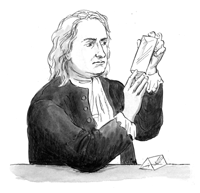 NOVA presents the life and science of Sir Isaac Newton (1642-1727),
one of the greatest scientists who ever lived.
NOVA presents the life and science of Sir Isaac Newton (1642-1727),
one of the greatest scientists who ever lived.
The program:
-
chronicles Newton's upbringing in the early part of the
Scientific Revolution.
-
recounts Newton's attendance at Trinity College at Cambridge
University in England, where he studied the latest scientific
ideas, and his return to his hometown of Woolsthorpe four years
later when the plague struck Cambridge.
-
reviews the advances Newton made in gravity, calculus, and the
composition of light while he was at Woolsthorpe.
-
relates Newton's return to Cambridge, where he was appointed the
Lucasian Professor of Mathematics, a chair currently held by
physicist Stephen Hawking.
-
reports how Newton solved the problem of chromatic aberration in
refracting telescopes by designing and building a reflecting
telescope based on mirrors rather than lenses.
-
recounts Newton's election to the Royal Society and details the
contentious relationship between Newton and fellow society
member Robert Hooke, who accused Newton of stealing his ideas.
explores Newton's interests in alchemy and religion. -
explains Newton's concepts of the inverse square law, the laws
of motion, and gravity.
-
describes the 1687 publication of
Philosophiae Naturalis Principia Mathematica, a work
generally acknowledged as the greatest scientific book ever
written.
-
relates how Newton had what some believe was a nervous
breakdown; following his recovery, he takes a job as warden of
the Mint in London.
-
reports how Newton published his second great work,
Opticks, the year after Hooke died.
-
concludes by noting how, more than 250 years after his death, a
new picture of Newton—as scientist, alchemist, and
theologian—is emerging.
Taping Rights: Can be used up to one year after the program
is taped off the air.
|
|












