|
On December 26, 2004, at 7:59 a.m. local time, an undersea section
of the Earth's crust slipped along a 700-mile-long fault off the
coast of Sumatra, setting in motion a train of destructive waves
called tsunamis that left well over 250,000 people dead or missing.
In "Wave That Shook the World," NOVA traces exactly what happened,
and why.
Before 2004, the Indian Ocean's most devastating tsunami was caused
by the titanic eruption of the volcano Krakatoa in 1883.
(Immediately following the original airing on March 29, PBS revisits
this earlier disaster with "KRAKATOA," a 90-minute docudrama.)
Causing nearly 40,000 deaths, Krakatoa was long considered an almost
unimaginable catastrophe, until last December's tsunami showed that
humans are more vulnerable than ever to rare but inevitable natural
disasters.
This program tells the minute-by-minute story of the 2004 tsunami,
featuring video footage and scientific analysis of the onrushing
waves that spread for 3,000 miles around the Indian Ocean basin.
NOVA interviews eyewitnesses, including one of the few people who
survived when a train carrying 1,500 passengers along a coastal
route in Sri Lanka was swamped by the waves; and two men who
videotaped the second, more destructive wave that hit their
beachfront bar in Thailand. Thousands had been lulled into a false
sense of security after the first wave passed. Tsunamis, however,
usually consist of several waves, separated by many minutes or even
hours, and the biggest can come at any time.
Some geologists estimate that the earthquake that caused the
disaster measured 9.3 on the Richter scale, making it the second
largest on record. The quake occurred near the surface of the
seafloor, where one plate of the Earth's crust is slipping beneath
another, creating periodic releases of pent-up energy. NOVA uses
detailed animation to show how the quake raised a portion of the
seafloor, which also lifted all the water lying above it. This
movement caused a series of massive waves that radiated outward from
the quake's epicenter at speeds approaching that of a passenger jet.
(For a detailed look at the event, see
Anatomy of a Tsunami.)
Barely a minute after the quake, computers at the Pacific Tsunami
Warning Center in Hawaii picked up seismic signals and automatically
notified scientists. Within a few minutes they had issued a warning
bulletin. But they still did not know the full magnitude of the
quake or whether it had triggered a tsunami. The Center's
ocean-sensing gauges are confined to the Pacific, where tsunamis
regularly occur. No similar network or warning system exists in the
Indian Ocean.
Fifteen minutes after the temblor, a colossal wall of water struck
the northwest coast of Sumatra and washed several miles inland,
destroying everything in its path. Over the next few hours, a series
of gigantic waves traveled across the Indian Ocean, killing tens of
thousands of people in Thailand, Sri Lanka, and India.
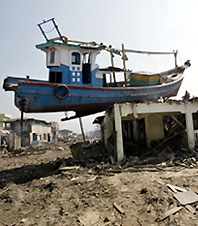
The degree of destruction is almost impossible to fathom. It was
"like the aftermath of an atomic bomb, maybe worse," says disaster
photographer Geoff Mackley as he surveys the Sumatran coast, site of
the earliest waves, which are estimated to have been as high as 60
feet. The area is littered with debris of every description, from
battered factories to shattered concrete breakwaters to ships tossed
around like toys.
"KRAKATOA" addresses a catastrophe at the southern end of Sumatra,
in the strait separating the island from Java. There, in the late
spring and summer of 1883, the volcano Krakatoa came to life with
ominous rumblings that culminated in the largest volcanic explosion
ever recorded. The program brings this legendary event to life with
dramatic recreations and computer animation.
The eruption generated a wave that was even more powerful than the
tsunami of 2004, although it didn't spread as far and resulted in
about 15 percent as many casualties. (See
Once and Future Tsunamis
for more on this and other deadly tsunamis through history.)
Krakatoa itself was obliterated by the explosion, which was heard
thousands of miles away. Airborne debris spread around the world,
producing vivid sunsets for years. Today, a new volcano is rising
near where Krakatoa once stood. This discovery is a stark reminder
that, with nature, the question is not could it happen again but
when.


|

|
An Indonesian man looks at a boat left stranded atop a
house in Banda Aceh, the provincial Sumatran capital
that was desolated by the tsunami.

|
|
|







