|
In January 1993, six scientists and three hikers were scalded and
crushed to death when they ventured into the smoking mouth of the
active volcano Galeras in Colombia, confident that no eruption was
imminent. This program tells the gripping story of this
controversial field trip and the quest to predict when volcanoes
will blow.
Tragically, the key to Galeras's impending eruption may have been in
plain sight though inadvertently overlooked by trip leader Stanley
Williams of Arizona State University. Williams, who suffered two
broken legs, a partially severed foot, and a severe brain injury,
has subsequently been accused of ignoring the clues and leading his
colleagues into a deathtrap from which only a handful escaped.
The warning signs ignored were seismic signals like those recorded
during earthquakes. They are the key to a revolutionary new theory
that not only could have alerted those on Galeras but may provide
accurate advance warning of massive eruptions such as the one that
struck Colombia's Nevado del Ruiz in 1985. This eruption sent
melting glaciers and mud rushing down onto the city of Armero, where
more than 20,000 people perished.
Tremors and smoke have long been omens that a dormant volcano was
coming back to life, but no one could say with certainty when or if
it would explode. Now, a new theory, developed by Bernard Chouet of
the U.S. Geological Survey, focuses on a previously mysterious type
of seismic signal. For decades no one knew what the signals meant,
but Chouet realized they were signs that magma and gas were surging
into a volcano like air being pumped into a tire. Repeated
injections of magma and gas create unbearable pressure, and the
volcano eventually blows. Chouet's theory was tested in December
2000 to forecast the largest eruption of Mexico's Popocatepetl in a
millennium, allowing the orderly evacuation of 30,000 people.


|
|
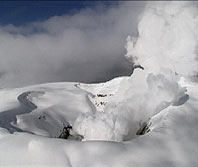
Colombia's Nevado del Ruiz exploded in 1985, sending
mudflows down onto the town of Armero, where more than
23,000 people were killed.
|
|
|





