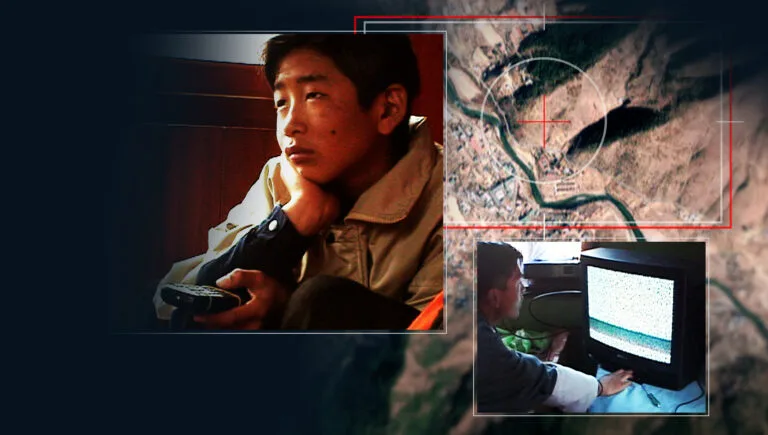
When 13-year-old Kainat Soomro accused four men of gang rape, she risked everything: her reputation, her education and even her life. “Outlawed in Pakistan” explores the country’s flawed justice system through the lens of her complicated case.
A new study released today helps explain how Lashkar-i-Taiba, one of the world’s most dangerous militant organizations, is integrated into Pakistani society.
Although David Coleman Headley avoided the death penalty, Judge Harry Leinenweber says the sentence “will keep him under lock and key for the rest of his natural life.”
A federal judge Thursday sentenced a Chicago immigration consultant to 14 years in prison for his role in supporting the Pakistani terrorist group that worked with Pakistan’s intelligence service to carry out the 2008 Mumbai attacks and plot a follow-up strike in Denmark.
Earlier this week the State Department announced that two former Pakistani intelligence directors are immune from the wrongful death lawsuit filed by the families of Americans killed in the 2008 Mumbai attacks.
An interactive film that explores the tangled web of relationships that helped the American behind the 2008 Mumbai attacks move from small-time drug smuggler to international terrorist and spy.
As the world closely watches the fate of Malala Yousafzai, the 14-year-old Pakistani schoolgirl fighting for her life after being gunned down by the Taliban last week, the pressure is on Pakistan to bring her attackers to justice.
The Obama administration’s decision to designate the leadership of Pakistan’s Lashkar-e-Taiba group as terrorists last week sends a pointed, if largely symbolic, message to a Pakistani government that remains unable or unwilling to crack down on the extremist organization.

Zabiuddin Ansari’s statements to Indian police have reinforced evidence of Pakistani intelligence’s role in a terror plot that killed six Americans at the same time Pakistan was receiving billions of dollars in U.S. aid.
Afghanistan’s former spy chief Amrullah Saleh told NPR this morning that the new strategic partnership agreement with the U.S. is a good step, but warns of the consequences if the U.S. engages in talks with the Taliban.
Khalil Dale, a British aid worker employed by the International Committee of the Red Cross (ICRC), was found dead in Pakistan yesterday, almost four months after he was kidnapped while he was driving home from his office in Quetta.
Opium production will rise across Afghanistan in 2012, spreading to more parts of the country than it has in the last few years, according to a new UN assessment.
After months of negotiations, the U.S. and Afghanistan reached an agreement on Sunday that will transfer more control of controversial night raid operations to Afghan forces, allowing the two governments to move ahead in negotiating a broader strategic-partnership agreement.
The U.S. and Afghanistan are near reaching a deal that would give Kabul greater control over night raids — the controversial signature tactic of the U.S.-led kill/capture campaign in the country — and allow the two governments to move ahead in negotiating a broader strategic-partnership agreement.
The day after the U.S. announced up to a $10 million reward “for information leading up to the arrest and conviction of Hafiz Mohammad Saeed,” the suspected mastermind of the 2008 Mumbai terror attacks brazenly took to the media to defend himself.
“He presides over a campaign that has killed thousands of Islamist militants and angered millions of Muslims,” wrote The Washington Post’s Gregg Miller, in a rare profile of the head of the CIA’s Counterterrorism Center (CTC). “But he is himself a convert to Islam.”
In the wake of the March 11 bloody shooting rampage allegedly carried out by Army Staff Sgt. Robert Bales, the U.S. has found itself in a vulnerable position as it attempts to negotiate a strategic-partnership agreement with the Afghan government.
A nearly-six-month-long investigation published by the Associated Press on Friday tracks with earlier studies that found 70 to 80 percent of those killed in CIA drone strikes in Pakistan are militants.
There’s no shortage of thorny issues currently facing Pakistan’s intelligence chief — and Lt. Gen. Ahmed Shuja Pasha’s term as director-general of the Inter-Services Intelligence (ISI) is set to expire on March 18.
Shakila was just 8 years old when a group of men abducted her and her cousin from their beds as they slept in Naray district in Afghanistan’s Kunar province.
CIA drone strikes in Pakistan have killed “dozens of civilians” who had gone to help rescue victims of drone strikes or were attending funerals for the victims of previous strikes, a new report by British and Pakistani journalists asserts.
The BBC reports today that a classified NATO report leaked to the news organization “fully exposes for the first time the relationship between the Pakistani intelligence service (ISI) and the Taliban.”
In a rare break with the usual silence regarding the CIA’s covert drone program, President Obama yesterday defended the controversial strikes that target suspected Al Qaeda and Taliban leaders abroad.
Sources now say the target of resumed U.S. drone strikes in Pakistan’s tribal areas was Aslam Awan, an “external operations planner” for Al Qaeda who was planning attacks against the West.
It’s an arresting sight: A Pakistani Taliban commander confidently rolls into a village in an American Humvee his forces have just captured. He turns to the journalists he has come to address and delivers a stark warning.
(60 minutes) FRONTLINE's 10,000 mile journey that conveys just what the U.S. is up against. (Web site »)
Mar. 5, 1985
Buying the Bomb
(60 minutes) Pulitzer Prize-winning investigative reporter Seymour Hersh presents his first television investigation for Frontline. After six months of work, Hersh uncovers the story of a Pakistani businessman who tried to ship electrical devices which can be used as nuclear bomb triggers out of the US to Pakistan.
Dec. 11, 1984
Red Star Over Khyber
(60 minutes) In 1979, the Soviet Union invaded Afghanistan. On the fifth anniversary of the invasion, Frontline correspondent Richard Reeves reports from Afghanistan and Pakistan, examining the stalemate in the Persian Gulf and the pressure placed on Pakistan to accept over one million Afghan refugees.