REPORTED BY
Ghaith Abdul-Ahad
DIRECTED BY
Safa Al Ahmad
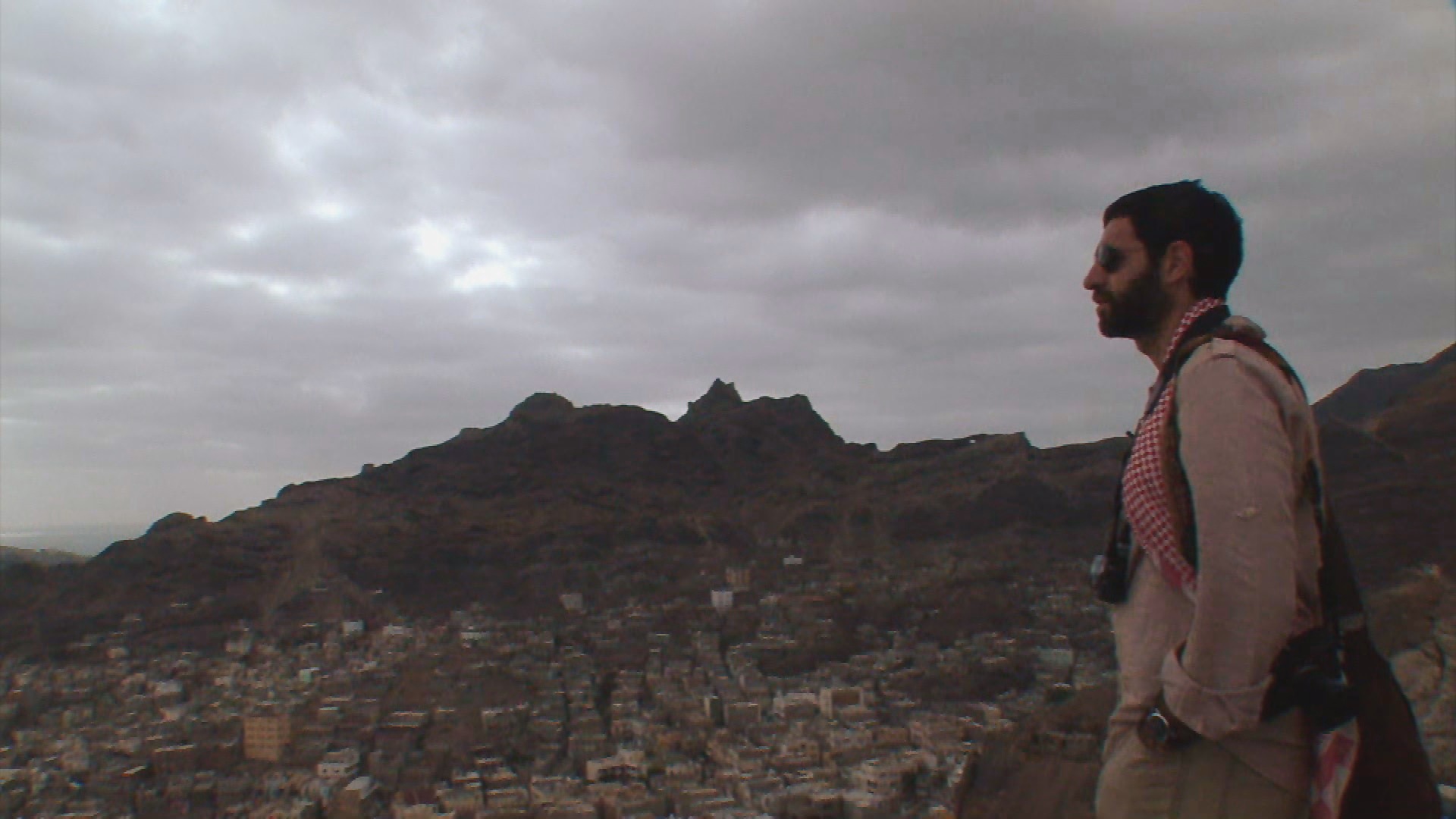
NARRATOR: Reporter Ghaith Abdul-Ahad’s journey in Yemen began here, in the dangerous no-man’s land between the Yemeni army and Al Qaeda in the Arabian Peninsula.
GHAITH ABDUL-AHAD, Reporter, The Guardian: [voice-over] The government doesn’t allow journalists to go see al Qaeda.
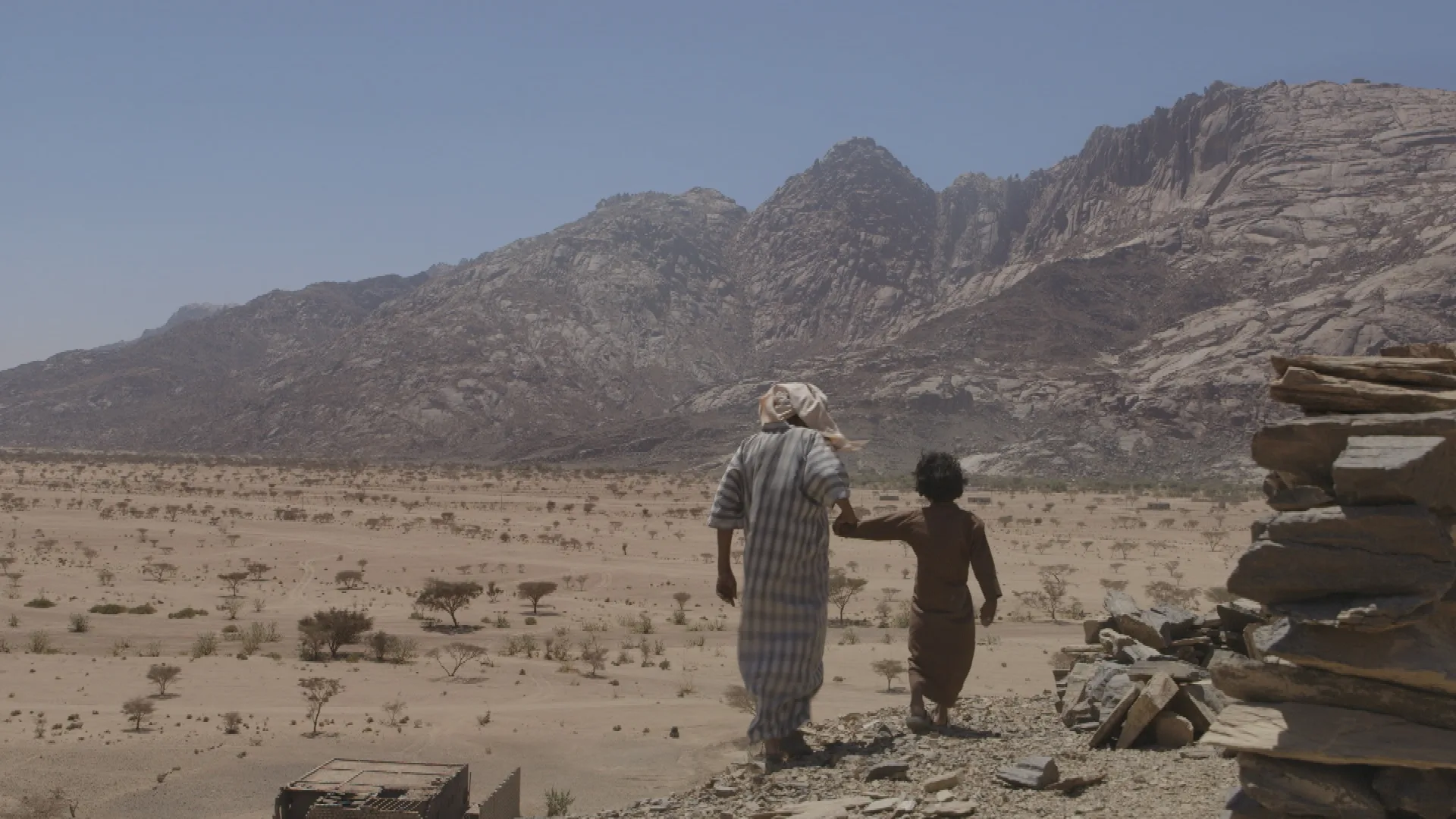
NARRATOR: They had to take a risky route through the desert.
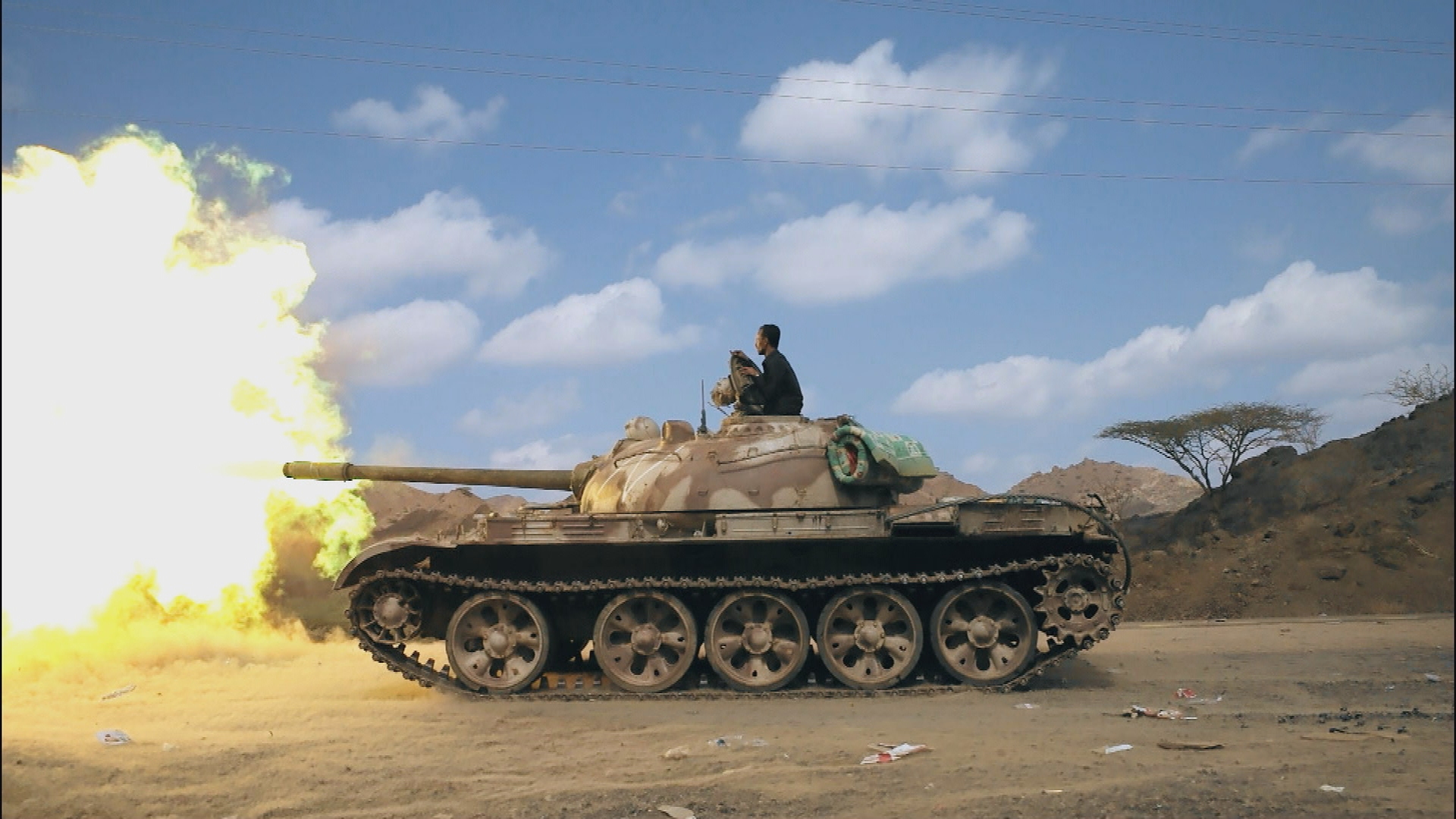
GHAITH ABDUL-AHAD: [on camera] We had to leave the main road, as it’s being blocked by the military. And all along the main way, we saw military installations, we saw tanks, pick-up trucks mounted with machine guns.
NARRATOR: Just days earlier, Ghaith, an Iraqi journalist, had heard from his contact inside al Qaeda. It had taken months of secret negotiations.
GHAITH ABDUL-AHAD: We’re trying to hit a Bedouin settlement and find a guide who can take us through that desert into the town.
[Twitter #frontline]
NARRATOR: Ghaith’s destination was Jaar, a large town under al Qaeda control. On his way, Ghaith’s vehicle broke down in the sand.
MAN: [subtitles] We are going to try to pull it out.
NARRATOR: He called his al Qaeda contact.
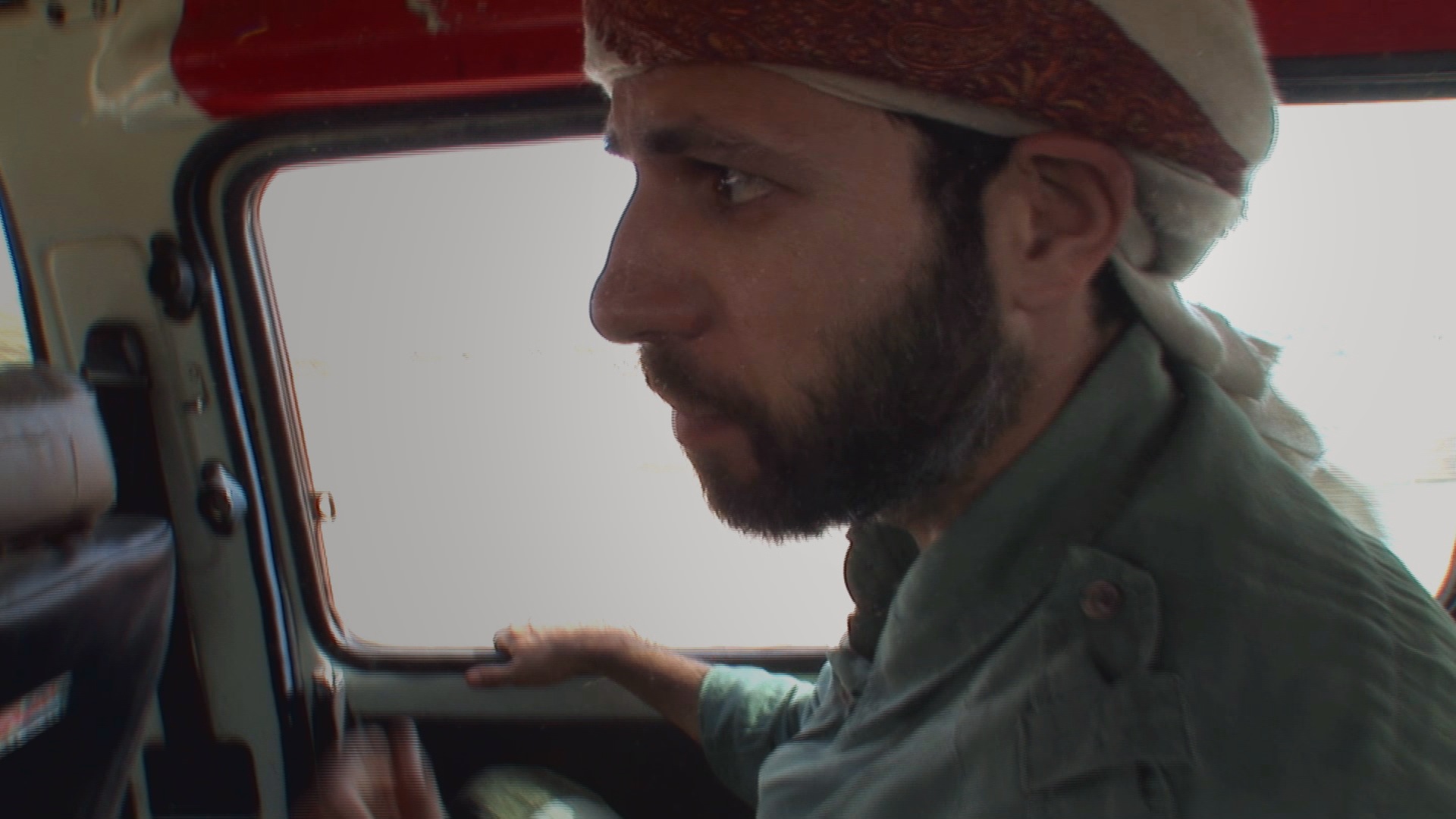
GHAITH ABDUL-AHAD: He said we are in al Qaeda territory, and he would send a car to come pick us up. From the moment of the call, it’s extreme anxiety. This is an organization known for kidnapping journalists, detaining them for a long time, sometimes beheading them.
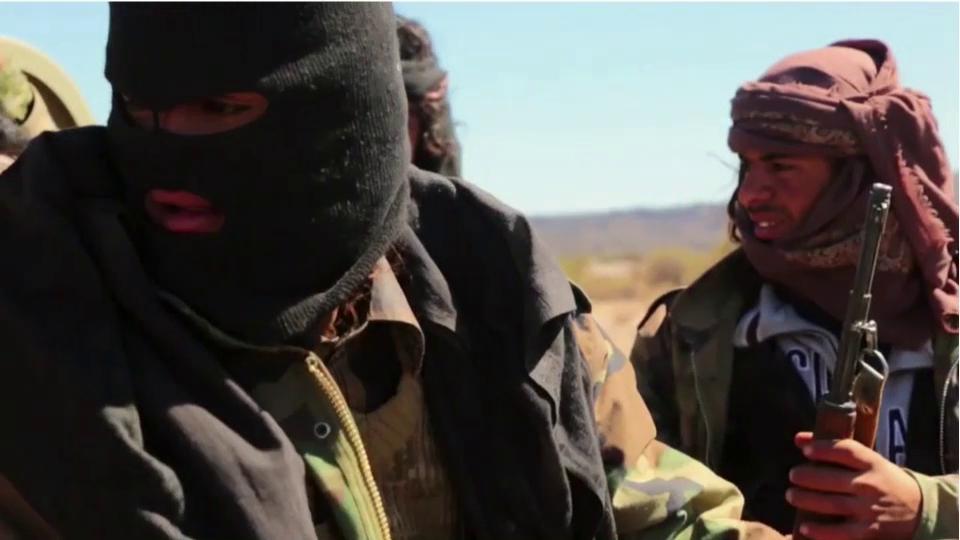
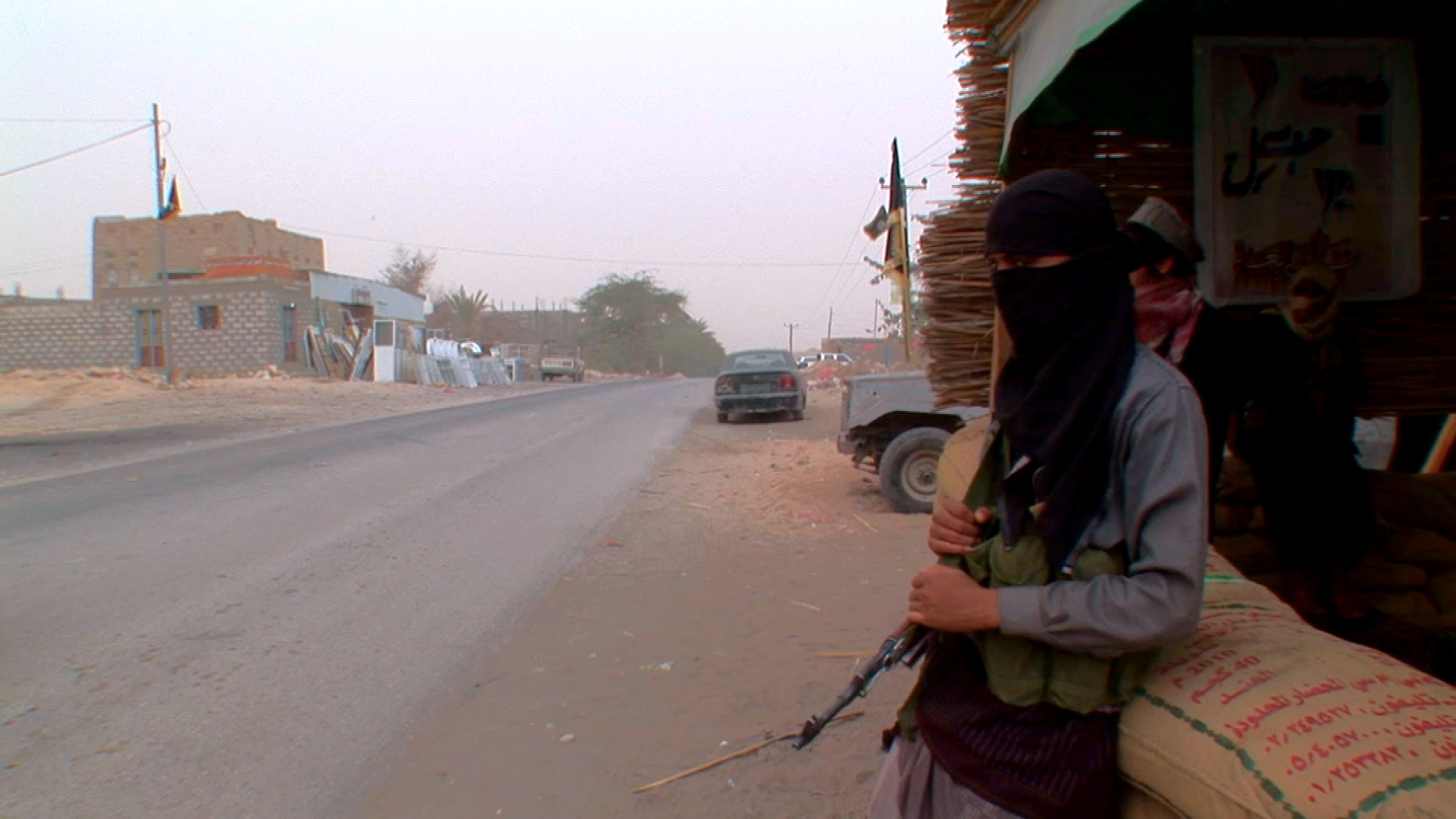
NARRATOR: After two hours, a unit of al Qaeda fighters arrived to help Ghaith. They didn’t want their faces shown on camera.
AL QAEDA FIGHTER: [subtitles] No filming now, please.
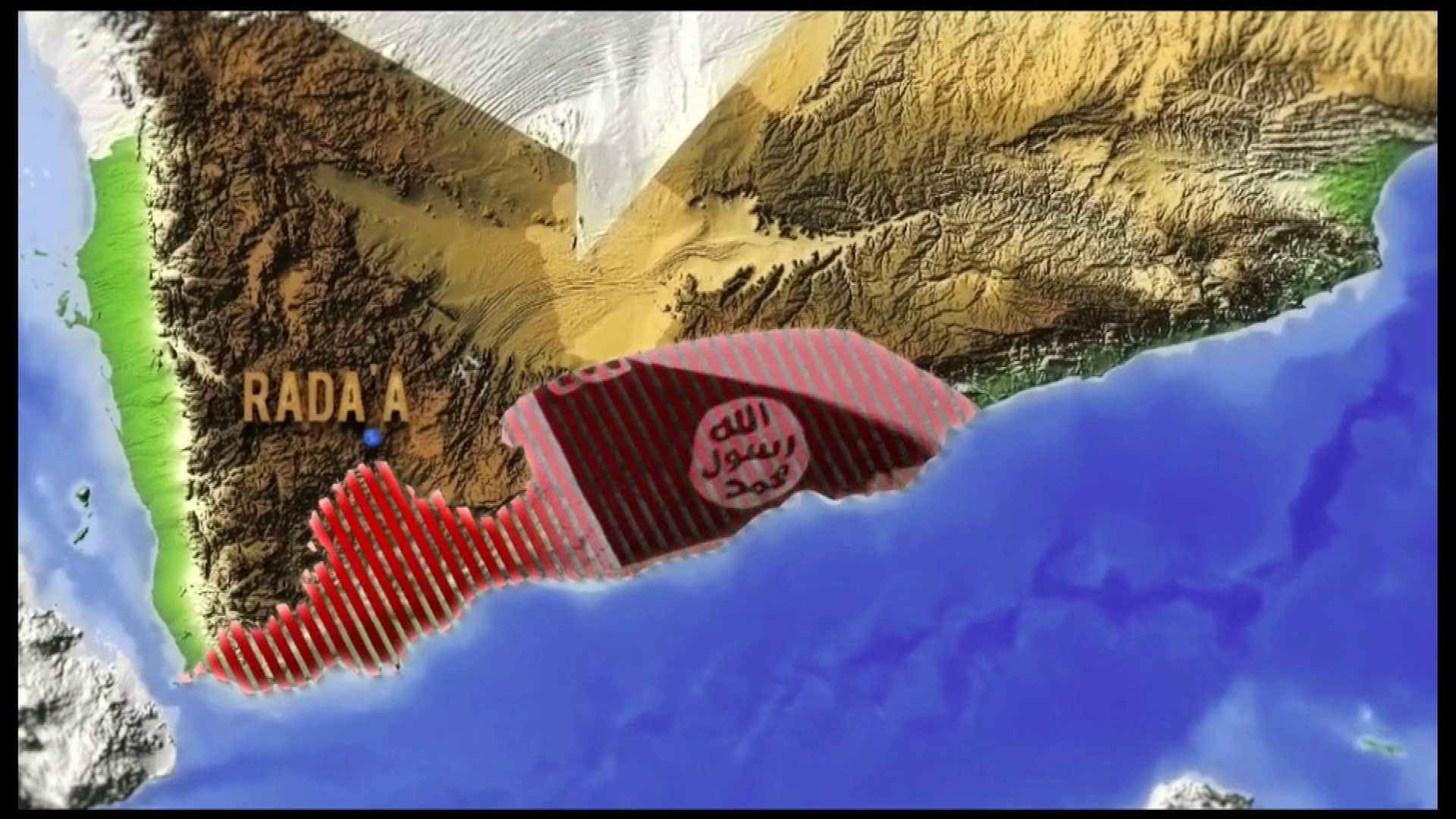
NARRATOR: Ghaith was then escorted to Jaar. A year ago, al Qaeda had taken the town over without resistance from the Yemeni army, which receives arms, training and intelligence from the United States.
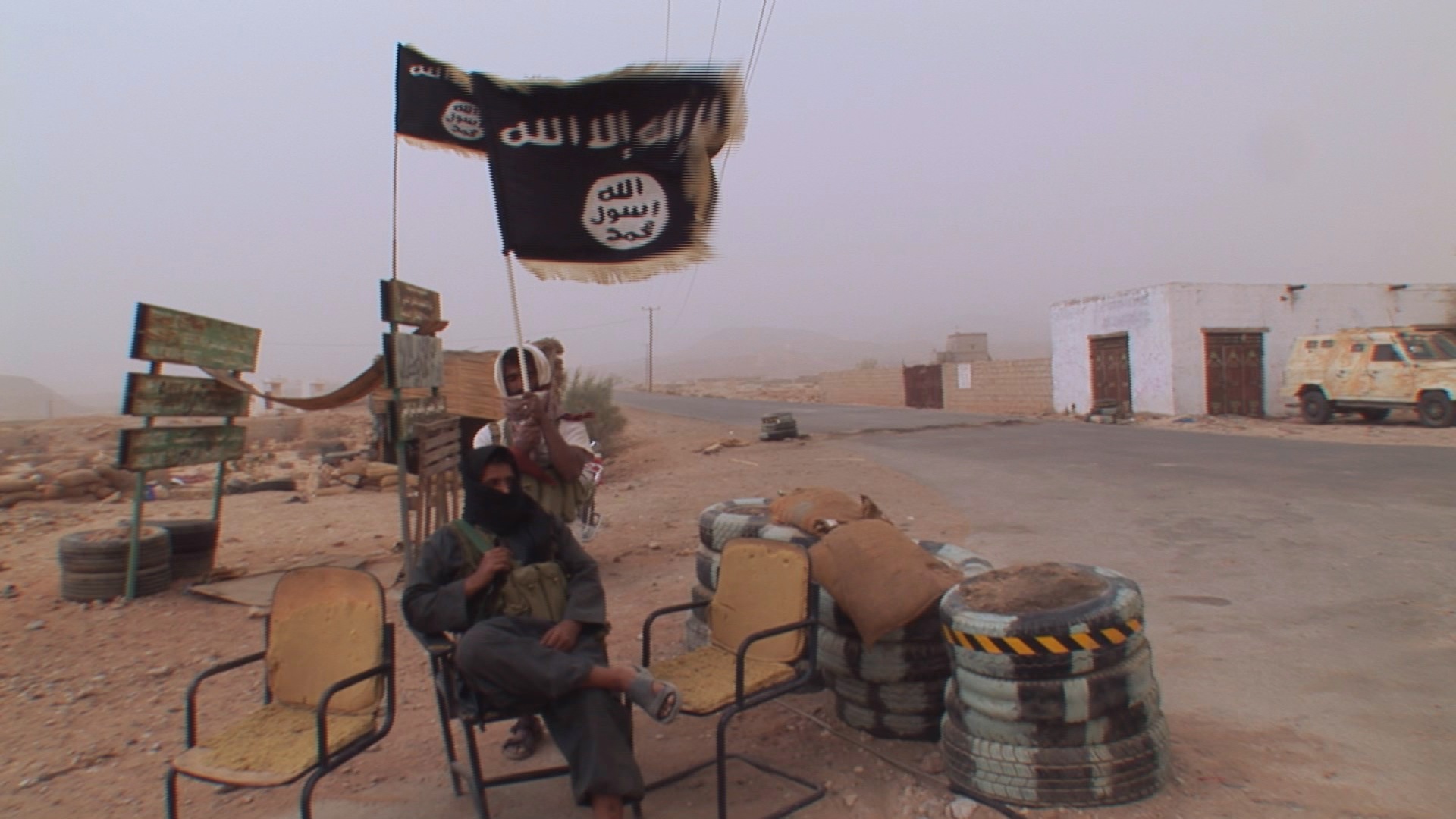
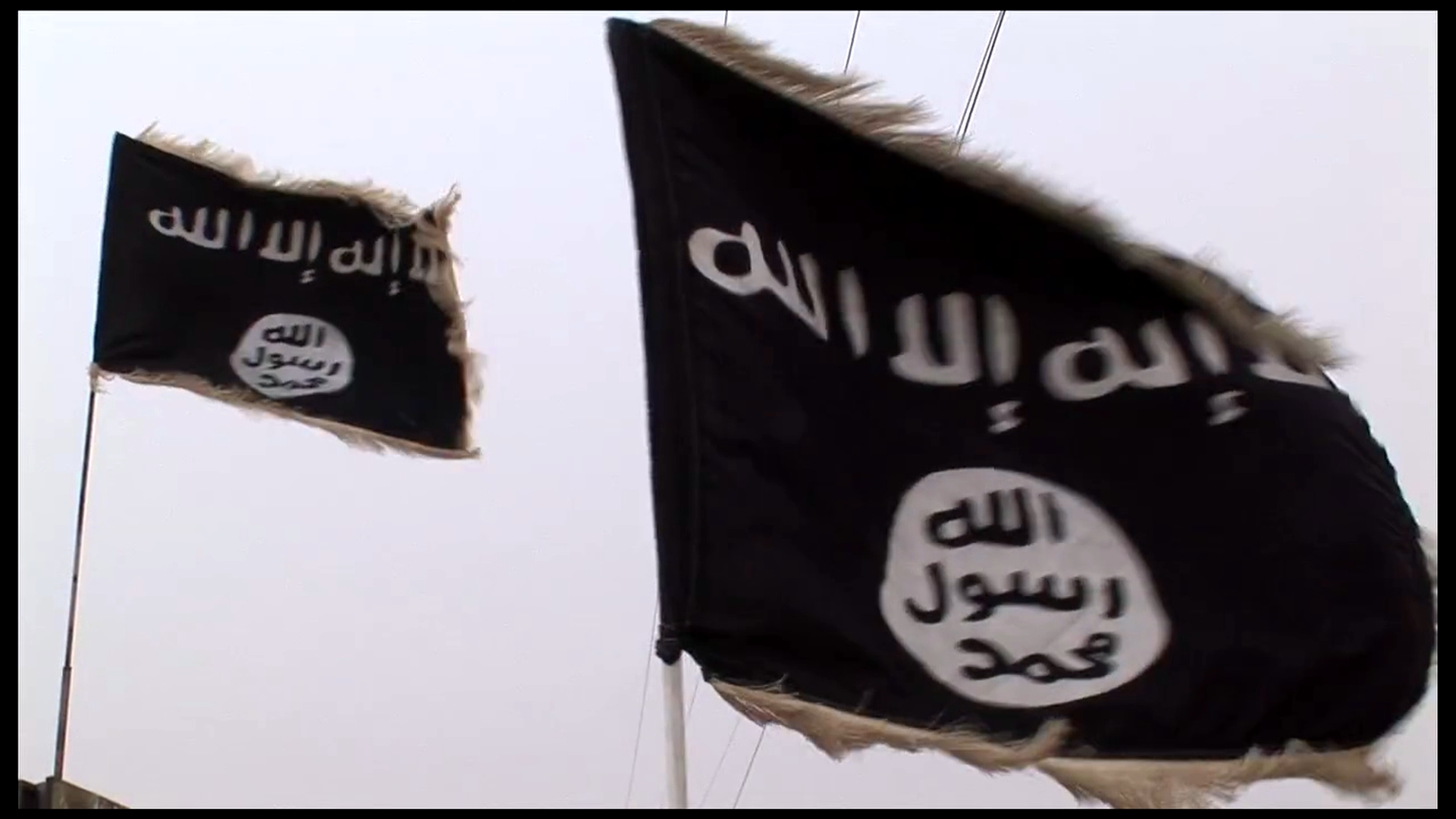
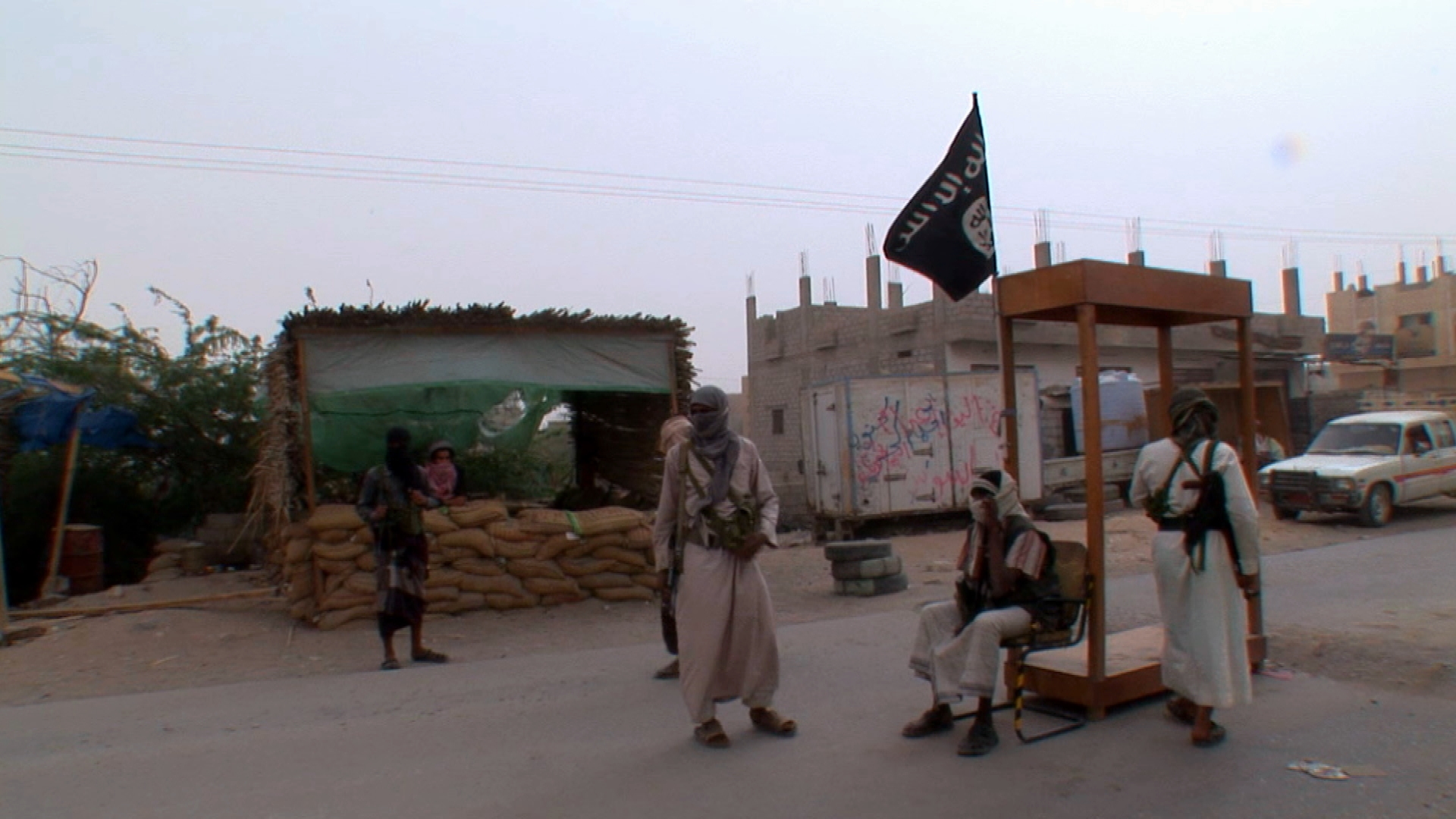
On the edge of Jaar, the first glimpse of the flag of al Qaeda.
GHAITH ABDUL-AHAD: [on camera] It’s a very sinister thing. It’s a black flag inscribed with the words “No God but one God,” and then the seal of the prophet. It has an impact on you. It’s very scary.
MAN IN STREET: [subtitles] Welcome, welcome.
NARRATOR: Ghaith’s contact was a fighter and political officer who called himself Fouad. He was a member of Ansar al Sharia, the local franchise of al Qaeda.
[Ansar al Sharia footage]
Ansar al Sharia was started last year to provide Al Qaeda in the Arabian Peninsula with foot soldiers and a new image. Some experts question the exact relationship between the two groups, but Ghaith found that they operated as one and the same.
GHAITH ABDUL-AHAD: Once we talked to them, we saw how clearly they referred to themselves as Al Qaeda in the Arabian Peninsula. And for Fouad to talk to us, he would have to have permission from the highest authority.
NARRATOR: Fouad said that U.S. drones and the Yemeni air force often attacked.
“FOUAD”: [through interpreter] They bomb people’s homes to prove to Washington they are truly fighting terrorism, but they have failed.
NARRATOR: He agreed to take Ghaith on a tour of Jaar. He wanted to show how al Qaeda was effectively governing an entire city.
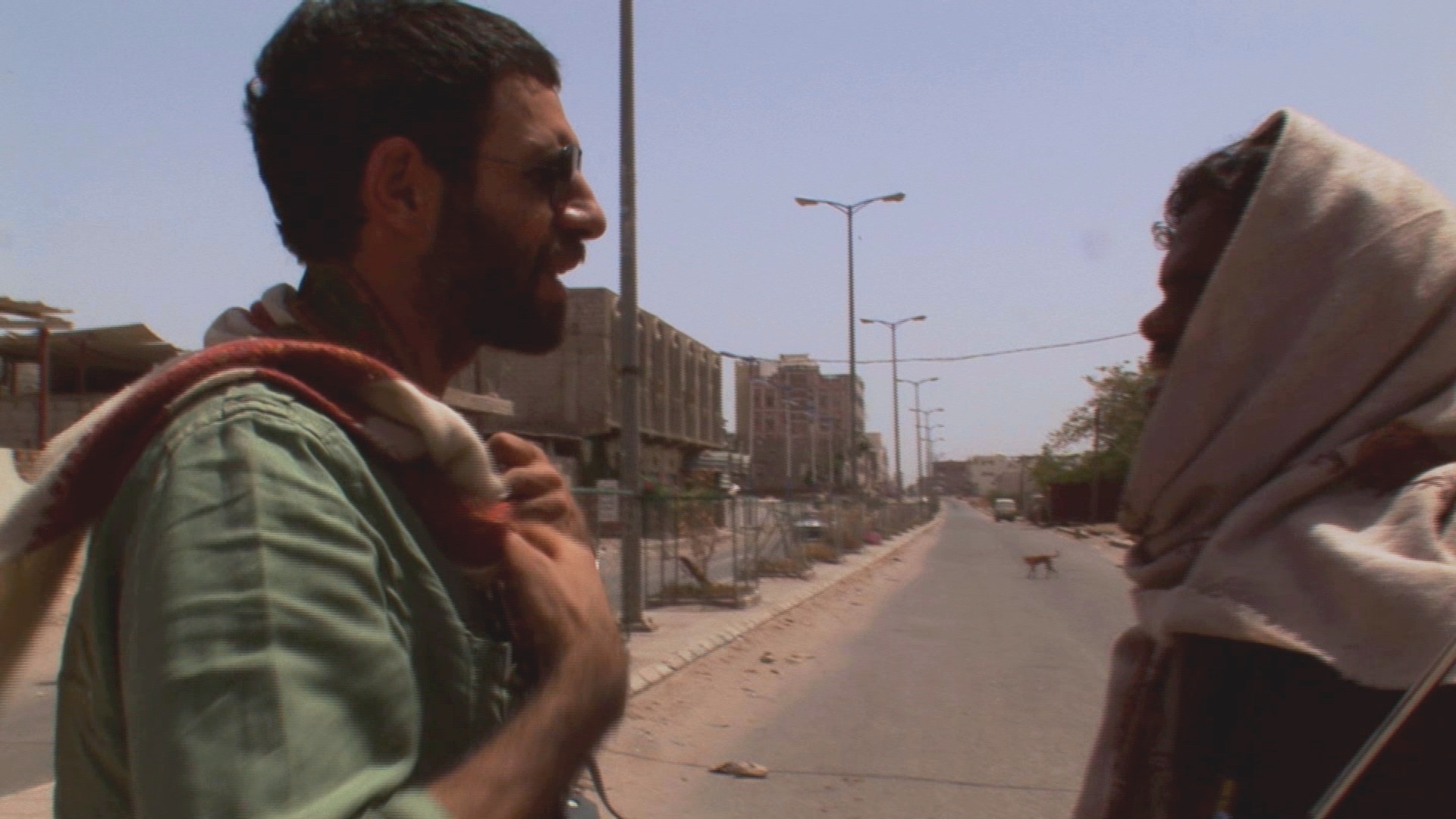
GHAITH ABDUL-AHAD: [voice-over] Jaar is really poor. It’s wretched. Yet he points to all of this and he says, “This is the ultimate just city because we’re implementing Sharia.”
NARRATOR: But Fouad told him that the attacks from both the Americans and the Yemeni air force made the locals fear for their lives.
GHAITH ABDUL-AHAD: [on camera] [subtitles] Can you tell us, how is life in Jaar?
“FOUAD”: [through interpreter] These days, a lot of people have been displaced. You see the streets are empty. The schools have shut down.
NARRATOR: It came as a surprise that al Qaeda allows national newspapers to be sold. This headline says that a government air strike on the town had killed many local fighters.
“FOUAD”: [through interpreter] They talk about the air force. They’re too embarrassed to say it’s actually the American drones.
NARRATOR: He also said that only three fighters had been killed and claimed to have known them.
“FOUAD”: [through interpreter] We are at war with America and its allies. Just like Bush once said, if you’re not with us, you’re against us.
GHAITH ABDUL-AHAD: [on camera] Did you see that? Did you see two guys on a motorbike with the flag of al Qaeda?
NARRATOR: Ghaith met fighters who he believed were from Somalia, Afghanistan, Iraq and Saudi Arabia, but he wasn’t allowed to interview them on camera.
[www.pbs.org: More of Ghaith’s journey]
GHAITH ABDUL-AHAD: The whole day was very strange. We passed army checkpoints. We drove through the desert. We were met by the fighters.
And now we are in a city. It’s a real city. It’s a natural city. People are living in the city. People are having their normal life, as we’re going to see. Yet at the same time, this is al Qaeda. This is not even, you know, Taliban and al Qaeda. This is Al Qaeda in the Arabian Peninsula and they just control a whole city.
NARRATOR: Ghaith was shown this video filmed by al Qaeda.
[Ansar al Sharia footage]
Local people had been summoned to the town’s theater. It showed al Qaeda fighters attacking a major army base near Jaar. Almost 200 Yemeni soldiers were reported killed, and dozens of prisoners were believed to be held in Jaar.
Jalal Al Marqashi, the top al Qaeda commander in this region, was shown visiting the prisoners.
JALAL AL MARQASHI: [subtitles] Why did you come to fight us? Did we not implement Sharia? Don’t you want to follow Sharia law?
PRISONERS: [subtitles] We want Sharia Law.
GHAITH ABDUL-AHAD: [voice-over] It’s inconceivable for a small unit of 60 fighters to achieve this kind of victory. I really wanted to see, did they actually detain 73 officers?
NARRATOR: Ghaith asked to be taken to see the prisoners. After hours of negotiation, Fouad got word he could bring him─but blindfolded.
GHAITH ABDUL-AHAD: He said, “I will have to blindfold you.” And immediately, inside you as a journalist, you realize, “Aha, that’s the point when we’re being kidnapped.” You’re very scared. But you can’t run away, you are in the middle of them.
We were driven for 15 minutes and taken into this compound─ very, very well guarded. The soldiers there were different from the soldiers we had seen. They were more aggressive.
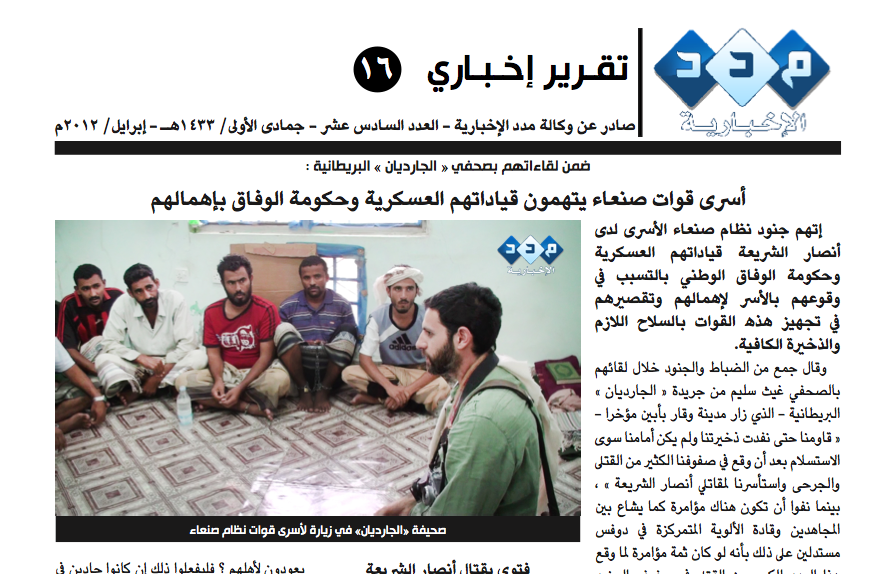
NARRATOR: Ghaith was then taken to see the detained prisoners, held in a series of small rooms. The prisoners told him they were, in fact, the Yemeni soldiers captured in the attack near Jaar. While the camera was rolling, they pleaded for the government to agree to demands for a prisoner exchange.
PRISONER: [subtitles] We are now prisoners of Ansar al Sharia. They will not release us until the government releases its prisoners.
NARRATOR: Many claimed the al Qaeda fighters had been better armed and supplied.
PRISONER: [subtitles] We fought down to the last bullet, and then we surrendered. What is our crime?
GHAITH ABDUL-AHAD: It was a very, very difficult situation to be taken as a journalist to interview prisoners. I have been detained before, and I know how hard it is, how hopeless you are, how you have no control. It was very difficult.
[www.pbs.org: The fate of the prisoners]
NARRATOR: A few minutes after this scene was filmed, the guards ordered the cameras turned off and blindfolded the team again. Their visit was over.
GHAITH ABDUL-AHAD: I thought, “OK, we’ve done something. Now we’ll be detained and we’ll be put with the prisoners.” And as we sat blindfolded, a man comes and he starts addressing us. He had this very deep, sinister voice.
And he said, “Those are our detainees. The Sharia tell us we can kill them or we can exchange them for prisoners, and we want to tell the Yemeni government that those people will be killed if negotiation doesn’t start very soon.”
It was later when we realized that the person who addressed us was the al Qaeda commander in the whole of the province, their Amir, their supreme commander.
NARRATOR: Back in town, Fouad told Ghaith about al Qaeda’s ambitions.
“FOUAD”: [through interpreter] Our fighters always wanted an Islamic state. They didn’t just want to fight, they wanted a state with services and institutions, a state to take care of its citizens and represent Islamic law.
NARRATOR: He also said foreigners were coming to join their struggle.
“FOUAD”: [through interpreter] Anyone who comes to help our brothers, may God reward their kindness for coming to defend them. This is good, not something to be ashamed of.
NARRATOR: In the evening, the shops opened and families came into the street.
GHAITH ABDUL-AHAD: The people would tell you that after al Qaeda took over, the crime disappeared from the town. Al Qaeda chopped off the hands of three thieves─ you know, stupid crimes, yet they got their hands chopped off. And that created a fear, terror within the society.
NARRATOR: It is prayer time, and as Al Qaeda’s interpretation of Sharia law requires, everyone had to go to the mosque and pray.
GHAITH ABDUL-AHAD: [voice-over] I asked Fouad, “So what happens if someone doesn’t want to pray?” And he says, “Well, we’ll go to them and convince them to pray.” “And what if they don’t pray?” “We will lock them up.”
[on camera] It’s almost a surreal scene in this part of town. All the shops are empty, open, no people inside, yet no one’s stealing, no one is taking everything. I don’t know if it says much about the honesty of the town or the fear from the Ansar al Sharia.
NARRATOR: As night approached, Ghaith decided it was too dangerous to stay.
GHAITH ABDUL-AHAD: You carry inside your heart this worst anxiety that if something happens, they will turn against you. They’re very paranoid, they’re very scared, and they look for a scapegoat.
NARRATOR: Ghaith traveled to the city of Aden to regroup and wait for the next call from his contact. This is a strategic port city near vital shipping routes at the entrance of the Red Sea.
GHAITH ABDUL-AHAD: Returning to Aden is not returning to safe zone, to your own safety. Aden is a city gripped by chaos.
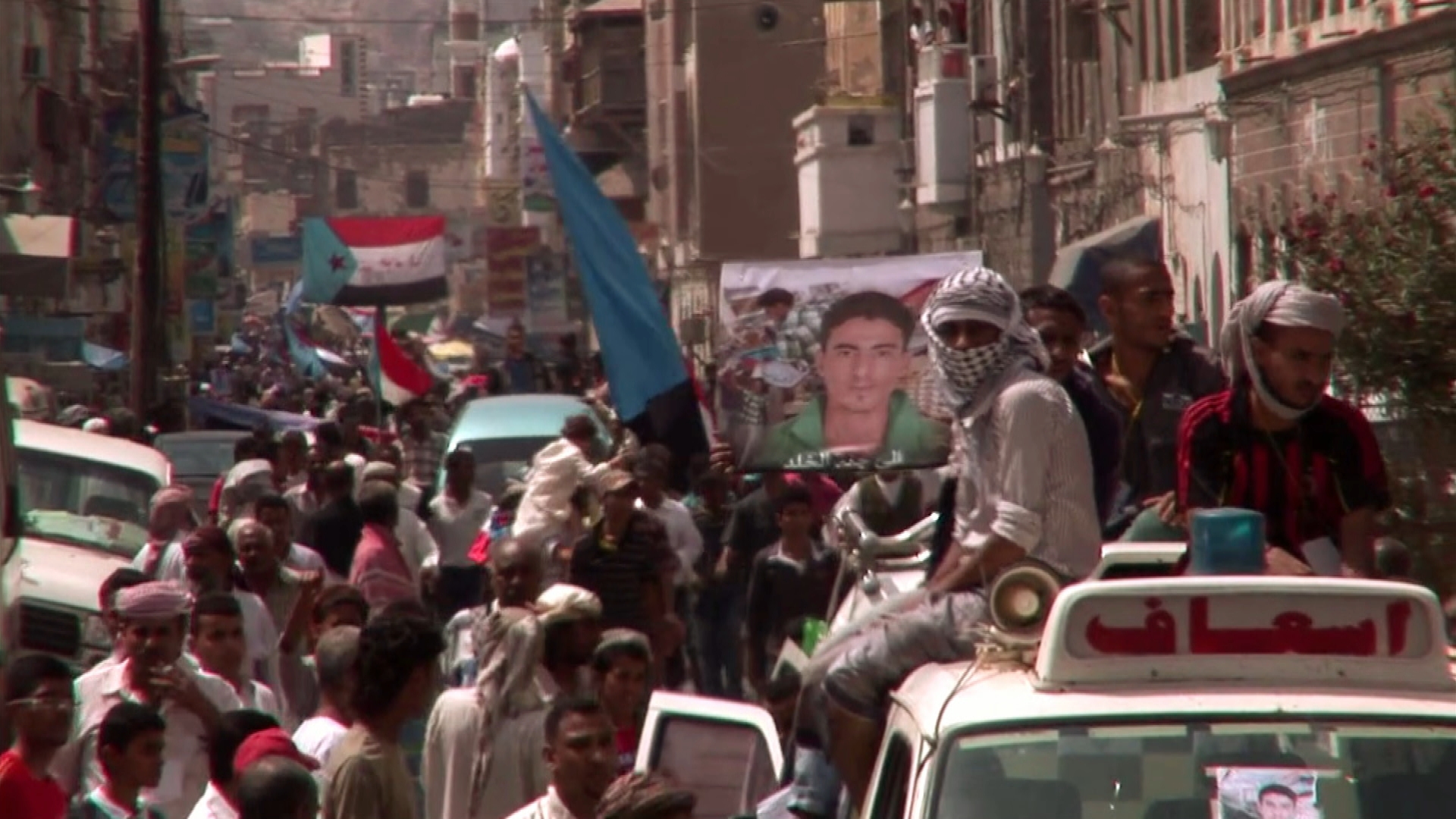
NARRATOR: People here know the power of protesting. Demonstrations across the country last year drove Yemen’s long-time president Ali Abdullah Saleh from power. They’re still marching here, this time to win back the independence south Yemen lost two decades ago.
But along the way, lives have been lost. Ghaith joined the funeral of the latest victim, a 15-year-old girl, Nada Shawqi.
GHAITH ABDUL-AHAD: [on camera] We are following another funeral. The girl was killed by army fire a few days ago. And it’s part of the security chaos that is in Aden at the moment.
[voice-over] Surrounding the cemetery, you see all these military positions. What do the soldiers do? They open fire into the crowd. They fire bullets, live bullets.
[on camera] Army soldiers on top of the hill. He’s pointing at the people.
1st MOURNER: [subtitles] Is this normal?
2nd MOURNER: [subtitles] Don’t be afraid.
3rd MOURNER: [subtitles] They always shoot at us. This is an occupation.
NARRATOR: In Aden, there are more than a 100,000 refugees from the fighting between al Qaeda and the government. In this former school, hundreds of refugees are struggling to survive.
Saeeda Alhakami and her family have lived in this small classroom for a year. They fled their home for fear of being killed.
GHAITH ABDUL-AHAD: They haven’t fled al Qaeda, they’ve fled the shelling of the army, the aerial bombardment, drones and Yemeni army fighter jets.
SAEEDA ALHAKAMI: [subtitles] My brother and husband were killed. The army and security force made it worse instead of protecting us.
NARRATOR: Ghaith was also told about life under al Qaeda’s rule.
TOWNSMAN: [subtitles] They killed a man, crucified him, and left him there for three days. What kind of people do this?
NARRATOR: Al Qaeda has posted video of this crucifixion. They accused the man of being a spy.
In Aden, Ghaith worked to arrange another trip to see al Qaeda. This time, he hoped to meet with the senior leadership.
GHAITH ABDUL-AHAD: A week later, they came back to us and they said, “OK, we’re allowed to go and visit them.”
NARRATOR: His contact told him he could travel to the town of Azzan in the Shabwa region. Azzan is one of the most dangerous places in Yemen.
GHAITH ABDUL-AHAD: [on camera] This, in a way, is the heartland of al Qaeda or Ansar Sharia in Yemen. This is where they’ve set up base five years ago. It is here in the rugged mountains of Shabwa where the leadership of al Qaeda’s been based.
[www.pbs.org: Watch on line]
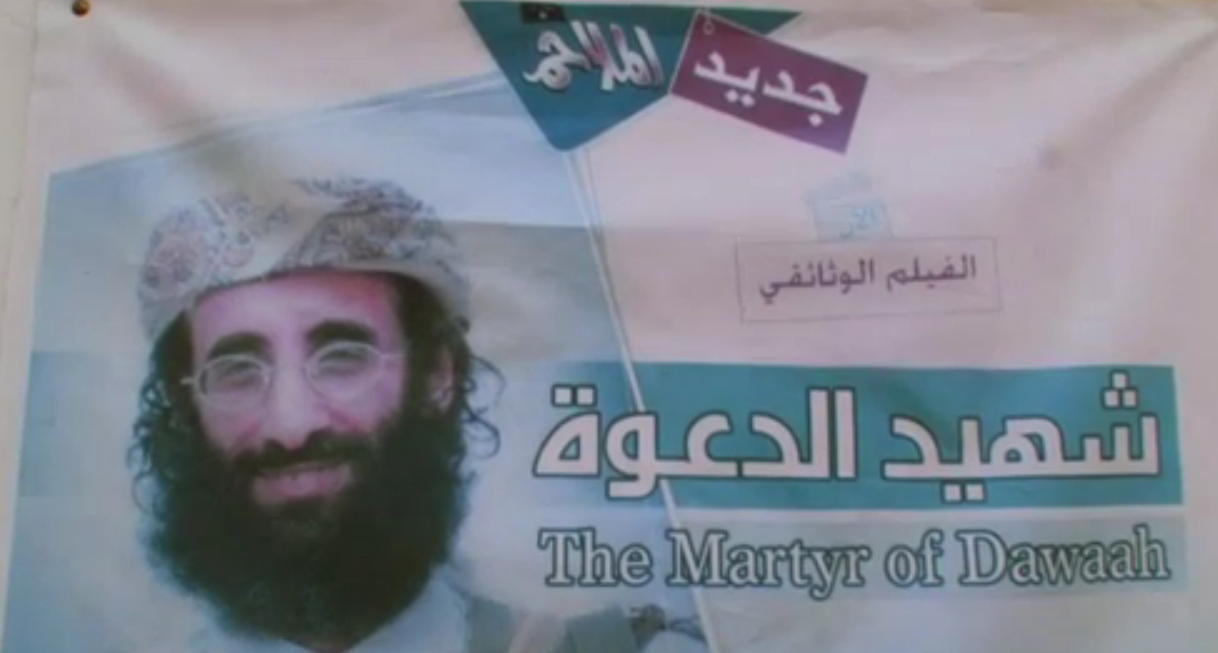
NARRATOR: This was the home of Anwar al Awlaki, an American-born preacher killed last year in a U.S. drone attack.
GHAITH ABDUL-AHAD: Allegedly, it’s out of here where they kind of masterminded all their terror plots.
NARRATOR: The approach to the town of Azzan was heavily guarded by al Qaeda fighters.
GHAITH ABDUL-AHAD: Azzan is their fortress. When you reach Azzan, you feel it’s more sinister than Jaar. The town is more desolate, more empty, heavily guarded.
They’re very, very paranoid, far more than in Jaar. I had many conversations with judges, clerics in Azzan, and they wouldn’t let us film because no one was allowed to be filmed, to even have his voice recorded by the camera. No one was allowed to carry a cellphone.
NARRATOR: Ghaith was shown the site of a U.S. drone strike.
GHAITH ABDUL-AHAD: [on camera] These are the spots where the son of the American preacher Anwar al Awlaki was killed.
NARRATOR: The 16-year-old son of the al Qaeda leader was a U.S. citizen.
GHAITH ABDUL-AHAD: His son and eight of his friends were sitting in this place, having dinner, and they were targeted by one rocket here, and another rocket there, if you see this big circle, targeted them, and then another rocket beyond this area.
They say it’s an American-targeted killing for an American citizen, of course.
[www.pbs.org: Map of U.S. drone strikes in Yemen]
NARRATOR: It was the time for afternoon prayers. The streets were empty.
MAN IN AL QAEDA VEHICLE: [subtitles] Move along, my brothers. God bless you. Go pray. Go pray.
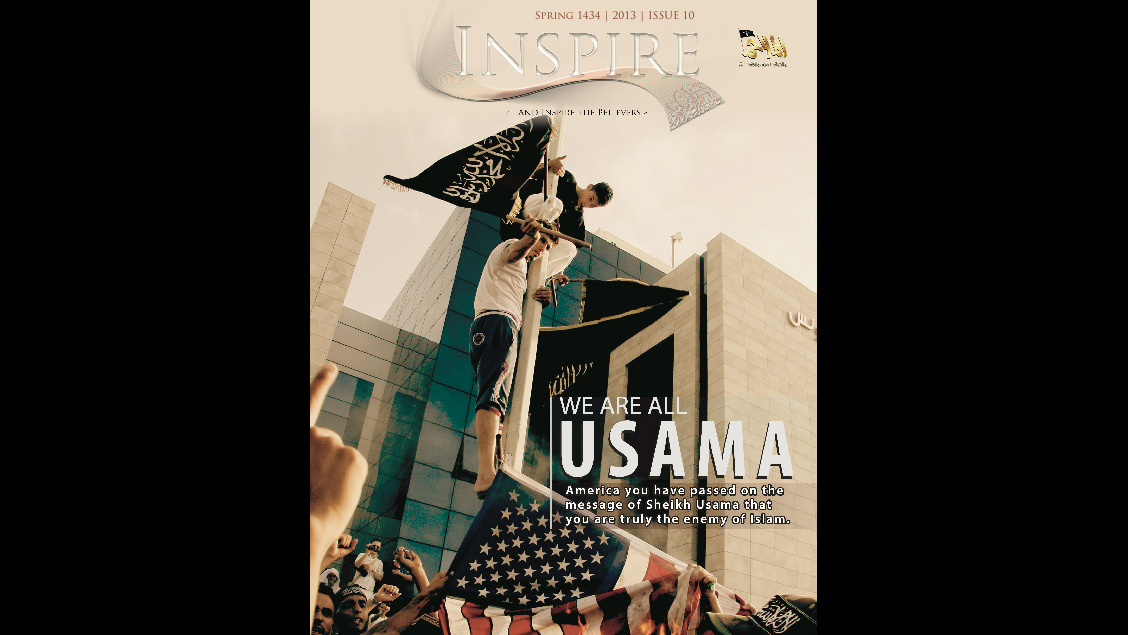
NARRATOR: At this checkpoint, Ghaith discovered one gunman was from Somalia and another from Afghanistan. Inside this booth by the side of the road, recruits were distributing al Qaeda newsletters.
GHAITH ABDUL-AHAD: This is kind of very, very isolated region, yet here is this organization, have devoted a part of its resources to a media wing of the organization. It’s a small office, but it’s very sophisticated.
[sign on building, subtitles, “Islamic Education Center”]
That’s why they are very, if we want to say, successful in their existence.
NARRATOR: They also gave away DVDs, including one called The Survivors about commanders who’ve survived drone attacks. Surviving or being killed in a U.S. drone strike is seen as a badge of honor here.
One of the senior al Qaeda officials in the town agreed to talk to Ghaith, but like the others, he wouldn’t appear on camera.
GHAITH ABDUL-AHAD: He told me that the biggest threat for al Qaeda is not the Americans, not the Yemeni army, but the tribes of south Yemen. They’re very keen not to go into the same confrontation they had in Iraq, when the tribes turned against al Qaeda and drove them out of the towns and the cities.
NARRATOR: Ghaith decided it was time to go. The atmosphere had become tense, and they had filmed all that they could. But as he left, his contact told him there was a chance that he could come back and interview a high-ranking officer on camera.
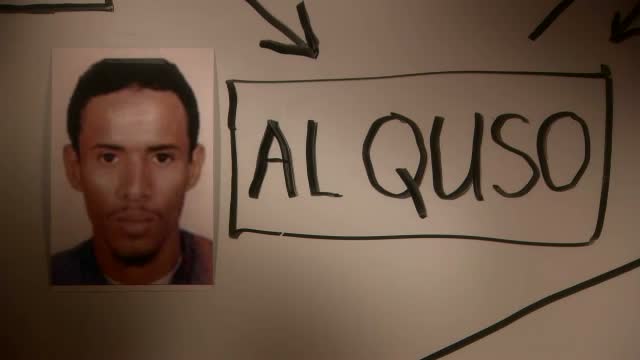
GHAITH ABDUL-AHAD: We were told that we might be able to interview Fahd al Quso. We don’t know if it was him personally or someone close to him, but this is what our understanding was, that we will be able to interview Fahad Al Quso.
NARRATOR: Al Quso was a plotter in the 2000 bombing of the USS Cole and a prime target for American forces.
Ghaith left al Qaeda territory behind him and traveled to the capital of Yemen, Sanaa. Senior U.S. officials are increasingly concerned about Yemen. They travel to the capital frequently to urge the new government and armed forces to confront al Qaeda.
We talked to the U.S. ambassador about the situation.
GERALD FEIERSTEIN, U.S. Ambassador: We consider that al Qaeda present a very significant challenge. For the first time, we see al Qaeda actually trying to hold territory, and this is a departure from anything that we’ve seen before in Pakistan or Afghanistan, in Iraq, and even in Somalia and the horn of Africa.
NARRATOR: But the troops that the U.S. is relying on to defeat al Qaeda are weak and divided. On this day, Ghaith found soldiers openly protesting. They said their commanders were corrupt and wanted them removed from power.
Since the fall of President Saleh, the new government has struggled to maintain control, crippled by infighting between rival politicians.
GHAITH ABDUL-AHAD: [on camera] This is responsible for why the army is suffering such big losses in the south of the country. It shows you how weak the military is, basically, and how splitting they are along political factions.
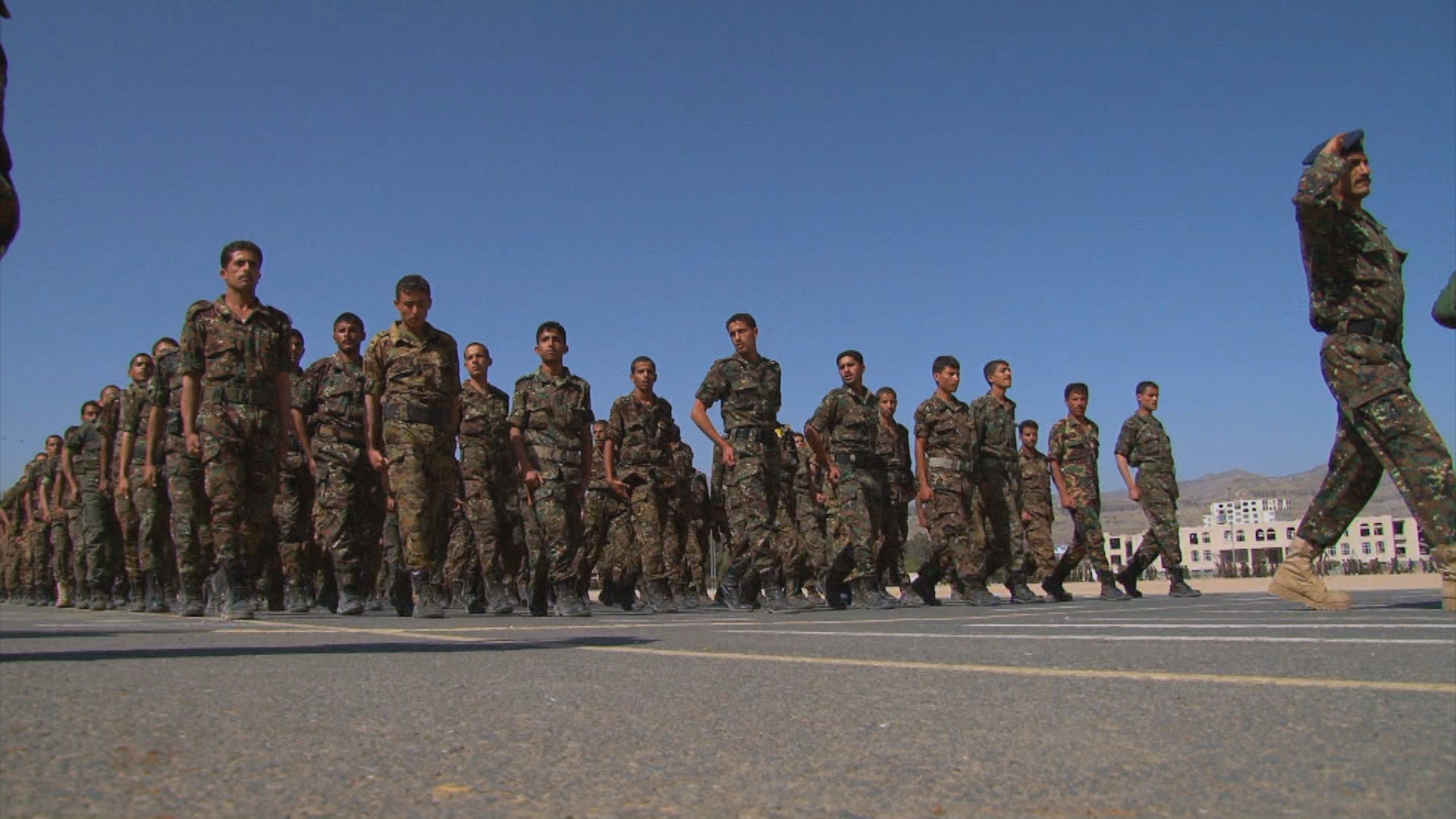
NARRATOR: These are the latest recruits to Yemen’s elite security forces. They’re funded in part by the United States. But instead of fighting al Qaeda, they mostly defend the interests of their commander, Brigadier General Yahya Saleh. He’s the powerful nephew of the former president.
Saleh admits Yemen’s political turmoil has allowed al Qaeda to grow.
Gen. YAHYA SALEH, Central Security Force: [through interpreter] Al Qaeda today is not the same as al Qaeda a year-and-a-half ago. They have more followers, more money, more guns. The area they control is bigger. And this is a great danger.
NARRATOR: Last week, an al Qaeda suicide bomber targeted the unit we’d filmed. Hundreds were killed and wounded. Al Qaeda said the attack was in retaliation for government efforts to retake the southern areas under al Qaeda control.
GHAITH ABDUL-AHAD: This is a very direct message to the military institutions of Yemen. It’s not only to kill people, but also to send a message that “We can reach you in the capital.”
NARRATOR: Ghaith waited for weeks to hear if he would be able to interview the high-ranking al Qaeda official Fahad Al Quso. But his contacts had gone quiet. Then on May 6th, Fahad al Quso was killed in a U.S. drone strike.
Before he left Yemen, Ghaith took one more trip, this time to the town of Lawder, on the edge of al Qaeda territory. Something surprising had happened here. A year ago, the locals had chased out al Qaeda after its fighters assassinated their tribal leader.
TRIBESMAN: [subtitles] We destroyed them, OK?
GHAITH ABDUL-AHAD: It was the first military defeat of al Qaeda. This is the army that is supported by God, fighting and being stopped by a bunch of tribesmen.
NARRATOR: Now al Qaeda wanted the town back. Its fighters attacked every day.
GHAITH ABDUL-AHAD: [on camera] [subtitles] Tell me, guys, how’s the situation?
TRIBESMAN: [subtitles] It’s good. God willing, we will be victorious. We kicked the al Qaeda dogs of hell out of Lawder.
GHAITH ABDUL-AHAD: Every single man was carrying a gun. If the millions of tribesmen decide collectively one day that they would like to kick out al Qaeda, it will just disappear.
NARRATOR: There is a Yemeni army base nearby, but the soldiers have abandoned the fight. Holding off al Qaeda is something the local tribes have to do themselves.
GHAITH ABDUL-AHAD: Every single man would go fight in the front, spend an hour or two fighting at the front line, and come back.
NARRATOR: Here Yemen’s future and America’s security is being defended by tribesmen one shot at a time.