Join a live chat on “The Education of Michelle Rhee” with the film’s correspondent, John Merrow, and a panel of leading journalists and experts. You can leave a question now.
The debate over how to improve K-12 public education in America has long been highly charged and contentious, but in recent years, it’s taken on a polarizing either or mentality.
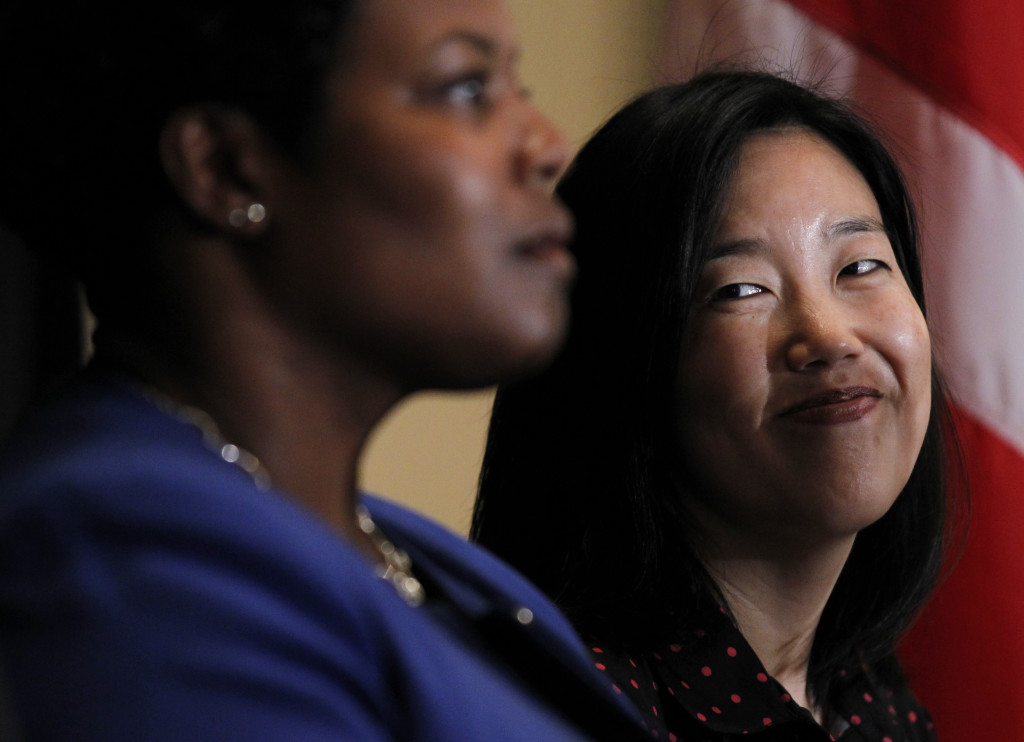
Michelle Rhee has taken her education reform agenda nationally, yet supporters and critics alike continue to wrestle with the same questions that dominated her tenure in Washington. For example, how do you turn around a struggling school? What makes a good teacher? Three experts weigh in.
A Department of Education investigation has found no evidence of widespread cheating in the Washington, D.C. school system in response to a whistleblower lawsuit filed by a former principal.
As a young elementary teacher in Baltimore, Michelle Rhee struggled to capture the attention of her students. That is, until the day she won over her classroom with a surprising move.
Today the education reform group StudentsFirst, led by former D.C. public schools chancellor Michelle Rhee, released a report grading states based on adherence to its platform, giving 11 states failing grades of F. The highest grade any state received was a B-.
When we last saw Marcus, the stubborn, charismatic student in Dropout Nation, he had just punched another kid in the face two hours before the school year ended, an act that jeopardized his chance to stay in school and play football.
After 15 years of pioneering a private model of disciplining public school students — and arousing persistent controversy from Florida to Texas — Community Education Partners (CEP), one of the nation’s largest private education firms, says it is closing its doors.
Like many of the kids who wind up in failing public schools, Harvard economist Roland Fryer grew up amid violence and drugs, and with little hope for the future.
When the school year began again, Marcus came back to Sharpstown. He had thrown away all of his school uniform polo shirts at the end of last school year, in a fit of frustration.
(60 minutes) Ten years after "edupreneur" Chris Whittle first announced his bold plan to revolutionize the way we educate children, Whittle's Edison Schools continue to be a lightening rod for the issue of for-profit, public education. FRONTLINE and the PBS education series The Merrow Report join forces with The New York Times to investigate the intertwined fortunes of Edison Schools and its charismatic yet controversial leader, and examine whether it's possible to create world-class schools that turn a profit. (Web site »)
(60 minutes) President Bush's proposal for mandatory public school testing in grades three through eight signals the beginning of a new era in public education, one marked by increased federal involvement in schools and an unprecedented expansion in the role of tests. A business school graduate and self-styled "CEO President," Bush envisions a business model where educators set objectives, measure performance, and hold students and teachers accountable for results. But will the business model work in education? FRONTLINE correspondent John Merrow examines how the quest for higher scores is changing teaching and learning in America. (Web site »)
(60 minutes) With more students than ever enrolled in kindergarten through high school, education is now a top voter concern. What's needed to improve our public schools-better teachers, smaller classes, greater parent involvement, higher standards, more tests? Or, is privatization the answer? Democrats and Republicans differ sharply on the hot button issue of school vouchers and whether public funds should be used to pay for private or parochial schools. FRONTLINE explores the heated political debate over the reform of public education and investigates the spectrum of "school choice" options-from vouchers to charter schools to for-profit academies-and their growing popularity in troubled inner cities. FRONTLINE also interviews presidential candidates Al Gore and George W. Bush about their views on reform initiatives and looks at their track records on improving public schools. (Web site »)
(60 minutes) How fair are standardized tests? What do they measure? And what's their impact on racial diversity on America's college campuses? FRONTLINE examines the debate over fairness in college admissions, looking at the national obsession with test scores, the multimillion dollar test prep industry, and the legal challenges to race-sensitive admissions policies. A diverse set of students are followed through the stressful college admissions cycle as they dream of attending some of the country's most prestigious universities. (Web site »)
Apr. 28, 1992
Who Cares About Children?
(60 minutes) With 410,000 children in foster-care and over half a million expected by 1995, child advocates across the country say nearly every state is in, or approaching, a crisis. Frontline examines the child-welfare crisis in Arkansas and the struggle to reform the system-a political battle that focused squarely on Arkansas Governor Bill Clinton as he launched his presidential campaign.
Jun. 12, 1990
Teacher, Teacher
(60 minutes) Frontline explores the hopes and frustrations of public school teachers in one midwestern town as they face the threat of funding cutbacks, the criticism of parents, and a growing number of troubled children from troubled homes.