|
|


Tell me the story about how the Jews and the Israelites ended up being
defeated and enslaved by the Babylonians.
 | | | | |
White is Professor of Classics and Christian Origins at the University of Texas
at Austin, and acted as historical consultant for "Apocalypse!" | | |
It's important if we're going to understand apocalyptic thinking to realize
that the political history of the Jewish people is central to the story. And
it really begins in the year 586 B.C when the Babylonians, under the famous
King Nebuchadnezzar, conquer the city of Jerusalem itself and in the process
destroy Solomon's Temple. This particular event really is what separates the
period of ancient Israel's freedom and national identity from what will become
Judaism. And in the process also sets in motion this thinking about what will
be the future of this city, Jerusalem, in the plan of God for the people of
Israel. ...
After Nebuchadnezzar defeated the Israelite armies and Jerusalem was destroyed,
quite a large proportion of the Israelite people were deported to Babylon
itself. And the estimates vary significantly. Some say as few as ten percent.
Some of the numbers that we get from the ancient history say almost all the
people were taken away. No matter how many were actually taken, it is a
significant experience that the people had to go away and live in a foreign
land. And we have quite a number of poignant scenes from the Hebrew scriptures
which reflect the trauma of this event of being separated from Jerusalem, and
how we will worship our lord in a foreign land.
What kind of a place was Babylon in those days?
... Babylon was a magnificent city for its day. It's perched right on the
banks of the Tigris and Euphrates rivers in an extremely important strategic
location. And it's a massive city with huge stone walls, great wooden gates,
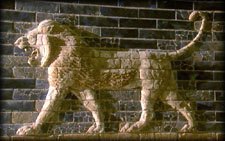
studded with gold and bronze and decorated with these enormous gorgeous
pictures of winged beasts and powerful images of the kings of the Babylonian
empire. If you think about the imagery of demons and dragons and winged beasts
that we find so commonly in apocalyptic literature, some of it comes from this
very experience of seeing the powerful images of the enemy of Babylon.
And then when the Jewish people found themselves subject to this all-powerful Babylon and these great images of power did this lead to a sort of
agonizing reappraisal about what their own God was worth or meant or how
powerful he must be?
The destruction of Jerusalem by Nebuchadnezzar had a profound effect on Jewish
thinking and theology. For one thing, the promises that had been given to
David now had to be questioned. What did God mean by saying the throne
of David would last forever, when obviously it had just been toppled? So the
Babylonian exile is really an important watershed in the development of Jewish
theology as they began to think, what went wrong? Has God abandoned us? Is
[the Babylonian god] more powerful than our God? Or is there some other
reason why this fate has befallen us? Maybe it's not God's fault. Maybe it's
our fault. Maybe it's our sins that have caused this. And in the process of
this thinking they start to take the trauma of the destruction of Jerusalem and
the Temple and turn it inward as theological reflection. There's a profound
effect on all later Jewish and Christian theology.
Babylon and Jerusalem now stand for two polar opposites in terms of good and
bad. Tell us what Jerusalem and Babylon came to symbolize since then.
So if we think about the political struggle that has just taken place with the
defeat of the Israelites' Jerusalem, the city of God has been conquered by
Babylon, the city of the enemy of God's people. Jerusalem and Babylon then
forever thereafter will stand as the symbols of this opposition. The forces
locked in a battle of good and evil for all eternity. ... If we imagine the
experience of the exiles living in Babylon, the idea of Babylon itself comes to
symbolize enslavement. Oppression. The notion of exile or alienation. In
contrast to Jerusalem which is home. So these two symbols, really--Jerusalem
home; Babylon exile, enslavement, oppression--will always be at the center of a
lot of the trauma of apocalyptic experience. And the hope that it also
provides for that idea of release, triumph and going home. ...
As a result of the defeat by the Babylonians, Jewish tradition both during and
after the exile really has to rethink its history. And this rethinking of
history of the story of the people from times past is carried out by actually
writing or in some cases rewriting parts of the biblical text itself. And so
in fact much of what we think of as the Hebrew scriptures or the Old Testament
as it is called by Christians is really a product of the re-thinking that
occurs after the Babylonian exile. ...
The process of re-writing the scriptures is somewhat easy to understand if you
think about it. Here is a story that starts with God choosing Abraham and
leading the people out of exodus and into a land of promise, and selecting a
king, David. But after the fall of Jerusalem that story now obviously
continues. At the same time though that they continue writing the history they
go back and reflect on how the earlier story must be understood. So whereas
earlier it's a story of God's promise to Abraham and David, after the exile the
new theology tends to emphasize, well, that promise is conditional. If we
don't live up to our end of the bargain, if we don't remain faithful to God,
God will allow us to be punished. And this new way of thinking about the
theology--what we call the covenant theology--is an important new dimension of
Jewish thinking. And it's filtered through all of the biblical books that are
put together in this period after the exile. ...

Now, in a sense the Jewish oppression at the hands of the Babylonians didn't
last very long because, what, about fifty years later or so the Persians
overran Babylon. In your own words, tell us how the Persians conquered Babylon
and what happened to the Jews.
The Babylonian empire that conquered the nation of Israel ... despite its
opulence, nonetheless had a rather a short reign thereafter. Within
approximately fifty years after the destruction of Jerusalem, the Babylonian
empire, itself, had been overthrown by the Persians who had moved into the
Mesopotamian region from farther east beyond the Persian Gulf. The Persians
overran the city. It's quite an amazing story ... As the story goes, they
actually dam up the canals that feed the city and come in through the water
channels, invade the city secretly, throw the gates open and a massacre ensues.
So this great city of Babylon, the city that conquers everyone else ... all of
a sudden is conquered itself. And this reversal, this rapid change, comes to be
viewed in a new way even by the Jewish people. God got his revenge at last. ... For example, in Isaiah, chapters
44 and 45--a portion of the book of Isaiah actually written during the exile
itself--we hear of Cyrus the great Persian king referred to as God's anointed
one. The Lord's Messiah. And it even goes on to say he will be a shepherd for
my people. Now this is God speaking. He, Cyrus, will be a shepherd for my
people and he will be the one to rebuild Jerusalem. ...
So here's what this text from Isaiah is beginning to show us. A new way of
thinking. Now instead of just feeling traumatized over the destruction of
Jerusalem, now one can look back and say, "Oh, maybe there was a plan of God
all along. Yes, our God, in the final analysis, is in charge of all human
history. Look, he even directs foreign kings to do his will for our benefit."
...
The Persians, having overrun Babylon and released the Jews, also made a big
impact on Jewish religion. What was the nature of the Persian empire's
influence on Jewish religion?
So following the age of Babylonian control in the Middle East, the Persian is
really the next great empire. Interestingly enough, part of the story of the
Jewish people throughout this ancient period is that, after the Babylonians,
the Jews will almost always be under the thumb of one or another of the world's
great powers of the ancient history. And that's going to create new influences
... [The Persians], in fact, are a source for a major new component. One of the
important features of Persian religion, the religion that we usually refer to
as the Zoroastrianism, named after the great prophet of this tradition,
Zoroaster--or sometimes called Zarathustra. Zoroastrianism has a much
more dualistic way of looking at the world. In the Persian mythological
tradition we have Ahriman, the evil god who is at war with Ahura Mazda, the
good god, the god of light. ... Good versus evil. Now, on the one hand this has
some similarity to the combat myth that we hear of in other ancient near
eastern societies. Only now it's the good and evil themselves thought of as
abstract entities that dominate the world. That gives a new dimension. ...

After the Persians basically allowed the Jews to go back to Jerusalem and
they rebuilt their lives there, another sort of wind swept to the middle east.
What happened? How did Alexander the Great change the ancient world and how
did he change the ancient world for the Jews, in particular?
... After a century of war between Greece and Persia, finally, Alexander
[sweeps] through the Middle East, defeats the last of the Persian kings, Darius
III. And instead of stopping, [Alexander the Great] continues to conquer much
of the rest of the Middle Eastern world all the way over to the
Indes River Valley. Egypt, Syria, Palestine, all fall under Alexander's power.
...
One of Alexander's self-conscious policies is, as far as we can see, to bring
Hellenistic culture to these conquered peoples. There's a great deal of
emphasis on imparting Greek ideals and Greek culture throughout this new empire
of Alexander. ... One good example of the emergence of Greek influences in
Jewish tradition, after the conquest of Alexander the Great, is the document
that we know as First Enoch. Now First Enoch was written somewhere between
around 250 BCE and 200 BCE, in the early phase of Greek control of the
Middle East. And First Enoch reflects the tensions that face Jewish tradition
as a result of these Greek influences. On the one hand, First Enoch is
extremely, intensively Jewish. It is a retelling of the biblical creation story
and the early chapters of Genesis with an idea of our God being in control. So
in that sense, it's very traditional. On the other hand, the way it tells that
story of Genesis clearly has elements of Greek influence within it. ... It's
the story of Enoch, one of those characters before the flood. Genesis Chapter
5. And in this story Enoch is taken away to heaven. ... Now what he sees then
is something that the biblical story doesn't describe. He sees the rebellion
of the angels. This too is based on Genesis, from the story in Genesis 6 where
the sons of God rape daughters of men and produce a race of giants. Only now in
First Enoch this is the rebellion of the angels under their leader, Azazel,
whom we'll later call Satan... .
So First Enoch gives us some of the most important components of what we think
of as later Jewish and Christian apocalyptic tradition. We have God and Satan,
good and evil. We have angels. The story of Genesis about the sons of God now
have become the angels. In fact in the book of First Enoch, these angels are
also called the watchers. They're the stars in heaven. At least the ones who
don't fall. The others are the demons of hell. And importantly we have a cosmic
battle thought of in these very dualistic terms where the forces of God and the
forces of Satan will fight for control of the universe. But the stage for this
battle, the battleground itself, is earth.

Now, initially, the Greek influence is relatively benign, but things turn
ugly, don't they? Tell us about the Maccabean Revolt, what was that
about?
The Jewish experience under Greek rule initially seems not to have had a kind
of political resistance. There's a strong emphasis on retaining Jewish
religion and identity, but they're not talking about the Greeks as oppressors,
and certainly not as an evil empire. That perspective will change radically
about the beginning of the second century BCE, around the year 200
when the Ptolamaic Greeks, that is the Greeks from Egypt, who had previously
been in control of Jerusalem and Judaea, gave way to the Seleucid Greeks in
Syria. And under Seleucid rule the experience of Jerusalem and Judaea will be
quite different. In part because the program of Hellenization of the Seleucid
Greeks is much more oppressive, and it's much less tolerant of Jewish religion
and identity and that's where we're [going to] get some really important new
tensions that are [going to] shape the political experience of the Jews
thereafter.
The key story related to this is of course what we know as the Maccabean
Revolt. And here's basically what happened. The Seleucid King Antiochus the
Fourth ... comes through Jerusalem, and because the Jewish people are in
resistance to some of his oppressive policies he decides to make a show of his
power, and to make an example of the Temple. As the story goes, he then
marches into the Temple, desecrates the Temple, puts a pig on the altar of
sacrifice and generally does everything you shouldn't do in the Temple of
Jerusalem. This experience is really one that galvanizes most of the negative
reaction that we hear in later Jewish tradition. It also galvanizes a political
response. Shortly after his desecration of the Temple, a small band of
warriors under Judas the Maccabee--his name literally means Judas the
hammer--began a kind of guerrilla war against these Greek armies. And
interestingly enough they managed to win a lot of battles, quite surprisingly
from the size and strength of the Greek army. The culmination of this story is
when in the year 164 a small band under command of Judas himself actually
manages to retake the Temple and, while holding off the Greek armies, proceeds
then to repurify and rededicate the Temple. That is the event celebrated as
the feast of dedication, better known as Hanukkah. ...
For the first time since the Babylonian destruction of Jerusalem the Jewish
people are facing a power that, as it would seem, wants to destroy them and their
religious tradition. ... So the responses that we get in the Maccabean Revolt
are extremely influential later on. On the one side we have the response of
Judas and his followers. To fight, to defend the land and its traditions. The
theology of the Maccabean revolutionaries is, "God helps those who help
themselves." But the other response equally caught up in these ideas of the
tension between good and evil and of preserving nationhood is the response that
says we have to remain faithful and God will deliver us. And that's the
response that we get in the Book of Daniel which takes it even more into
an apocalyptic vein.

The Maccabean Revolt was largely successful in creating a new independent
Jewish state, sometimes referred to as the Second Hebrew Commonwealth, and for
roughly the next hundred years the Jewish people were ruled by the descendants
of Judas the Maccabee, referred to as the Hasmonean kings ... . But by the
latter part of that rule there is a new force coming on the horizon as Rome
begins to extend its power into the eastern Mediterranean. This will come to a
head in the year 63 BCE when the great Roman general Pompeii is in Damascus,
having conquered a number of the provinces of Syria. In Judaea at precisely
this time, the last two heirs of the Hasmonean dynasty have entered into a kind
of civil war against one another, each one wanting to be the new king. And so,
as by a fluke of history, the Jewish people, the city leaders of Jerusalem
actually appealed to Pompeii the Roman, "Would you come over here and help
settle this war?" The only problem is that they didn't expect Pompeii and the
Romans to stay around, and unfortunately they did.
This period of Roman expansion is one that will lead up to what we think of as
the beginning of the Roman Empire. It starts with conquest, with the expansion
of empire under these late republican generals like Julius Caesar and Pompeii.
They acquire land, provinces. After the assassination of Julius Caesar,
however, in the forties, there will be a new turn that is taken in Roman
political history when Julius Caesar's adopted son, Octavian, assumes the title
of Augustus and proclaims himself emperor of the Roman Empire. After his
famous conflict with Anthony and Cleopatra, he will now not only control Rome
but its vast empires all the way from Spain and Britain in the west to the
Persian Gulf in the East, and the prize in part is Egypt itself. But one of the
gateways to the East is the land of Judaea on the eastern Mediterranean shores,
which becomes one of his points of entry into this political realm. So here,
once again, is, and we see throughout this period of history, little Judaea is
central to the story of politics and power throughout the Mediterranean world
... .
Now because of the sense of building the empire and the glory that's created
under Augustus, the Romans start to have what we might call an ideology of
empires, sometimes referred to as the Pax Romana, the peace of Rome. But there
is a sense of what we might think of as manifest destiny. ... It was the will
of the gods that this should happen. It was our role in history because of our
virtue and our strength and our nobility. ... Now we have to put this way of
thinking along side of Jewish sense of destiny, a destiny often reflected as a
plan of God worked out through a revealed sense of history, in apocalyptic
tradition. But now we're watching that Jewish sense of destiny run into conflict with the Roman sense of destiny. ...

It's precisely in this period under Roman rule that the Temple itself was being
rebuilt once again. On the one hand, this was a lavish building program under
the infamous Herod the Great. It was to be really kind of a hallmark of Jewish
identity that we would have this great temple. On the other hand, the
rebuilding and Herod, himself, was a symbol for many of corruption and
perversion. And thus, the Temple at Jerusalem becomes a symbol. A symbol of
national identity, a symbol of hope, a symbol of all that is good and true and
divinely ordained in God's will. On the other hand, for some, it's a symbol of
corruption and evil and the seat of a coming battle between good and evil.
So what did some of them do?
Some people then left Jerusalem entirely. This is what the Essene [group] seems
to have done. They moved off to the to the Dead Sea to form a pure priestly
community until such time that the Messiahs would come, recapture the Temple
and restore it to its purity. So they're really looking forward to a time when
the forces of God will take Jerusalem once again.
|
 | |
essene caves by the dead sea
| | |
The Essenes themselves think they are a prophetic community, operating under
the plan that God has set in motion from ages past. Quite literally, they think
they are fulfilling the prophecies of Isaiah by going out into the wilderness
to prepare the way of the Lord. And when we go to the Dead Sea and we look at
the Essene community we can see the wilderness that they have entered. Because
as you leave Jerusalem you go off to the east, within only about thirteen
miles you drop off from the mountain tops into the rugged prairies, and the
land is desolate and harsh. And then as we get to the banks of the Dead Sea
itself, the bottom drops out from in front of you and we have this lake that
sits nearly fourteen hundred feet below sea level. It's all those cliffs of
the Dead Sea and this extremely harsh wilderness environment that the Essenes,
following the plan of Isaiah, sought to build the pure community where they
would await for the coming of the Messiahs.
What were the Dead Sea Scrolls?
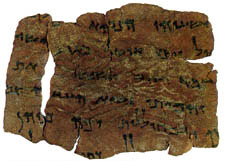
The Dead Sea Scrolls, which were discovered in 1947 in caves along the banks of
the Dead Sea near where the Essene community was founded, contained a number of
different documents. Many thousands of fragments have actually been discovered.
But basically, [there are] three key types ... . First, copies of all of the
biblical texts from the Hebrew scriptures, including text of First Enoch and
other apocalyptic literature of this period. In most cases, these manuscripts
are our oldest known copies of all the ancient biblical literature. Secondly,
it contains commentaries on these texts. And a particular type of commentary,
the Essene style of commentary called [pesharim]. It's from the word which
mean, "this is interpreted." The pesher is a way of doing commentary where they
take passages from older scriptures and say how they are to be interpreted for
the present day. ... The third type of literature that we have among the Dead
Sea scrolls is what is usually referred to as their sectarian writings. These
are scrolls that refer to the community themselves and how they live and how
they think. One of these is called the Rule of the Community and
explains the very difficult procedure of getting in and how you have to go
through several stages of initiation and rigorous kind of examination and it
sounds somewhat like a monastic community. Another document out of this group
is what's called the War Scroll. And it is quite literally their battle
plan for the battle at the end of the ages. It starts off this is the war of
the sons of light against the sons of darkness. And they think of it quite
literally as the way the final battle will be carried out.
They, themselves, are getting ready to fight this battle?
They take this quite literally, they're planning to fight this battle and
indeed, in the war of 66-70, the first revolt against Rome, the Essenes
themselves, following this battle plan, literally marched out to war against
the Roman soldiers and were annihilated. As we see in the War Scroll, the
Essenes expected a final battle led by the forces of God to bring a triumph
very soon. This is what we see in the apocalyptic tradition known as
eschatology, that is, thinking about the last things or the end of the ages. ... It's very important to recognize that
this eschatology that they're talking about is not the end of the world, even
though they use a lot of last things or end of the ages language. What they're
referring to in traditional Jewish apocalyptic is the break that occurs between
the present evil age and the coming golden kingdom. It's a kind of dualism of
the ages; the eschaton, the end is the break between the two ... .
Were John the Baptist and Jesus in the same traditions as the
Essenes?
The Essenes weren't the only such new voices of protest and expectation at this
time. We hear of quite a number of others ... some of them calling for
different kinds of religious reform and different kinds of ways of looking at
the hope of Israel. And two of the best known figures of this
period are John the Baptist and Jesus, both of whom come out of this
early very Jewish apocalyptic tradition, both calling for an expectation of a
new kingdom. The classic formulation of John the Baptist is, "Repent, for the
kingdom of heaven is at hand. Let's return to a pure nation of Israel." And in
the case of Jesus it's also, "The kingdom is at hand." But the classic
statement of Jesus, more profound and in some ways more problematic later on,
is the one that looks down the road for the kingdom to come. In several
passages we hear it something like this. "For some of you standing here," and
he's talking to his own group of disciples around him ... "will not taste death
until you see the kingdom come with power." But they expect something to
happen soon. Even a full generation after the death of Jesus ... they still
think that the second coming of Jesus and the arrival of the kingdom would be
something that's just around the corner ... .

Now in what way did apocalyptic expectations like these lead to the Jewish
revolt, and how did that end?
Diverse as their religious outlooks may have been, these different streams of
apocalyptic expectation all came together in about the year 66 when there was
an outbreak of war against the Romans. This war would last for four years, and
it would result in a devastating destruction of Jerusalem once again. But it
[had] more clearly been fought as a war against Roman oppression, where the
Romans are viewed as the evil empire, the forces of Satan, and the Jewish armies
then see themselves as the forces of God trying to expel them ... . The Jewish
War began ... with a great deal of hope and expectation. This was to be the
messianic war. This was to be the triumph of Israel. The war ended on a very
different note. After successive losses and some devastating battles with
massive loss of life, eventually the Roman armies bottled up the remaining
revolutionaries in the city of Jerusalem itself. Then there was a long and
protracted siege which had the result of greater loss of life and starvation
and horrendous stories of death. And in the end a final siege where the Romans
broke through the city walls, burned and destroyed the city and worst of all
destroyed the Temple itself once again. So from the perspective of the Jewish
mind, and for very many people in this period, the hope of triumph and victory
is has now been dashed with the very thing they thought could never happen
again. Namely the Temple destroyed. And the trauma of that experience, then the
trauma of rethinking what it means for our understanding of what God has in
store for us had to be tremendous. For some it was another moment where they
had to say, "We've done something wrong, we must have sinned ... . " For others
maybe it's only the beginning of a new stage of history where the final victory
is just about to come.
Does this lead to yet another phase of reinterpretation of their own
history? Another burst of apocalyptic writing or something?
The destruction of Jerusalem in the year 70 C.E. leads to yet another stage of
apocalyptic reinterpretation. They have to retell their story. They have to
rethink their own past. ... In the period between roughly 75 and 100 CE we have
a proliferation of new Jewish apocalypses, documents like Fourth Israel,
or Second Baruch, or the Apocalypse of Abraham. All figures from ancient Jewish
history now are the sources for a new understanding of the future.
Does the New Testament itself reflect this period of re-evaluation?
In a similar way the early Christians, who at this point in time are
largely still within the larger framework or Judaism, also have to reinterpret
their understanding of history. Some of their expectations for the war did not
come to pass. Many of them apparently thought that this was going to be the
return of Jesus, and that Jesus was at this time going to restore the kingdom
to Israel. So it is in the period, between roughly 70 and 100, on the Christian
side that we find a new conceptualization of apocalyptic tradition, a new sense
of what will be God's plan for the future, and for the eschaton. Among the
writings that we have in this period are the gospels. And in all of the
gospels of this generation, we hear of attempts to explain what Jesus really
intended for the eschaton, and what was misunderstood by people of an earlier
generation. We get new writings attributed to Paul or Peter to explain
eschatology. Some of these also are in the New Testament. And then we get the
Book of Revelation. ...
home ·
apocalypticism ·
book of revelation ·
antichrist ·
chronology ·
roundtable ·
primary sources ·
discussion
readings ·
video ·
glossary ·
links ·
synopsis
web site copyright 1995-2014
WGBH educational foundation
|