Visit Your Local PBS Station PBS Home PBS Home Programs A-Z TV Schedules Watch Video Support PBS Shop PBS Search PBS
NOW on PBS -- August 31st, 2009

Keep on Trucking?
Video: Keep on Trucking?

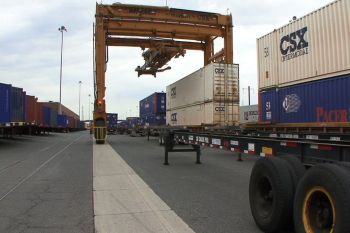
The majority of American goods are transported by trucks, even though freight trains are greener and more fuel-efficient. Where should America be placing its bets for moving our economy and what would you personally sacrifice for it?

Blueprint America Correspondent Miles O’Brien looks at the contemporary needs, challenges, and solutions for transporting vital cargo across America, and how those decisions affect the way you live, work, and travel.

To view this site, you need to have Flash Player 9
or later installed. Click here to get the latest Flash player.

   Print    Email    comments (7)

1 Star2 Stars3 Stars4 Stars5 Stars (7 votes)
Loading ... Loading ...

Comments

7 comments

#1

Last time I checked, there were only 4 major rail companies that move the majority of the freight across this nation. Meanwhile the number of trucking companies numbers in six figures. The trucking industry is cutthroat in competition which is why rail can’t compete. Are you telling me the American taxpayer needs to subsidize monopolies?

You interviewed a railroad employee who bragged about how efficient rail freight is. If it is so efficient, why does most of the freight go by truck?

#2

Some reasons trucks move much freight are: 1) RRs pay for their own tracks, maintenance, and real estate taxes on top of that, all along the line; 2) RRs pay employees more; 3) RRs have more work rules and pay higher wages; 4) RRs have more internal, governmental and cultural hamstrings from their much longer history than just about any other major industry; 5) both the Teamstears and the size of the trucking carry a huge amount of clout; 6) evils analogous to agri-business & hostile takeovers led to decimation of the mid-size RRs so we have a few huge RRs and a myriad of short lines, sometimes state-run branches, etc.; and 7) RR tracks were torn up where they should have been left intact, but unlike with trucks, less track mileage meant less taxes, maintenance, etc.

#3

I’m surprised the show didn’t cover a large part of the reason why our highways need work- 18 wheelers do over 80% of the damage to them; they’re just too heavy.

Most freight goes by truck because their infrastructure is subsidized. Yes, their taxes are particularly high, but still do not pay for how much damage the trucks wrack up. Rail is so efficient that thus far they’ve managed to maintain their own infrastructure, even though at this point they need help.

#4

[...] Keep On Truckin’  A look at the critical need to move truck freight through a crumbling infrastructure. [...]

#5

I am a 3rd generation American involved in the transportation industry. Grandfather and Father in railway, and I’m in the trucking industry. Railroads are an economical solution, and there are still plenty of unused railroad right of ways to handle the rail traffic. It is going to take more of an investment into the rail infrastructure, and more efficient trailer drop off points to get the freight quickly to its destination.

#6

Allow trucks to piggyback on maglev trains over superhighway & abandoned rail right of ways. Make trucks self propelled railcars like the old freight trolley cars by installing a maglev undercarriage on each truck. In congestion, they can link for a stretch via intelligent transportation design.

Reducing deisel fumes: Why not put recessed solar panels on the container roofs. Build hybrid trucks using that brake “heat”.

To even the competion betw rail & trucks, tax trucks the real cost of their weight upon the highways.

#7

“One man’s meat is another man’s poison.” I don’t know
who coined this phrase…but it’s certainally true
according to the competive nature of these two industries.

Post A Comment

Please note - if you do not have a previously approved comment, your comment will be held for moderation.


Please note that the THIRTEEN editorial staff reserves the right to not post comments it deems to be inappropriate and/or malicious in nature, as well as edit comments for length, clarity and fairness. No solicitations or advertisements will be allowed. Users may link to other Web sites relevant to discussion, but most often links to commercial Web sites will not be permitted.

Submit

Inside This Report

Facebook

Produced by THIRTEEN WNET New York    ©2009 Educational Broadcasting Corporation. All rights reserved.

Major Support for Blueprint America is provided by the Rockefeller Foundation.