
Mark G. Toulouse: Faith, Hope, and American Values
I turned on CNN just before leaving for work in Toronto early Tuesday morning. Cameras showed a sea of people making their way onto the National Mall, hurrying in order to wait for five hours, happily enduring 20-degree temperatures. A reporter on the scene captured comments from people as they gathered. What are you feeling? One woman simply said, “Faith, hope . . .” The reporter looked at the camera earnestly and repeated, “Faith, hope . . . these are more than just words, they are American values.”
Many watching, no doubt, nodded their heads in agreement. I must confess a different personal reaction, more like “no, these aren’t American values—these are words that belong to the world, to all times and all places, words historically associated with most of the great religions across the globe, words not properly suited to nations or legitimately claimed as national values.” The origin of these words is found within the human spirit, within its perennial search for a meaningful connection to something beyond itself. There is nothing uniquely American about these words. Faith and hope are universal and profoundly human expressions.
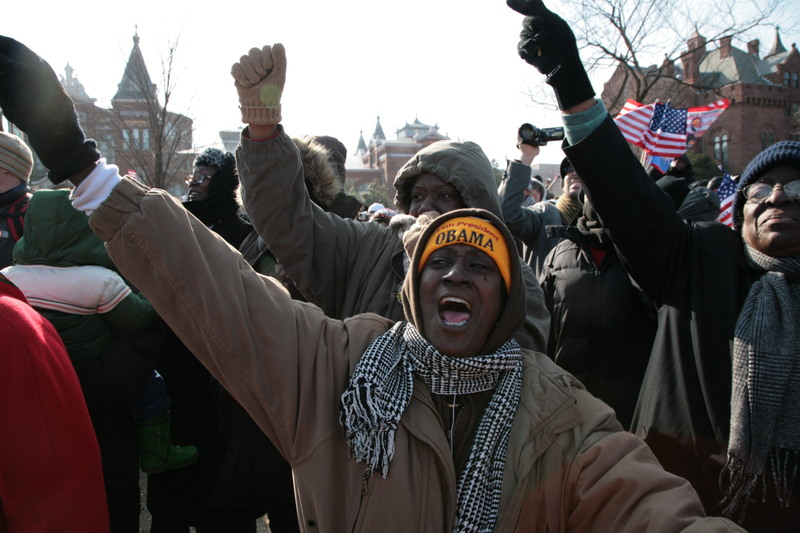 But perhaps my gut reaction is simply too cynical for such a day as January 20, 2009. Like many Americans, I looked forward with great anticipation to the noon hour on that day. What an incredible moment in American history. An African American taking the oath of office in an historic neighborhood carrying not-too-distant memories of slave pens, a black family moving into a White House built by slave labor. A grand day for all Americans, but a day especially holding promise for all African-American children like my nineteen-month-old granddaughter, Kylee, and her yet unborn cousin who is due to enter the world sometime in July. The word “hope,” thrown around all day by those who covered the event, seemed especially appropriate. “On this day,” to borrow a phrase from President Obama, people across the world found a reason to feel good about things American during a time when reasons for feeling good about things American have been way too hard to find.
But if the hopes wrapped up in the inaugural’s celebration of America’s peaceful transfer of power are to linger, we must not dishonor the dearly purchased legacy of either Martin Luther King or the black church by placing those hopes in either Barack Obama or the nation. Presidents and nations, ultimately, are bound to disappoint. But this temptation, this disposition, to place our hopes in them is perhaps a genuine American value. Historically, Americans have been too inclined to put hopes in the nation or the nation’s leadership, especially during times of crisis.
All our politicians end their speeches with that inevitable line “God Bless America,” as if America naturally deserves God’s blessing. Obama’s inaugural was no exception. But his content offered a contrasting point. “God,” he said, “calls on us to shape an uncertain destiny.” America’s destiny is not certain. Something is required of us. The themes he sounded included duty, responsibility, accountability to the common good, global awareness, self-sacrifice, congruity between our ideals and the ways we seek to insure our safety, and a mutual respect for difference. While recognizing the failures of our past, he told us “the time has come to reaffirm our enduring spirit, to choose our better history.” He claimed Americans, in these recent days, “have chosen hope over fear,” and he challenged all Americans to “carry forward . . . the God-given promise that all are equal, all are free, and all deserve a chance to pursue their full measure of happiness.”
Here, using language of his own faith, President Obama emphasized that hope must rest in something greater than ourselves. “It is,” he argued, “precisely this spirit that must embody us all.” Whether Muslims or Jews or Hindus or Christians or nonbelievers, all Americans can place their hope, or express their faith, in something greater than themselves. But Americans, perhaps more than any other people in the world, need to learn that genuine hope and faith cannot rest in either nations or charismatic leaders. Instead, these must rest in something transcendent to our self-interests, something capable of teaching us to recognize, affirm, and support the common humanity we share with all who inhabit this globe. If only we could claim that as an American value.
–Mark G. Toulouse is the Principal at Emmanuel College of Victoria University and the Toronto School of Theology in the University of Toronto.


